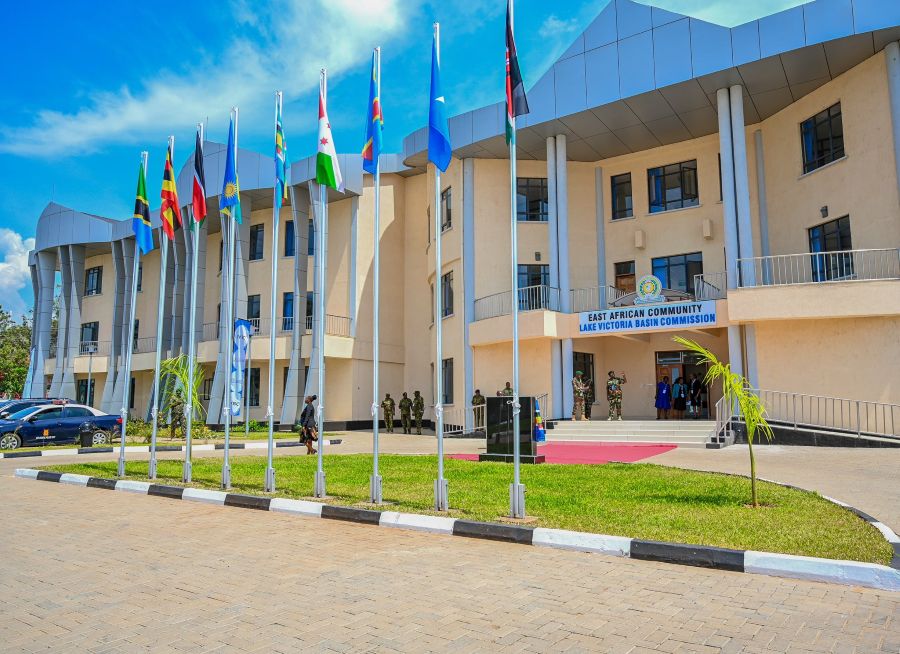
The East African Community on Monday inaugurated the new headquarters of the Lake Victoria Basin Commission in Kisumu, marking the completion of a long-delayed regional investment that now carries heavy implications for how East Africa governs its most important shared freshwater resource.

Image source: East African Community Webpage
The ceremony, held on 1 December and officiated by Kenya’s Cabinet Secretary for EAC and Regional Affairs Beatrice Askul, brought together regional leaders to explain why a building on a 2.8-hectare parcel of land matters for the millions of people who depend on Lake Victoria, how it will influence scientific decision-making, and what it signals about the region’s broader sustainability trajectory.

The headquarters, funded by EAC partner states at a cost of USD 3.54 million, arrives at a moment when Lake Victoria’s expanding population, shifting climate patterns and rising pollution loads are colliding against outdated management systems. With over 40 million people living in the wider basin across Kenya, Tanzania, Uganda, Rwanda and Burundi, the lake’s future has become inseparable from the region’s development ambitions.
In Kenya alone, government figures suggest that at least 200,000 residents derive direct income from its waters through fishing, transport, small-scale agriculture and tourism. Similar figures hold across the borders: Uganda’s fisheries department estimates that more than 1.2 million people depend directly on the lake’s fishing economy, while Tanzania’s Ministry of Water has repeatedly warned that declining water quality is threatening urban supply systems from Mwanza to Bukoba. Against that backdrop, a functioning regional institution is no longer simply administrative; it becomes the arena in which countries negotiate the survival of a shared lifeline.
During the inauguration, Hon. Askul described the building not as a symbolic addition to Kisumu’s lakeshore skyline but as the operational centre for a more coordinated basin-wide response. Her remarks aligned with growing pressure across East Africa to shift from fragmented national interventions to regional science-backed policies.
Over the past decade, harmful algal blooms have become more frequent along the Winam Gulf, causing periodic fish kills and threatening a sector that generates hundreds of millions of dollars annually across the three main riparian states. A dedicated research and coordination hub is expected to reduce delays in data-sharing, harmonise pollution control standards and tighten oversight across cross-border fisheries, long recognised as the basin’s weakest enforcement point.
Read also: Ghana raises VAT threshold to ease pressure on SMEs and boost sustainable growth
EAC Secretary General Veronica Nduva emphasized that the facility is structured to operate as a regional think-tank as much as an administrative office. She highlighted aspirations for stronger biodiversity protection, clearer protocols on water quality monitoring, and wider adoption of climate-resilient lake management practices.
While these goals have appeared repeatedly in regional communiqués over the years, the absence of a fully-equipped central facility has meant that many initiatives stalled at pilot stage. The new headquarters is fitted with research and policy coordination spaces meant to fast-track the kind of joint programming that has often taken years to materialise.
The Commission’s Executive Secretary Dr. Masinde Bwire traced the building’s roots to 2008, when Kenya set aside the land for an eventual headquarters. Construction began in 2020, slowed by pandemic disruptions and supply chain constraints, but has since been completed with technical support from Kenya’s State Department for Public Works.
Behind the ceremony lies nearly two decades of donor-backed programming from institutions such as the World Bank, GIZ, KfW, UNESCO, the European Union and the African Development Bank, whose financing has shaped most of the basin’s past environmental initiatives. The new headquarters is expected to consolidate those fragmented projects into a more coherent long-term strategy for water governance and ecosystem protection.

Local governments, particularly Kisumu County, view the headquarters as a practical boost to ongoing development plans around fisheries modernization, maritime transport revival and the gradual growth of the blue economy. County officials referenced recent investments in fiber glass fishing vessels, the upgrading of landing sites and efforts to restore lake transport corridors in partnership with Kenya Shipyards Limited and Kenya Railways.
These initiatives are unfolding alongside similar drives across the lake’s coastline. In Tanzania, the expansion of the Mwanza dry dock and renewed interest in marine cargo routes are meant to reduce road freight pressure, while Uganda’s fisheries reforms have been attempting to rebuild depleted fish stocks after years of illegal harvesting. A regional institution with the capacity to coordinate these parallel efforts could define whether they produce lasting ecological benefits or simply shift pressure from one shoreline to another.
Read also: New West Africa Sustainable Ocean Programme targets fisheries decline and blue economy development
What the new headquarters represents, in concrete terms, is a recalibration of how East Africa intends to manage one of the continent’s most strategic natural assets. Lake Victoria supports food production, energy generation, trade movements and household water supply across five countries.
Its declining resilience has already begun to mirror wider continental challenges: urban pollution increasing faster than infrastructure upgrades, climate variability disrupting previously stable livelihoods, and regional cooperation struggling to keep pace with environmental change.
By giving the Lake Victoria Basin Commission a permanent home built for data management, research, and policy integration, the EAC is edging toward a more structured approach to sustainability.
The Commission now carries expectations that stretch far beyond Kisumu’s shoreline. Its work will be judged by the accuracy of the science it publishes, the speed at which countries respond to shared threats, and the credibility of policies that govern a lake whose economic weight continues to grow.
For Africa’s broader sustainability conversation, the inauguration serves as a reminder that environmental governance is not only about grand declarations but about the slow, methodical construction of institutions capable of outliving political cycles.
Engage with us on LinkedIn: Africa Sustainability Matters