On December 29, 2025, Cameroon’s government announced it would begin shutting down certain artisanal and small-scale gold mining sites from January 2026, a decision driven by mounting evidence that much of the country’s gold is leaving through informal routes and reappearing in foreign markets unrecorded.
The move, confirmed by Mines Minister Fuh Calistus Gentry in Yaoundé, follows a transparency report that exposed a stark mismatch between what Cameroon says it exports and what the rest of the world reports receiving, with the United Arab Emirates emerging as the main destination.
Read also: EU prepares new recycled plastic import rules for 2026 to protect domestic recycling industry
The scale of the discrepancy has raised difficult questions for a country that officially produces very little gold on paper but appears to be a significant source in practice. According to the Extractive Industries Transparency Initiative, Cameroon declared gold exports of just 22.3 kilograms in 2023.
In the same year, international trade data showed that other countries reported importing 15.2 tonnes of gold attributed to Cameroon. More than 90 per cent of that volume was linked to the UAE, a global gold trading hub that has become a major entry point for African gold, including metal sourced through informal or opaque supply chains.

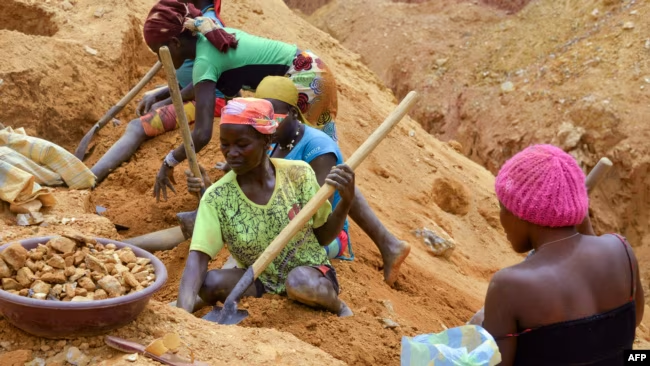
At the heart of the government’s response is a plan to close artisanal mining sites that do not operate closed-loop ore processing systems. These systems are designed to ensure that gold is processed and recovered in controlled environments, reducing losses and making production easier to monitor. In Cameroon, as in much of Africa, artisanal and small-scale mining dominates gold production, often taking place in remote areas with limited state oversight and weak record-keeping.
The reliance on artisanal mining has long made accurate production data difficult. Government officials say most gold mined in Cameroon is produced without feasibility studies or production forecasts, leaving authorities unable to estimate output or verify volumes entering the market. This gap has been compounded by porous land borders, which allow gold mined in neighboring countries to move across frontiers and be exported under Cameroonian origin, particularly toward the Gulf.
To tighten control, the government plans to strengthen the role of the state-owned mining company, SONAMINES, which is mandated to purchase domestic gold production. By channelling output through a single buyer, authorities hope to improve traceability and reduce incentives for smuggling.
At the same time, Cameroon is seeking to encourage industrial gold mining projects, arguing that large-scale operations are easier to regulate, audit and tax. At present, the country has no industrial gold mines in operation, leaving the sector largely informal.
The policy shift comes as African governments face growing pressure to clean up mineral supply chains. Gold is a critical source of income for millions of Africans working in artisanal mining, but it is also one of the continent’s most smuggled resources.
Swiss NGO SWISSAID estimates that the UAE imported about 748 tonnes of African gold in 2024, much of it linked to informal mining. The figure underscores how deeply African gold is embedded in global markets, often bypassing national treasuries and regulatory systems.

For Cameroon, the challenge is balancing enforcement with livelihoods. Artisanal mining supports entire communities, and abrupt closures risk pushing activity further underground if alternatives are not provided. The government has not yet detailed how affected miners will be supported or integrated into formal systems, a question that will shape the social impact of the policy.
Elsewhere on the continent, similar efforts have produced mixed results but offer some indication of what is possible. In Burkina Faso, reforms to formalize artisanal mining and strengthen the state purchasing agency SONASP have led to a sharp increase in officially recorded gold. SONASP purchased 29.56 tones of artisanal gold in the first nine months of 2025, compared with 5.57 tonnes over the same period in 2024.
The improvement suggests that tighter controls, when combined with accessible buying channels, can draw production back into the formal economy.
Engage with us on LinkedIn: Africa Sustainability Matters