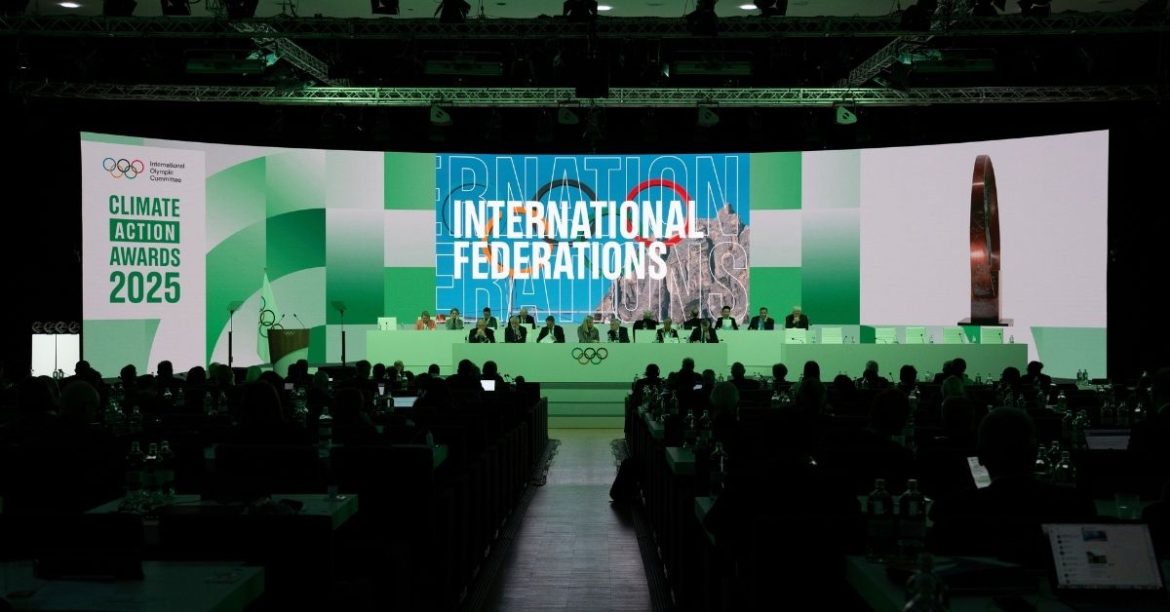
The International Olympic Committee has named a Kenyan rugby sevens player, European sporting bodies and a winter sports federation among the winners of its 2025 Climate Action Awards, signalling a push by global sport to move climate commitments from statements into operational change, with growing implications for Africa’s sustainability agenda.
Announced this week, the awards recognise athletes, national Olympic committees and international federations that have delivered measurable emissions reductions, behavioural change and climate engagement across their operations. For Africa, the inclusion of Kenya’s Kevin Wekesa places a spotlight on how climate action in sport is beginning to emerge not only from well-funded institutions, but from grassroots initiatives responding directly to local environmental pressures.

Wekesa, a member of Kenya’s national rugby sevens setup, launched the Play Green programme as temperatures rose and dry conditions increasingly disrupted livelihoods across large parts of the country. His approach focused first on visible, low-cost interventions.
By replacing single-use plastic bottles with reusable aluminium ones across national rugby teams, Play Green has removed close to 1,000 plastic bottles from circulation each week. In Kenyan cities, where plastic waste regularly blocks drainage channels and worsens flood risk, the impact is immediate and tangible.
The programme has since expanded into schools, partnering with 40 institutions to link sport with climate education. Tree planting activities are paired with lessons on water conservation, waste management and environmental justice, reaching thousands of pupils and supporting the planting of more than 2,300 trees.
In a country where forest cover has declined steadily over decades and land degradation threatens agricultural productivity, the emphasis is less on scale than on replication. Wekesa’s next target is to introduce plastic-free zones in stadiums and a national Green Ambassador network in schools, creating a model that local clubs and federations can adopt with limited resources.
Read also: International Olympic Committee opens call for medal designs for Dakar 2026 youth olympic games
The contrast with initiatives from Europe illustrates the range of pathways now being recognised by the International Olympic Committee. The Netherlands’ Olympic committee, NOC*NSF, was awarded for an integrated mobility strategy that tackled domestic travel, which accounted for nearly 70 per cent of its emissions.
By shifting most of its fleet to electric vehicles and integrating public transport, shared mobility and charging infrastructure through a single digital system, the organisation has cut emissions by 40 per cent, with full electrification planned by 2027. Changes to athlete kit procurement for the Paris 2024 Games reduced associated emissions by more than 70 per cent compared with Tokyo.

At the federation level, the International Biathlon Union was recognised for embedding climate targets across events, operations and fan engagement. Its climate challenge mobilised 12,000 supporters and led to the planting of 150,000 trees in sub-Saharan Africa, linking winter sport audiences in Europe and North America to restoration efforts on the continent.
The significance of the awards lies in how they frame sport as infrastructure. Sport reaches millions weekly, often in communities underserved by formal climate education or environmental services. Initiatives such as Play Green demonstrate how behaviour change, waste reduction and environmental awareness can be delivered through existing sporting systems, without waiting for large capital flows or complex policy reform.
The IOC says it redistributes more than 90 per cent of its income back into the sporting movement, equivalent to about USD 4.7 million a day. As climate impacts intensify across Africa, from prolonged droughts to urban flooding, the challenge will be whether such resources can increasingly support locally grounded climate action, turning global recognition into practical resilience on the ground.