


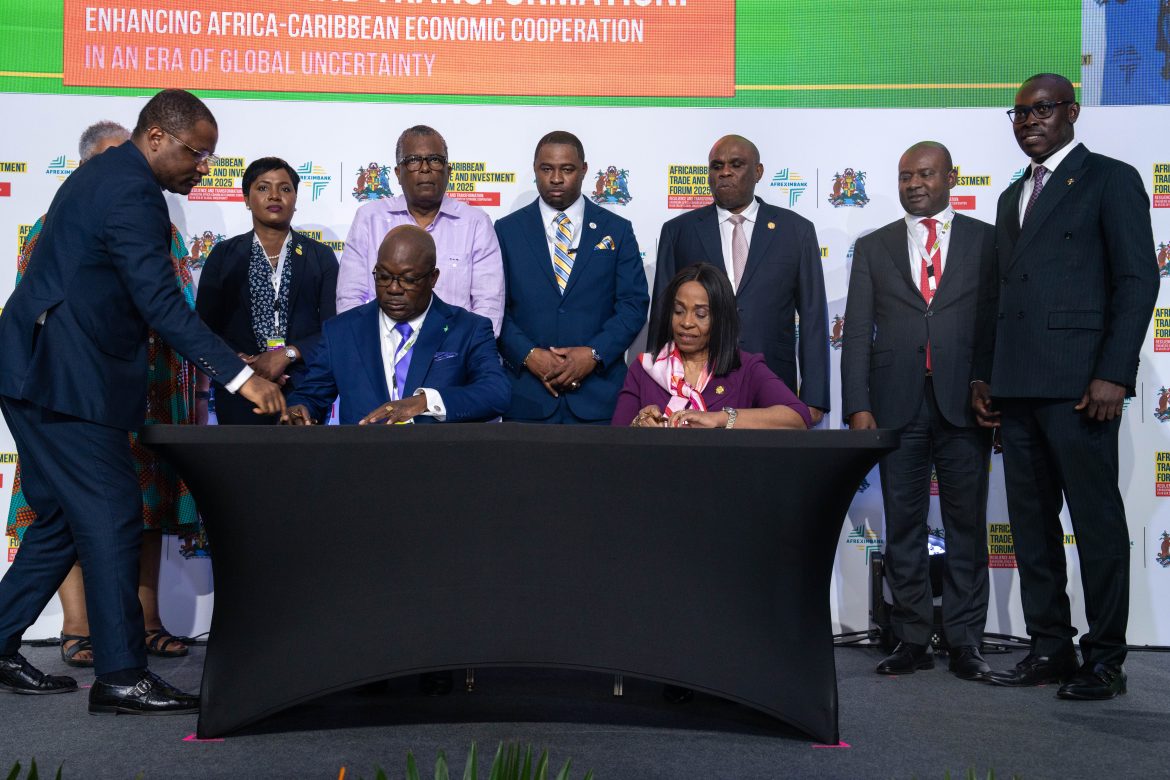
The African Export-Import Bank has disbursed a US$100 million receivables discounting facility to Bahamas Striping Group of Companies Ltd (BSGC) to finance the rehabilitation and construction of more than 200 miles of road infrastructure across The Bahamas, marking a further expansion of the bank’s cross-regional operations with Caribbean partners.
BSGC is an indigenous Bahamian-owned entity founded in 2010 and has completed over 200 projects across Nassau, Exuma and Eleuthera regions, employing over 300 persons, including subcontractors
The facility, structured against government-approved contracts, enables BSGC to access upfront liquidity for certified works, including asphalt paving, road striping, safety enhancements and maintenance across multiple islands. The agreement follows a broader framework arrangement signed with the Government of The Bahamas in 2025 on the sidelines of a Caribbean Community summit.
Under the receivables discounting structure, Afreximbank advances funds linked to verified public works invoices, allowing contractors to accelerate project execution while reducing cash flow constraints. According to officials familiar with the transaction, the approach is intended to strengthen delivery timelines for critical infrastructure without immediately increasing sovereign borrowing in conventional loan form.

For The Bahamas, an archipelagic economy heavily dependent on tourism and trade, transport infrastructure is central to economic resilience. Road quality affects logistics costs, airport and port connectivity, and access to services across dispersed islands. Disruptions or delays in maintenance can raise operating costs for small businesses, increase vehicle damage and limit mobility for communities reliant on road transport for health and education access.
BSGC, founded in 2010, has completed more than 200 projects across Nassau, Exuma and Eleuthera and employs over 300 people, including subcontractors. Access to structured trade and infrastructure finance is expected to support payroll stability, procurement of materials and coordination with local suppliers, according to company executives.
For Afreximbank, the transaction reflects its strategy of positioning itself as a bridge between Africa and the Caribbean under the concept of “Global Africa”. While the immediate impact is domestic to The Bahamas, the facility signals the bank’s growing role in cross-regional infrastructure finance. According to Afreximbank’s public disclosures, the institution has increased its exposure to Caribbean markets in recent years as part of efforts to deepen trade and financial links between African and CARICOM economies.
The structure of the deal highlights an emerging financing model in developing markets, where receivables-backed facilities are used to de-risk contractor payments and improve execution of public infrastructure. In African contexts, similar arrangements have been used to support energy, transport and water projects, particularly where delayed government payments have constrained private sector participation.
The implications extend beyond a single road programme. For small island developing states, infrastructure modernisation intersects with climate resilience, as stronger road surfaces and drainage systems can reduce vulnerability to extreme weather events. While the current facility focuses on paving and striping, improved durability may reduce maintenance cycles and long-term fiscal pressure.
Afreximbank’s involvement demonstrates the outward expansion of African financial institutions into new geographies. The bank’s balance sheet, traditionally focused on trade finance within Africa, is increasingly supporting infrastructure and structured finance transactions beyond the continent. This diversification carries both opportunity and exposure, as it broadens the institution’s development footprint while requiring robust risk management across jurisdictions.


