


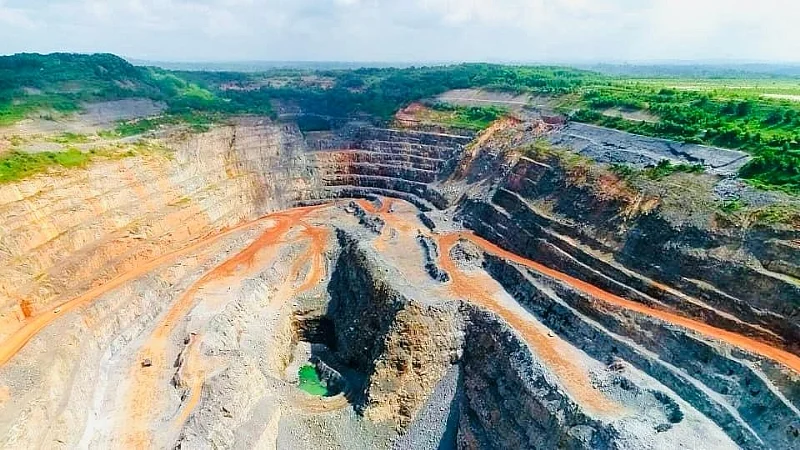
Ghana’s decision to transfer operational control of the Damang Gold Mine to local engineering and mining contractor Engineers & Planners (E&P) is emerging as a significant test of the country’s resource governance framework, placing transparency, local ownership and long-term economic value creation at the centre of debate within one of Africa’s largest gold-producing economies.
The transition follows the expiration of Gold Fields Ghana’s mining lease in 2025 and the conclusion of a competitive bidding process overseen by the Minerals Commission in April 2026. Under the arrangement approved by the Ministry of Lands and Natural Resources, E&P secured the right to operate the mine after demonstrating technical competence, financial capacity and compliance with local content requirements, including access to financing exceeding US$500 million.
 The transfer represents one of the most prominent examples of Ghana’s efforts to increase domestic participation in strategic extractive assets, reflecting a broader policy shift seen across several resource-rich African countries seeking to capture greater economic value from natural resources.
Speaking during the handover process, Minister for Lands and Natural Resources Emmanuel Armah-Kofi Buah described the transaction as part of a wider national agenda aimed at strengthening indigenous participation in mining while preserving employment, sustaining production levels and ensuring continued economic benefits for surrounding communities.
The Damang Mine occupies a strategically important position within Ghana’s mining sector. Gold remains the country’s largest export earner, accounting for a substantial share of foreign exchange earnings, government revenues and investment inflows. According to government and industry data, the mining sector contributes significantly to national gross domestic product and remains a critical source of fiscal revenues at a time when many African governments are seeking to strengthen public finances amid rising development spending requirements.
However, the transition has generated scrutiny from governance specialists, civil society organisations and opposition figures who argue that greater transparency is required to reinforce confidence in the allocation process.
The Natural Resource Governance Institute (NRGI) has called for the publication of evaluation reports, assessment methodologies and tender scoring criteria used during the bidding process. Governance advocates argue that while compliance with legal procedures is important, public disclosure remains essential for demonstrating fairness and accountability in the management of strategic national assets.
According to NRGI and other governance observers, the absence of publicly available documentation risks creating perceptions of opaque decision-making, particularly in sectors where large financial interests and public resources intersect.
The Minerals Commission has rejected allegations of bias, maintaining that the process was competitive and conducted in accordance with Ghana’s mining legislation. Officials have stated that multiple bidders participated and that E&P emerged as the strongest candidate based on predetermined technical, financial and operational requirements.
The debate extends beyond the specifics of Damang and reflects broader questions facing resource-dependent economies across Africa. Governments increasingly seek to promote domestic ownership and participation in extractive industries, yet these objectives must be balanced against investor confidence, operational efficiency and transparent governance standards.
Across the continent, policymakers are under growing pressure to ensure that mineral wealth translates into broader economic transformation rather than remaining concentrated within limited segments of society. This challenge has become more pronounced as global demand for mineral resources continues to rise amid industrialisation, urbanisation and energy transition requirements.
For Ghana, the Damang case arrives at a time when expectations around extractive governance are evolving. International investors, development finance institutions and local communities increasingly assess mining projects not only on production performance but also on governance quality, environmental stewardship and the equitable distribution of economic benefits.
The implications extend to public finances and long-term development planning. Transparent allocation processes can strengthen investor confidence, reduce governance risks and support stable revenue generation. Conversely, perceptions of weak accountability can increase uncertainty, potentially affecting investment decisions and the cost of capital available for future projects.
The transition also highlights the growing importance of local content policies as African governments seek to deepen domestic participation in resource sectors. While foreign investment continues to play a critical role in financing and technology transfer, many countries are exploring mechanisms that allow national firms to assume larger roles within mining value chains.
From a sustainability perspective, governance remains central to ensuring that extractive activities contribute to durable development outcomes. Effective oversight influences how environmental standards are enforced, how community relations are managed and how mining revenues are allocated to support infrastructure, education, healthcare and economic diversification.
 The African Union’s Agenda 2063 places particular emphasis on accountable institutions, inclusive growth and the responsible management of natural resources. The outcome of Ghana’s approach to Damang will therefore be assessed not only through ownership structures but also through measurable economic, social and governance outcomes over time.
As production continues under the new arrangement, the Damang Mine may become an important case study for African policymakers seeking to balance national ownership ambitions with the transparency, accountability and institutional credibility required to sustain long-term investment and development. The effectiveness of that balance will likely shape broader perceptions of resource governance in one of Africa’s most influential mining jurisdictions.


