


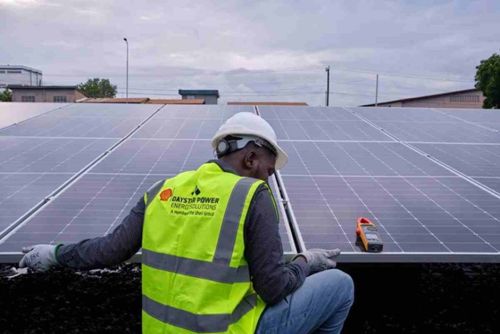
ABIDJAN, Côte d’Ivoire Renewable energy developer Daystar Power has completed and commissioned nearly 7 megawatts (MW) of solar capacity across four Nestlé manufacturing facilities in Côte d’Ivoire, Ghana and Senegal, underscoring the growing role of captive and commercial solar systems in helping African industries manage rising energy costs and improve power reliability.
The Shell-owned company announced on June 23 that the projects, with a combined capacity of 6.884 megawatt-peak (MWp), are now fully operational. The installations include two solar plants in Abidjan with a combined capacity of 3.447 MWp, a 2.547-MWp facility at Nestlé’s manufacturing site in Tema, Ghana, and an 890-kWp installation in Dakar, Senegal.The deployment marks one of the largest recent commercial and industrial solar portfolios commissioned for a multinational food manufacturer in West Africa and reflects a broader shift among African businesses toward decentralized energy systems as grid constraints and electricity costs continue to challenge industrial competitiveness.
Daystar Power said the installations are expected to reduce greenhouse gas emissions while strengthening operational resilience across Nestlé’s regional manufacturing network. The company has increasingly focused on providing integrated solar and energy solutions to commercial and industrial clients seeking alternatives to expensive grid electricity and diesel-powered backup generation. The latest projects build on an expanding pipeline of industrial solar developments across the continent. Since the beginning of 2026, Daystar has announced a 5.2-MWp solar facility for Société de Ciment de Côte d’Ivoire, a 1.9-MWp installation for Olam Agri Ghana and a 2.6-MW project for packaging manufacturer GZ Industries in Nigeria. Together, these investments illustrate how solar energy is becoming increasingly embedded in the operating strategies of African manufacturers.
The trend is particularly significant in West Africa, where businesses frequently contend with unreliable electricity supply, aging transmission infrastructure and volatile fuel prices. In many countries, industrial users depend on diesel generators to maintain operations during power outages, exposing companies to high fuel costs and foreign exchange risks. According to the Global Solar Council’s Africa Market Outlook 2026–2029, distributed solar systems, including rooftop, commercial and captive installations, accounted for approximately 44% of all new solar capacity added across Africa in 2025. The report noted that privately financed commercial and industrial solar projects are becoming a major driver of growth alongside utility-scale developments backed by governments and development finance institutions.
Africa recorded its fastest year of solar growth in 2025, with solar installations increasing by 54% compared with the previous year. The continent added approximately 4.5 gigawatts of new solar capacity during the year, driven by rising electricity demand, falling technology costs and growing interest from businesses seeking energy independence. Analysts say the rapid expansion of commercial and industrial solar is reshaping Africa’s energy landscape. Unlike utility-scale projects that often require lengthy permitting processes, grid connections and government-backed power purchase agreements, captive solar systems can be deployed directly at factories, warehouses and industrial facilities, delivering immediate cost savings and improved energy security.
For multinational manufacturers such as Nestlé, energy reliability has become increasingly important as companies pursue emissions reduction targets while seeking to maintain production efficiency across multiple markets. The food and beverage sector is particularly well suited to solar deployment because many production processes occur during daylight hours when solar generation is strongest. Manufacturing facilities also typically possess substantial rooftop or adjacent land space that can accommodate photovoltaic systems without disrupting operations.
The partnership between Daystar Power and Nestlé reflects a broader sustainability strategy being adopted by global consumer goods companies operating in Africa. International manufacturers face increasing pressure from investors, regulators and consumers to decarbonize supply chains and reduce exposure to fossil fuel-based energy sources. At the same time, renewable energy investments are increasingly being viewed as economic decisions rather than solely environmental initiatives. Falling solar equipment prices, improvements in battery storage technologies and rising electricity tariffs have significantly improved the business case for captive solar projects across emerging markets.
According to industry estimates, Africa remains one of the world’s most under-electrified regions despite possessing some of the highest solar irradiation levels globally. More than 600 million people across the continent still lack access to electricity, while many businesses connected to national grids experience frequent disruptions that affect productivity and increase operating costs. As a result, commercial and industrial consumers are becoming important drivers of renewable energy investment. Companies increasingly view solar power as a hedge against energy price volatility and grid instability, particularly in countries where electricity demand is growing faster than generation and transmission infrastructure.
https://www.aecweek-registration.com/2026/
The emergence of specialized energy service providers such as Daystar has also helped accelerate adoption. Rather than requiring companies to finance and manage solar systems themselves, developers can design, install and operate projects under long-term service agreements, reducing upfront capital requirements for industrial customers. For West Africa, where manufacturing remains a strategic priority for economic diversification and job creation, reliable and affordable energy is widely viewed as a prerequisite for industrial growth. Energy costs account for a significant share of production expenses in sectors ranging from food processing and cement manufacturing to packaging and agribusiness.
The completion of the Nestlé installations therefore reflects more than a corporate sustainability initiative. It highlights the increasing convergence between industrial development and renewable energy deployment across Africa, where businesses are turning to decentralized power solutions to improve competitiveness and reduce operational risks. Daystar Power indicated that the newly commissioned facilities could serve as a platform for further collaboration with Nestlé across the region. As industrial energy demand continues to rise and solar technology becomes more cost-competitive, similar partnerships are likely to play an increasingly important role in shaping Africa’s energy transition and industrial modernization efforts.


