


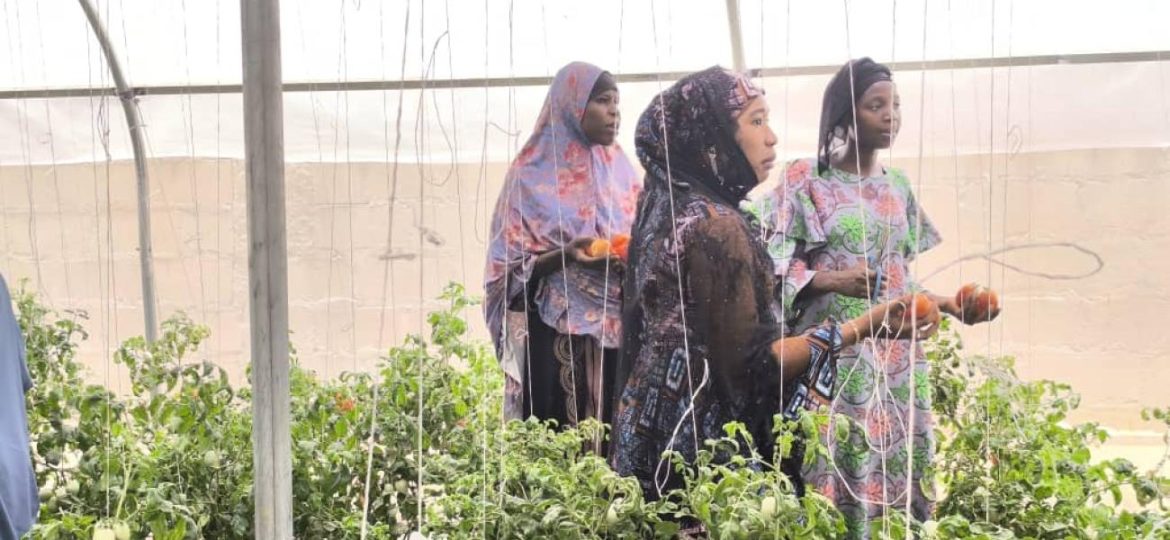
Across North East Nigeria, climate entrepreneur Fatima Zannah Mustapha is combining technology, climate-smart agriculture and women’s economic empowerment to strengthen community resilience, illustrating how locally driven innovation is becoming an increasingly important component of Africa’s climate adaptation agenda amid mounting environmental and economic pressures.
Mustapha, co-founder of the Future Prowess Foundation, has spent nearly two decades developing programmes that equip women and young people with digital skills, sustainable agricultural techniques and emerging technologies to improve livelihoods in communities heavily affected by climate change, conflict and economic vulnerability. Her work reflects a broader shift across Africa towards community-led climate solutions that integrate environmental sustainability with human capital development.
 Growing up in Borno State, one of Nigeria’s regions most exposed to insecurity and climate-related shocks, Mustapha witnessed how environmental degradation compounded existing social and economic challenges. Declining agricultural productivity, food insecurity and displacement increasingly constrained opportunities for rural households, while women and young people often remained excluded from decision-making and innovation ecosystems.
According to Mustapha, these experiences shaped her determination to develop practical climate solutions capable of strengthening resilience while expanding economic opportunities for vulnerable communities. Rather than viewing climate adaptation solely through an environmental lens, her approach positions technology, education and agricultural innovation as interconnected drivers of sustainable development.
Established in 2007, the Future Prowess Foundation focuses on reducing inequality by expanding access to education, digital literacy and climate-smart livelihoods for women, youth and displaced populations. The organisation has increasingly integrated climate adaptation into its development programmes, recognising that environmental resilience and economic inclusion are closely linked across many African economies.
One of its flagship initiatives centres on training women and young people in climate-smart agriculture, sustainable land management and environmental conservation. Participants receive practical instruction in improved farming methods, tree planting and soil management while also developing digital competencies that support broader entrepreneurship opportunities.
Read also: https://africarenewal.un.org/en/magazine/building-next-generation-climate-conscious-innovators
The foundation has also introduced plant tissue culture technology, enabling the production of disease-free, high-yield planting materials that improve crop productivity and resilience against climate-related stress. According to agricultural specialists, tissue culture techniques can significantly enhance food production by reducing crop losses, improving seed quality and increasing farm profitability, particularly for smallholder producers who dominate African agriculture.
Improved planting materials have allowed participating farmers to strengthen food security while creating additional income opportunities through higher agricultural output. In many rural communities, where agriculture remains the primary source of household income, such productivity gains carry wider implications for local economic stability and poverty reduction.
Mustapha argues that technological innovation alone is insufficient without local ownership and community trust. Early efforts to introduce modern farming techniques in Borno initially faced resistance from communities accustomed to traditional agricultural practices. Demonstration farms established by the foundation allowed farmers to observe improved methods directly, helping to build confidence in climate-smart production systems.
According to Mustapha, involving local women as trainers and community leaders proved critical in increasing acceptance of new technologies. Higher crop yields and improved household incomes subsequently encouraged broader adoption, illustrating how locally led implementation can accelerate behavioural change more effectively than externally driven interventions.
Despite these achievements, scaling climate innovation across underserved regions continues to face structural challenges. Limited research infrastructure, inadequate financing, weak extension services and restricted access to technology remain significant barriers to wider adoption of advanced agricultural systems. Gender inequalities also continue to constrain women’s access to productive assets, finance and technical resources, despite their central role in African food production.
These constraints mirror wider continental challenges. According to the African Development Bank, agriculture contributes significantly to employment across Africa while remaining among the sectors most exposed to climate variability. Rising temperatures, erratic rainfall and land degradation continue to threaten agricultural productivity, increasing pressure on governments to invest in climate adaptation, innovation and resilient food systems.
Development economists increasingly argue that strengthening agricultural resilience requires greater investment not only in infrastructure but also in human capital, particularly among women and young people who represent the largest share of Africa’s future workforce. Climate adaptation strategies that combine technology, entrepreneurship and local capacity building are therefore becoming central components of national development planning.
Mustapha’s work aligns closely with the objectives of the African Union’s Agenda 2063, which identifies agricultural transformation, youth empowerment, gender equality and technological innovation as essential pillars of long-term economic development. The approach also reflects growing international recognition that locally designed solutions often deliver more sustainable outcomes than externally imposed interventions because they are rooted in community priorities and practical realities.
Beyond Nigeria, the model illustrates how climate innovation can generate wider economic value by supporting food security, expanding employment opportunities and strengthening resilience against future environmental shocks. As governments across Africa seek to balance climate adaptation with economic growth, programmes that integrate digital technologies with sustainable agriculture are increasingly attracting attention from policymakers and development finance institutions.
 Mustapha believes Africa’s climate future will ultimately depend on empowering local innovators rather than treating communities solely as recipients of external assistance. Her organisation is now exploring the integration of artificial intelligence alongside climate-smart agriculture to improve decision-making, increase agricultural productivity and expand opportunities for women-led enterprises.
As African countries continue adapting to accelerating climate risks, initiatives that place community leadership, technological innovation and inclusive economic participation at the centre of climate action may offer an increasingly important pathway for building resilient economies capable of supporting long-term sustainable development.


