


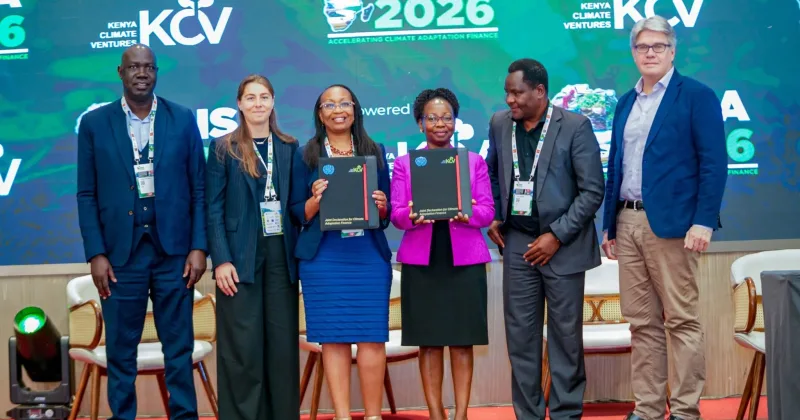
The United Nations Industrial Development Organization (UNIDO) and Kenya Climate Ventures (KCV) have signed a partnership aimed at mobilising more domestic and international capital for climate adaptation and resilience businesses across Sub-Saharan Africa, seeking to address one of the region’s persistent barriers to climate action: the shortage of finance reaching early- and growth-stage enterprises.
The Joint Declaration was signed during the Adaptation Investment Summit for Africa 2026 in Nairobi and brings together UNIDO’s expertise in industrial development, climate adaptation and market development with KCV’s experience supporting climate-smart enterprises and managing early-stage climate finance. The collaboration will focus on developing a stronger pipeline of investable businesses while connecting enterprises with public and private sources of capital.
The partnership comes as the financing requirements for climate adaptation continue to outpace available resources. According to the United Nations Environment Programme’s 2025 Adaptation Gap Report, developing countries will require between $310 billion and $365 billion annually for adaptation by 2035, while international public adaptation finance stood at only $26 billion in 2023. The gap is therefore between 12 and 14 times current flows.
For Africa, where climate-related droughts, floods, extreme heat and changing rainfall patterns are increasingly affecting agriculture, infrastructure and livelihoods, the financing challenge is particularly significant. Much of the continent’s adaptation requirement sits outside the traditional large infrastructure projects that attract development finance, creating a need for investment models capable of supporting smaller businesses developing practical resilience solutions.
UNIDO and KCV intend to address part of that gap by combining technical assistance, enterprise development and investment capabilities. The organisations said their cooperation will build on existing programmes including the Kenya Uganda Adaptation Accelerator (KUAA), the Advancing Climate-Resilience and Transformation in African Coffee programme and the proposed Africa Climate Adaptation Investment Catalyst Initiative.
The KUAA programme illustrates the approach. Launched in July 2026, the four-year, $5 million initiative is funded by the Adaptation Fund and implemented by UNIDO, adelphi, KCV and Finding XY in collaboration with the governments of Kenya and Uganda. It is designed to unlock investment for early-growth, gender- and youth-inclusive adaptation businesses in the two countries.
The new UNIDO-KCV partnership is expected to expand this model beyond individual programmes by strengthening investment frameworks, market intelligence and impact measurement while creating connections between enterprises, investors, fund managers, development partners and policymakers.
A particular focus will be the use of UNIDO’s Climate Risk and Vulnerability Assessment tool to inform financing decisions. Such assessments can help investors understand how businesses and projects are exposed to physical climate risks and whether proposed investments incorporate measures capable of improving resilience.
For investors, the objective is to improve the quality of information available before capital is committed. Early-stage adaptation businesses often operate in markets where climate risks are substantial but financial performance data, collateral and established investment histories can be limited. Better risk assessment and impact measurement could therefore help reduce information gaps that discourage private investment.
The partnership also reflects a broader shift in climate finance towards treating adaptation as an investment opportunity rather than solely a public-sector expenditure. UNEP estimates that targeted policy measures and blended-finance structures could enable the private sector to provide around $50 billion annually for adaptation.
That potential is relevant across African sectors including agriculture, water, energy, infrastructure, insurance and manufacturing. Climate-smart enterprises in these areas can provide services that reduce exposure to climate shocks while generating commercial revenues, but many remain too small or too early-stage to attract conventional institutional finance.
The coffee sector provides one example. UNIDO’s ACT programme focuses on climate-resilient transformation across Africa’s coffee value chain, linking climate adaptation with an industry that supports millions of livelihoods and generates export revenues. Connecting technical climate assessments with investment mechanisms could allow resilience measures to be incorporated into business expansion rather than treated as separate development projects.
The partnership also has implications for Kenya’s emerging climate finance ecosystem. Nairobi has become a regional centre for climate finance, impact investing and enterprise development, while Kenyan businesses are increasingly developing solutions in areas such as climate-smart agriculture, renewable energy, water management and circular economy services.
Yet scaling these enterprises will depend on more than identifying investment opportunities. Businesses need appropriate financial instruments, reliable market demand, technical assistance and regulatory environments that allow them to grow. Investors, meanwhile, need clearer evidence of financial performance, climate impact and risk.
The organisations’ agreement therefore seeks to connect different parts of the financing ecosystem rather than create another standalone funding mechanism. UNIDO said its Division of Innovative Finance and International Financial Institutions plays a catalytic role by linking technical cooperation programmes with public and private financial institutions. KCV brings an investment perspective focused on early- and growth-stage climate-smart enterprises.

Marko van Waveren Hogervorst, Programme Officer and Climate Finance Expert at UNIDO, said the cooperation would build on existing initiatives while developing new approaches to scaling adaptation finance. KCV Chief Executive Officer Victor Ndiege said the partnership would strengthen pathways for climate-smart enterprises and contribute to more resilient economies.
The wider test will be whether such collaboration can convert climate vulnerability into commercially viable investment opportunities. Africa’s adaptation challenge is too large to be addressed through public budgets and development assistance alone, but private capital will require clearer pipelines, credible risk assessment and investment structures capable of matching the realities of African enterprises.
For Sub-Saharan Africa, that makes the UNIDO-KCV partnership significant beyond the institutions involved. If the collaboration can strengthen the pipeline of bankable adaptation businesses and improve connections between those businesses and capital providers, it could help shift adaptation finance towards enterprises capable of delivering resilience while supporting employment, productivity and economic growth.
The immediate priority will be translating the Joint Declaration into investable projects, measurable outcomes and financing transactions. That will determine whether the partnership can help narrow the distance between Africa’s growing adaptation needs and the capital available to meet them.


