


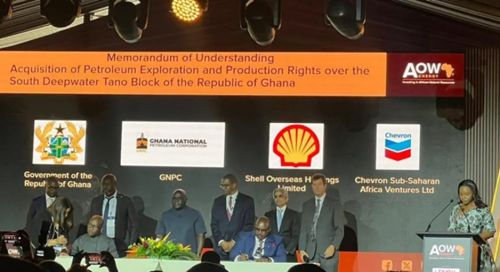
Ghana is offering Shell and Chevron more favourable terms to develop the South Deepwater Tano Cape Three Points block, including a proposed reduction in the Ghana National Petroleum Corporation’s (GNPC) carried interest from 15% to 10%, as Accra seeks to reverse declining oil production and attract fresh investment into an upstream sector facing maturing fields and weaker petroleum revenues.
The government, GNPC and GNPC Explorco signed a non-binding memorandum of understanding with Shell Overseas Holdings and Chevron Sub-Saharan Africa Ventures in Accra on September 1 during Africa Oil Week 2026. The agreement establishes a framework for negotiating production rights and final licence terms, but remains subject to regulatory approvals. Shell has described the memorandum as a basis for further negotiations, while no detailed work programme, expenditure commitment or drilling timetable has been publicly disclosed.
At the centre of the proposed fiscal changes is Ghana’s carried interest, under which GNPC receives an initial participating interest without financing exploration and development costs. The Petroleum (Exploration and Production) Act, 2016, currently requires petroleum agreements to provide GNPC with an initial participating carried interest of at least 15%.

Reducing that interest to 10% would give private contractors a larger share of production from any commercially successful discovery while leaving the companies responsible for financing the exploration and development associated with the carried portion. In practical terms, the proposed change is intended to improve the economics of a technically challenging offshore opportunity and make Ghana more competitive for capital.
The timing reflects increasing pressure on the country’s upstream sector. Ghana’s crude oil production fell for a sixth consecutive year in 2025, declining from a peak of 71.44 million barrels in 2019 to 37.3 million barrels. That represents an average annual decline of about 9%, according to figures cited by the Public Interest and Accountability Committee (PIAC).
The decline has also affected government revenues. Ghana received $770.3 million in petroleum receipts in 2025, with carried and participating interest contributing $339.3 million, or about 44% of the total. Corporate income tax generated $346.9 million, narrowly becoming the largest source of petroleum receipts.
That makes the proposed reduction politically and fiscally significant. The government would be accepting a smaller direct interest in future discoveries in exchange for improving the probability that investment actually takes place. The calculation is particularly relevant for a country whose existing fields are producing less but whose petroleum sector remains an important source of foreign exchange and public revenue.
Energy Minister John Jinapor has framed the trade-off in straightforward terms: “I’m better off having 10% of 1 billion than 15% of 1,000.” The argument captures the central challenge facing Ghana’s upstream sector: a larger nominal government share has little value if unattractive investment terms prevent technically difficult resources from being developed.
South Deepwater Tano also presents a higher-risk proposition than a conventional shallow-water development. The block was previously held by AGM Petroleum, which relinquished its interest in 2023 after drilling two ultra-deepwater wells, including the Nyankom discovery. The company said it had fulfilled its obligations and had advanced understanding of the subsurface, but the block required substantial further investment.
The history matters because Ghana is not simply reducing its fiscal take on a proven producing asset. It is offering revised terms for acreage where previous exploration did not immediately establish a commercially viable development.
That distinction is important for understanding the government’s strategy. Deepwater exploration requires substantial upfront capital and carries geological, technical and development risks. For Shell and Chevron, a lower carried interest, longer agreement terms and changes to tax and royalty arrangements could improve the potential economics of committing capital to drilling and subsequent development.
The proposed package reportedly goes beyond the GNPC stake. Government is considering extending petroleum agreements from 25 to 30 years, allowing tax losses to be carried forward for up to 10 years rather than five, making signature bonuses payable after a commercial discovery rather than upfront, and varying royalties according to water depth.
According to Finance Ministry adviser Theophilus Acheampong, the combined effect could reduce the state’s share of project value from roughly 65%-67% to about 55%. For Ghana, that creates a difficult balance between competitiveness and resource nationalism. Lowering the government’s take can improve the attractiveness of new exploration, but it also reduces the public share of any future commercial discovery. The question for policymakers is therefore not simply whether Shell and Chevron will invest, but whether the resulting production, taxes, employment, local procurement and wider economic activity will compensate for the lower direct state participation.
The proposed changes are not yet law. Act 919 sets the minimum carried interest at 15% and limits petroleum agreements to 25 years, meaning amendments will require parliamentary approval. The government has indicated that it wants Parliament to consider the changes before the end of 2026. The eventual petroleum agreement will consequently be more important than the memorandum itself. A non-binding MoU does not guarantee drilling or commercial production. The critical indicators will be the minimum work obligations, number of wells, exploration expenditure, timelines and mechanisms protecting Ghana’s additional petroleum entitlements.
The issue is particularly relevant because GNPC itself faces questions about how effectively the state captures and manages petroleum value. PIAC has been engaged in a dispute with GNPC Explorco over $561.6 million in proceeds from the subsidiary’s crude liftings between 2022 and 2024. PIAC argues that the proceeds should have been paid into the Petroleum Holding Fund, while GNPC maintains that the revenues represent commercial income belonging to Explorco.
For Ghana, the Shell-Chevron negotiations therefore sit at the intersection of investment attraction, public finance and long-term resource management. The country needs new exploration to offset declining production, but it also needs fiscal arrangements that preserve sufficient public value from resources owned by the state.
The broader African context is equally important. Governments across oil-producing countries are revisiting petroleum fiscal regimes as international companies become more selective about upstream investment, while the global energy transition increases pressure to develop resources efficiently and maximise their economic value during the remaining investment window.
Ghana’s approach could offer a test of whether more flexible fiscal terms can bring major international capital back into technically difficult frontier acreage. Shell and Chevron bring deepwater expertise and financial capacity, but the commercial case will ultimately depend on what drilling reveals. For Accra, the immediate objective is to convert the MoU into a binding petroleum agreement with clear investment obligations. For investors, the attraction will be the opportunity to access potentially significant offshore resources under a revised fiscal framework. For Ghanaian citizens, the measure of success will be whether new investment reverses production decline, strengthens public revenues and creates durable economic value.
The proposed 15%-to-10% reduction in GNPC’s carried interest is therefore more than a technical change to an upstream contract. It is a bet that a smaller share of a potentially larger and more investable petroleum sector can deliver greater value than maintaining a higher share of declining production.
Whether that bet pays off will depend less on the headline fiscal concessions than on what Ghana secures in the final agreement: firm exploration commitments, transparent development obligations and a credible mechanism for ensuring that any future resource discovery translates into lasting national value.


