


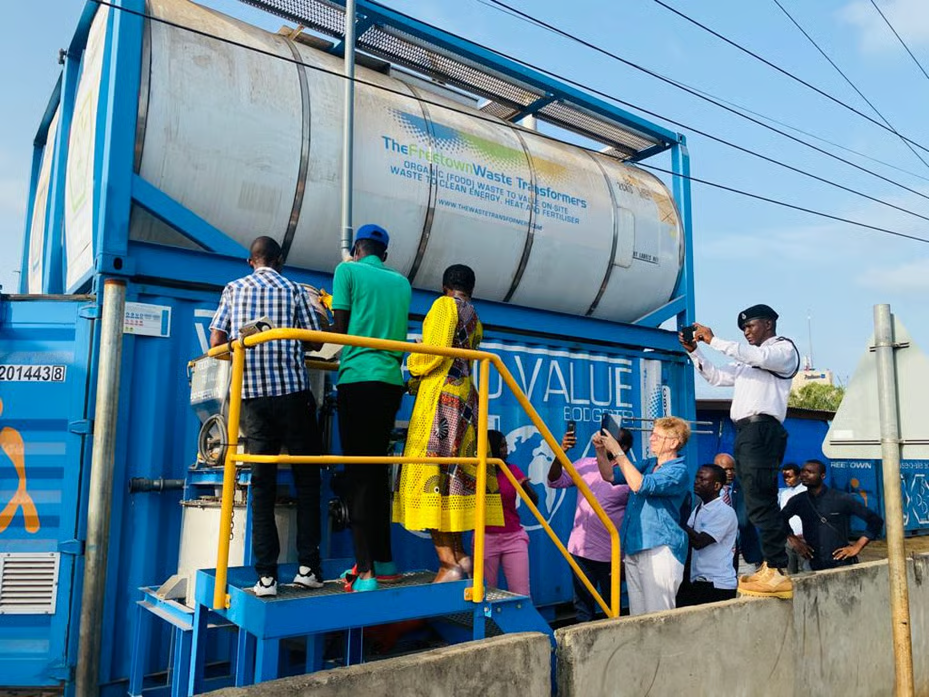
Freetown is expanding the use of biodigesters to convert organic waste into cooking gas and electricity, as Sierra Leone’s capital seeks to address rising climate and environmental pressures while reducing household energy costs and strengthening urban sanitation. The initiative, being implemented by Freetown City Council across communities and markets, combines waste management, clean energy and public infrastructure, providing a practical test of whether relatively small-scale technologies can help African cities manage climate risks while generating economic value from resources that are often treated as waste.
 Mayor Yvonne Aki-Sawyerr recently visited biodigester installations in Congo Town and Hagan Street Market, where the systems are being integrated into community cooking and market infrastructure. Four biodigesters have been installed in participating households in Congo Town, with each system capable of connecting to stoves serving up to 20 homes. At Hagan Street Market, two 50-cubic-metre biodigesters are being supplied with organic waste from market activities and are expected to produce biogas for a 30-kilovolt-ampere generator. The generator will power a newly installed cold room intended to improve the productivity of traders by reducing losses and improving storage conditions.
The model illustrates how climate adaptation in African cities is increasingly moving beyond standalone environmental projects and into basic urban infrastructure. Waste collection, sanitation, energy supply and food preservation are closely connected in rapidly growing cities, where weaknesses in one system can impose costs on another. Organic waste that would otherwise accumulate in markets or enter drainage systems can instead become an energy input, while sanitation facilities can provide part of the feedstock required for biodigester operations.
For Freetown, those connections are particularly important. The city has experienced severe environmental and climate-related pressures, including flooding, landslides, deforestation and rapid urban expansion. Research by the International Institute for Environment and Development notes that Freetown’s population has increased roughly tenfold over the past five decades, while expansion into flood-prone lowlands and steep slopes has increased exposure to climate risks.
The city’s infrastructure challenge is therefore not simply one of reducing greenhouse-gas emissions. Municipal authorities must also maintain sanitation systems, reduce exposure to extreme weather, protect vulnerable communities and support economic activity in areas where public infrastructure remains under pressure. Technology that can perform several of those functions simultaneously can have greater practical value than interventions designed around a single climate objective.
The Hagan Street installation demonstrates that potential economic connection. Markets generate substantial quantities of organic waste, while traders require reliable electricity for refrigeration and other activities. Turning market waste into biogas and electricity creates an opportunity to link waste management with commercial productivity. For traders, the benefit is not measured primarily in tonnes of emissions avoided, but in whether better refrigeration can reduce food losses, extend the period during which goods can be sold and improve income stability.
The approach also addresses the energy burden facing households. Each biodigester installed in Congo Town can potentially supply cooking gas to multiple homes, reducing reliance on charcoal and other conventional fuels. That has implications for household expenditure and indoor air pollution, while potentially reducing pressure on biomass resources. The Sierra Leone Telegraph reported that the city council is considering scaling the interventions to more residents in the coming months.
The challenge will be ensuring that such systems remain operational once the initial installation phase ends. Biodigesters depend on consistent feedstock, appropriate maintenance, functioning distribution systems and users willing to adopt the resulting energy. Market-based applications also require equipment capable of operating reliably under local conditions. Without those supporting systems, pilot projects can deliver short-term benefits without developing into durable municipal infrastructure.
That question of operational capacity is central to the wider African climate agenda. Cities across the continent are increasingly experimenting with decentralised energy, waste-to-resource systems, electric mobility, urban agriculture and nature-based infrastructure. Yet the transition from pilot projects to citywide systems depends on municipal finance, technical skills, procurement systems, data and long-term maintenance budgets.
Freetown has already been developing a broader technology and data infrastructure for environmental management. In May, the city launched its first municipal air-quality sensor network through C40’s African Cities for Clean Air Initiative, in collaboration with Breathe Cities. The programme is intended to establish a city-owned evidence base for identifying pollution sources and developing policies to improve air quality and public health.
The combination of environmental monitoring and physical infrastructure points to a broader shift in urban climate governance. Cities increasingly need data to identify where risks are concentrated and technologies capable of responding to those risks. Air-quality sensors, biodigesters, early-warning systems and digital platforms are different technologies, but they share a common requirement: municipal institutions must be able to integrate them into planning and service delivery rather than operate them as isolated projects.
Freetown’s experience also has relevance beyond Sierra Leone. Many African cities are confronting similar pressures from population growth, informal settlements, inadequate waste collection and unreliable energy infrastructure. The World Bank estimates that Africa’s urban population will continue to expand rapidly in coming decades, increasing demand for municipal services and infrastructure. For cities with constrained budgets, the ability to recover economic value from waste could become increasingly relevant to the financing of urban services.
Waste itself represents an underused economic resource. Organic material from households, markets and food businesses can be converted into biogas, while other waste streams can potentially support recycling, composting and energy recovery. Developing these systems at scale requires clear rules governing waste collection, private-sector participation, environmental standards and ownership of resulting energy products.
There are also fiscal implications. Municipal governments often have limited capacity to finance large infrastructure projects through conventional public expenditure. Systems that generate revenue or reduce operating costs can potentially improve the economics of municipal investment, although their financial viability depends on the cost of collection, processing, maintenance and energy distribution.
The cold-storage component of Freetown’s programme is particularly relevant because it connects climate and infrastructure policy to food security. Food losses are partly an infrastructure problem: unreliable electricity, inadequate refrigeration and weak logistics can cause products to deteriorate before reaching consumers. Improving energy access at markets can therefore support both economic productivity and resource efficiency.
For households, the transition away from charcoal has another dimension. Freetown’s clean-air strategy identifies air pollution as a public-health concern, particularly for vulnerable communities. Cleaner cooking systems can reduce exposure to household pollutants, although the scale of those benefits will depend on whether households use the technology consistently and whether the systems remain affordable and reliable.
The city is also developing a broader carbon-finance agenda. In June, the Presidential Initiative on Climate Change, Renewable Energy and Food Security and Freetown City Council discussed progress on Sierra Leone’s first municipal carbon-credit programme. The initiative included Freetown’s Tree Town programme, which the city says had planted approximately 1.2 million trees and created more than 3,000 green jobs at the time of the announcement.
That development creates another potential link between local climate projects and international finance. But carbon revenues, where applicable, cannot substitute for strong municipal systems. Projects must demonstrate measurable environmental benefits, maintain credible monitoring arrangements and operate within clear national regulations if they are to attract long-term investment.
Sierra Leone’s national climate policy framework has similarly recognised the importance of technology transfer and local innovation. The country’s climate strategy calls for stronger partnerships between government, the private sector, academia and international partners to develop indigenous capacity to adapt, develop, deploy and operate clean technologies.
The institutional question is therefore as important as the technology itself. Freetown’s biodigesters will provide useful lessons about whether municipalities can manage decentralised infrastructure, organise reliable feedstock supplies and connect environmental interventions to economic services. Those lessons could matter for other African cities seeking practical ways to manage waste and energy challenges without relying exclusively on large centralised infrastructure projects.
The immediate value of Freetown’s approach lies in its integration of problems that are usually managed separately. Waste becomes an energy input, sanitation becomes part of climate infrastructure, electricity supports food preservation and cleaner cooking becomes linked to household economics. The model does not remove the need for larger investments in drainage, power, waste collection or resilient urban infrastructure, but it demonstrates how local interventions can address several constraints simultaneously.
For African cities facing accelerating urbanisation and increasingly complex climate risks, that integration may become a defining feature of climate investment. The effectiveness of such projects will ultimately depend less on the novelty of the technology than on whether municipalities can finance, maintain and scale systems that deliver measurable benefits to residents and local businesses.

Freetown’s experience is therefore emerging as a test of a broader proposition in African urban development: climate resilience can be built not only through large infrastructure projects, but also through the redesign of everyday municipal systems. The outcome will depend on whether these interventions can move beyond individual sites and become reliable parts of the city’s sanitation, energy and economic infrastructure.


