


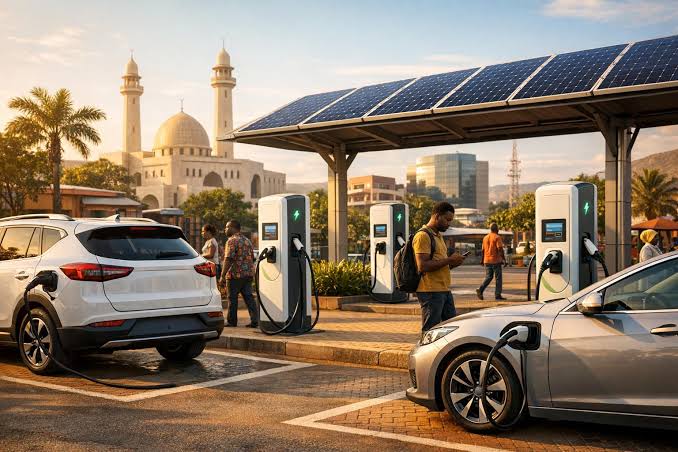
Africa’s electric mobility transition is beginning where the economics are strongest: in vehicles that work for a living. Commercial motorcycles, three-wheelers, buses, delivery fleets and logistics vehicles operate frequently, follow relatively predictable routes and consume significant amounts of fuel, making the lifetime cost of ownership more important than the upfront price alone.
That is already changing the structure of Africa’s emerging electric mobility market. Sales of electric two-wheelers on the continent reached about 70,000 in 2025, more than 80 times their level at the beginning of the decade, according to the International Energy Agency. Kenya and Uganda have been among the markets driving that growth, particularly through commercial motorcycle applications. In Kenya, electric two-wheeler sales more than tripled in 2025 to more than 25,000, representing about 15% of new two-wheeler registrations.
The numbers remain small compared with Africa’s overall vehicle market, but the economics are becoming harder to ignore. Battery prices fell by 8% globally in 2025 after declining by about 20% in 2024, according to the IEA. The decline has been driven by manufacturing improvements, technological changes and intensifying competition across the battery industry.

For high-utilisation vehicles, these cost reductions can have a greater commercial impact than they do for private passenger cars. A motorcycle used for deliveries throughout the day, a bus operating a fixed route or a logistics vehicle making repeated journeys can accumulate fuel and maintenance savings rapidly. The economics therefore depend less on whether an electric vehicle is immediately cheaper to purchase and more on how quickly its operating savings offset the initial investment.
That is why the vehicle itself is only one part of the opportunity. Every electric mobility system requires infrastructure around it: charging points, battery-swapping stations, grid connections, substations, depots, maintenance facilities, digital payment systems, fleet-management platforms and reliable electricity. These systems determine whether an electric fleet can operate consistently and whether the companies providing the vehicles can scale beyond individual pilots.
For infrastructure investors, this creates a different proposition from investing directly in vehicle manufacturers. Vehicle companies face competition over models, battery technology, consumer preferences and manufacturing costs. Infrastructure businesses can potentially serve multiple manufacturers and operators, creating revenue streams that are less dependent on which particular vehicle brand wins market share.
Charging networks, battery-swapping stations and electrified depots become more attractive when supported by contracted usage, predictable fleet volumes and credible counterparties. The investment question therefore shifts from which electric motorcycle or bus will dominate the market to which infrastructure assets every successful operator will need.
Kenya offers an early indication of how rising electric mobility can translate into electricity demand. Kenya Power reported that electricity consumed for electric vehicle charging increased 188% in 2025 to 8.43 million kilowatt-hours, from 2.92 million kWh in 2024. The additional consumption generated about KSh126 million in revenue for the utility, while 205 customers had been enrolled on the dedicated e-mobility electricity tariff by the end of the period.
This creates a potentially important link between transport electrification and power-sector economics. Electric vehicles can become a new source of electricity demand while also improving utilisation of generation and distribution infrastructure, particularly when charging is shifted towards periods of lower system demand.
But the relationship is not automatically positive. Concentrated charging demand can put pressure on local distribution networks if substations, transformers and connections are not upgraded ahead of fleet growth. Grid planning therefore needs to anticipate where commercial fleets, charging hubs and battery-swapping networks are likely to concentrate rather than waiting for congestion to emerge.
The next investment opportunity may consequently sit at the intersection of mobility and energy. Solar generation installed alongside a bus depot, logistics centre or battery-swapping network can provide electricity close to the point of consumption. Battery storage can further smooth demand and reduce dependence on the grid during periods of constrained supply.
This could be particularly relevant in African markets where electricity access, reliability and transport costs remain closely connected. Electrifying vehicles without strengthening the electricity system risks shifting one infrastructure constraint into another. Building mobility and power infrastructure together could instead allow the two systems to reinforce each other.
Africa will not follow a single electric mobility model. Countries with established automotive industries can seek to capture manufacturing and component opportunities. South Africa, for example, introduced a 150% first-year tax deduction from March 2026 for qualifying investments in new energy vehicle production, alongside existing automotive incentives. The policy is intended to strengthen local production and position the country’s automotive industry for the transition to electric and hydrogen-powered vehicles.
South Africa’s strategy is broader than vehicle assembly. Government is also seeking to connect new-energy-vehicle investment with critical minerals, battery production, component manufacturing and industrial development. That matters because the transition from internal-combustion vehicles to electric vehicles changes the composition of industrial demand, creating new markets for batteries, power electronics, software and mineral processing.
Morocco is pursuing another route, using its established automotive manufacturing base and proximity to European markets to develop a broader battery value chain. Investments in cathode and anode production and plans for a large-scale battery gigafactory point towards an industrial strategy that seeks to capture value beyond final vehicle assembly.
Other markets may have greater opportunities in two-wheelers, three-wheelers and commercial fleets. For these economies, local assembly, battery swapping, leasing, financing, maintenance, fleet management and charging infrastructure may generate more immediate economic value than attempting to reproduce the entire global electric vehicle supply chain.
That distinction is important for policymakers. Not every African country needs to manufacture battery cells or complete vehicles to benefit from electrification. One market may be competitive in vehicle assembly, another in software, another in charging infrastructure and another in battery recycling or component manufacturing.
The objective should therefore be to identify where a country can build durable capabilities rather than attempt to replicate every stage of the value chain. Finance remains one of the biggest constraints. Electric mobility companies frequently sit between venture capital and conventional infrastructure finance. They may require substantial upfront capital to build fleets, charging stations and depots, while lacking the operating history, contracted revenues or scale demanded by traditional infrastructure investors.
The IEA estimates that investment in African electric mobility reached almost $70 million in 2023, about eight times the level recorded in 2021. Yet that remains small relative to the capital required to build the physical infrastructure needed for mass adoption. The broader African clean-energy market also continues to face a shortage of early-stage and project-development capital. This creates a role for blended finance and specialised transition capital. Early-stage investors can finance initial depots, charging networks and fleet platforms while business models are established. Concessional capital can absorb specific development or market risks, allowing commercial lenders and institutional investors to enter once utilisation, contracts and cash flows become more predictable.
The objective should not be to subsidise electric mobility indefinitely. It should be to help businesses cross the gap between demonstration and infrastructure scale. Once a charging network has established utilisation, a fleet operator has long-term contracts and a battery-swapping platform has predictable transaction volumes, the underlying assets can begin to resemble conventional infrastructure investments. At that point, larger pools of institutional capital may become more comfortable financing expansion.
Policy certainty will determine how quickly that transition occurs. Investors need clear rules on vehicle imports, local assembly, charging standards, electricity tariffs, grid connections, battery ownership and taxation. Incentives can help create an emerging market, but their greatest value is often in providing enough certainty for businesses to commit capital.

Africa’s electric mobility transition also presents a wider industrial opportunity. The continent spends substantial amounts on imported fossil fuels and remains exposed to international oil-price and foreign-exchange movements. Electrification can shift part of transport energy demand towards domestically generated electricity, potentially reducing exposure to imported fuel while creating new demand for power-sector investment.
The transition can also create employment and enterprise opportunities around vehicle assembly, maintenance, battery services, charging operations, software, fleet management and recycling. The size of those opportunities will depend on whether African markets build local capabilities or remain primarily destinations for imported vehicles and equipment.
The central question is therefore no longer simply how many electric vehicles Africa can sell. It is whether the continent can build the infrastructure, businesses and financial systems that allow those vehicles to operate at scale. The vehicle will remain the most visible part of the transition. But charging networks, electricity infrastructure, battery systems, financing platforms and local industrial capabilities will determine whether electric mobility becomes a sustainable commercial market. Africa’s biggest opportunity may ultimately sit not inside the vehicle, but in everything that has to be built around it.


