


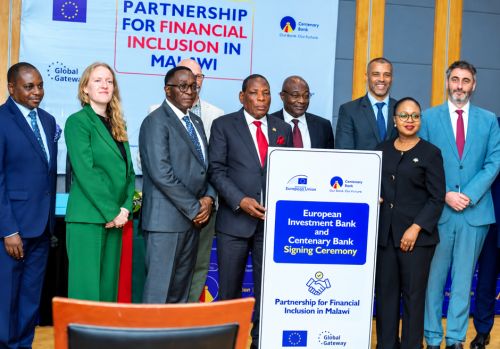
The European Investment Bank is providing €7.5 million to Centenary Bank Malawi to expand lending to smallholder farmers and micro agrifood businesses, targeting one of the country’s largest economic sectors at a time when climate shocks, limited finance and weak productivity are constraining rural incomes and investment.
The financing, announced by EIB Global on September 15, will be channelled to agrifood businesses with fewer than 10 employees and small-scale farmers. Half of the facility is earmarked for sustainable and climate-resilient agriculture, while the other half will support businesses advancing women’s economic empowerment. The operation is backed by an EU-funded guarantee under the European Union’s Global Gateway initiative.
The facility also includes technical assistance and capacity-building for Centenary Bank, designed to strengthen its ability to lend to agricultural businesses, reach underserved customers and support the adoption of climate-resilient practices. For a financial sector where lending to small agricultural businesses can be constrained by perceived risk, the combination of credit and institutional support is intended to address both the availability of capital and the capacity to deploy it effectively.
Agriculture remains central to Malawi’s economy. The World Bank describes the sector as the backbone of the economy, accounting for almost a quarter of GDP and employing roughly three-quarters of the population, with small-scale farming accounting for a large share of rural livelihoods. EIB project documentation puts agriculture’s contribution at about 25% of GDP and notes that micro, small and medium-sized enterprises account for around 47% of GDP and support approximately 1.7 million jobs.
The scale of the financing is therefore modest relative to the size of the agricultural economy, but its structure is designed to reach a segment that commercial finance often struggles to serve. The EIB facility specifically targets enterprises with fewer than 10 employees, placing the emphasis on the smallest businesses rather than larger agricultural companies that are generally better positioned to meet conventional lending requirements.
For farmers and microenterprises, the financing constraints are compounded by the nature of agricultural production itself. Revenues can be seasonal, collateral can be limited and income is exposed to weather conditions, commodity prices and input costs. These characteristics can make agricultural lending more difficult for banks while simultaneously increasing the importance of finance for farmers seeking to invest in irrigation, improved inputs, storage, equipment and climate-resilient production.
Climate risk is particularly important in Malawi. The World Bank has described the country’s dependence on rain-fed agriculture as a major source of vulnerability to droughts and floods. More recent economic assessments have also highlighted unpredictable rainfall, fertilizer shortages, power interruptions and foreign-exchange constraints as factors limiting agricultural output and productivity.
That creates a financing paradox. Farmers need greater access to capital to invest in resilience, but the same climate risks that make such investment necessary can increase the perceived risk of lending to the sector. A credit facility that combines longer-term funding with technical assistance can therefore address part of the problem by improving both the availability of finance and the financial intermediary’s ability to assess and manage agricultural exposure.
The World Bank has similarly argued that expanding access to finance is critical to climate-smart agriculture, particularly for smallholder farmers. Its work on climate finance in agriculture highlights the need to combine public and private capital with technical assistance for both lenders and borrowers.
The EIB operation follows that approach by making technical assistance part of the financing package rather than treating the loan as a standalone source of capital. Centenary Bank will receive support to strengthen its agricultural lending capabilities and deepen its outreach to underserved clients. The gender component adds another layer to the financing strategy. Half of the facility is intended to support women-owned or women-led businesses, creating a direct link between agricultural finance and women’s economic participation. The EIB’s project documentation identifies women borrowers and rural-based small enterprises as key beneficiaries of the operation.
For Malawi, expanding finance to women-led businesses could have implications beyond individual enterprises because women are heavily involved in agricultural production, food processing, trading and other activities across rural value chains. The effectiveness of the facility will nevertheless depend on whether eligible businesses can access loans on terms that reflect their cash flows and whether financing is accompanied by sufficient business-development support.
The broader economic environment makes that question particularly important. Malawi’s economy continues to face macroeconomic pressures, including foreign-exchange shortages, high inflation, fiscal constraints and limited private investment. The World Bank reported that real GDP grew by 1.9% in 2025, below population growth, while businesses continue to face high borrowing costs and foreign-exchange constraints.
These conditions can affect the ability of farmers and small businesses to use credit productively. Imported fertiliser, machinery and other agricultural inputs can become more expensive when foreign exchange is scarce, while high domestic borrowing costs can reduce the attractiveness of investment. Financing programmes therefore need to be considered alongside broader constraints affecting agricultural productivity and market access.
The EIB facility is also part of a wider European effort to use development finance to crowd capital into sectors considered important for economic resilience. Through Global Gateway, the European Union has sought to mobilise investment in sustainable infrastructure, digitalisation, health, education and private-sector development in partner countries. In Malawi, the EIB operation links that agenda directly to agricultural finance.
For Centenary Bank, the facility provides an opportunity to deepen a business segment that has historically presented both significant demand and elevated credit risk. The bank’s current management structure includes dedicated leadership for corporate banking, retail and SME banking, microfinance, credit and partnerships, capabilities that will be relevant as the new facility is deployed.
The bank’s ability to translate the facility into additional lending will ultimately determine its development impact. The key indicators will include how many farmers and microenterprises receive financing, the sectors and regions reached, the proportion of women-owned businesses supported, and whether borrowers use the funds for investments that improve productivity and resilience rather than primarily covering short-term operating gaps.
There is also a question of whether the financing can help build a pipeline of businesses capable of moving from micro-scale operations towards more formal and commercially sustainable enterprises. Access to credit can support investment, but farmers and agribusinesses also need reliable markets, storage, transport, electricity, technical knowledge and predictable access to agricultural inputs.
That broader value-chain perspective is important because Malawi’s agricultural challenge is not simply a shortage of finance. Productivity remains constrained by climate shocks, limited technology adoption, input constraints and weaknesses in market access. The World Bank’s recent assessment of the economy has also highlighted the need for greater private investment and stronger export-oriented sectors.

Climate resilience could nevertheless become one of the most important tests of the programme. If the facility succeeds in financing irrigation, water management, soil-health improvements, diversified production, storage or other resilience measures, it could help reduce the exposure of small businesses to increasingly volatile weather conditions.
The same logic applies to the bank itself. Building expertise in agricultural climate-risk assessment could allow Centenary Bank to develop more sophisticated lending products for farmers and rural businesses, potentially improving its ability to distinguish between risks that can be financed commercially and those requiring guarantees, insurance or other forms of risk-sharing.
The EIB’s intervention therefore sits at the intersection of agricultural development, financial inclusion and climate finance. Its €7.5 million commitment is not large enough to resolve Malawi’s wider agricultural financing gap, but its targeted structure provides a test of how development finance can use commercial banks to reach businesses that conventional financing channels frequently underserve.
The more consequential measure will be what happens after the money reaches the market. If farmers invest in more productive and climate-resilient systems, and micro agribusinesses use capital to expand processing, storage, services and market access, the facility could help strengthen parts of a rural economy that remain critical to Malawi’s employment and food security.
For Malawi, the challenge is ultimately to make agricultural finance work under conditions of climate and macroeconomic uncertainty. The EIB-Centenary Bank facility provides additional capital and technical capacity, but its longer-term significance will depend on whether that capital can help small businesses and farmers move from vulnerability towards greater productivity, resilience and commercial participation.


