


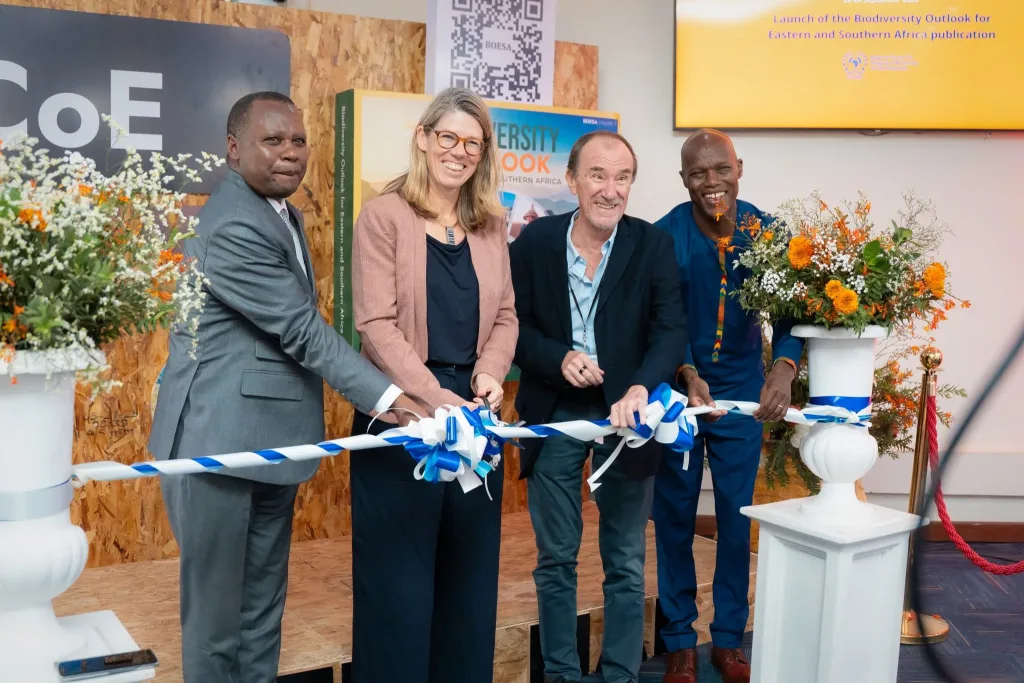
The Regional Centre for Mapping of Resources for Development (RCMRD) has launched the Biodiversity Outlook for Eastern and Southern Africa (BOESA), bringing together biodiversity data, regional perspectives and experiences from 24 countries to strengthen conservation planning, policy decisions and sustainable natural resource management across the region. The publication was launched in Nairobi during a regional workshop on integrated landscape-seascape modelling for climate-resilient development in East Africa, held from September 22 to 24, as governments and development partners prepare for a critical global review of progress under the Kunming-Montreal Global Biodiversity Framework.
The Biodiversity Outlook for Eastern and Southern Africa is designed to improve access to information on the region’s natural resources by combining geospatial intelligence, spatial analysis, scientific data and regional knowledge. RCMRD says the initiative is intended to make biodiversity information more accessible and actionable for policymakers, conservation practitioners, researchers, development partners and communities. The centre’s BOESA platform describes the initiative as an evidence-based regional biodiversity observatory providing information on the status, trends, opportunities and emerging challenges shaping biodiversity conservation across Eastern and Southern Africa.

The report was developed under the RCoE-ESA initiative in collaboration with the European Union, reflecting the growing role of international partnerships in strengthening Africa’s capacity to generate and use environmental data. The initiative comes as countries face increasing pressure to reconcile economic development, infrastructure expansion, agricultural production and natural resource use with biodiversity conservation and climate resilience.
European Union Regional Partnerships representative Sanne Willems said the report would help turn research and data into information that can be used by policymakers and other stakeholders.
“We have seen many programmes over the years conduct incredibly valuable research, but we often lack the next step of translating it into policy and, therefore, into action,” Willems said, highlighting a persistent challenge in environmental governance: the gap between scientific knowledge and decisions that shape investment, land use and development.
RCMRD Director General Dr Emmanuel Nkurunziza said the publication brings together data, knowledge and regional experiences to support biodiversity conservation.
“By making this information more accessible, we aim to support policymakers, conservation practitioners, researchers, development partners and communities in advancing nature-positive action across the region,” Nkurunziza said.
The launch also strengthens RCMRD’s expanding role in supporting regional biodiversity policy. In January 2026, the centre was designated a Subregional Technical and Scientific Cooperation Support Centre under the Convention on Biological Diversity (CBD), giving it a formal role in helping Eastern and Southern African countries strengthen their capacity to deliver biodiversity commitments. RCMRD has subsequently positioned BOESA as part of the technical infrastructure needed to connect scientific evidence with national and regional implementation.
The timing of the publication is significant because countries are approaching the 17th Conference of the Parties to the Convention on Biological Diversity, scheduled for October 19 to 30, 2026, in Yerevan, Armenia. COP17 will undertake the first global review of collective progress in implementing the Kunming-Montreal Global Biodiversity Framework, making the availability of credible regional and country-level biodiversity information increasingly important for governments and development partners.
The Convention on Biological Diversity has indicated that implementation of the Kunming-Montreal Global Biodiversity Framework is not yet occurring at the pace and scale required to achieve its goals. Following biodiversity meetings in Nairobi in August, the CBD said fewer than half of aligned national targets assessed by Parties were currently on track, with significant gaps remaining in areas including biodiversity finance, harmful subsidies, business impacts and sustainable consumption. These gaps make the quality and accessibility of biodiversity data increasingly important for determining where action is required and how resources should be directed.
For Eastern and Southern Africa, the implications extend beyond conservation agencies. Biodiversity underpins agriculture, forestry, fisheries, tourism, water systems and rural livelihoods, meaning changes in ecosystems can have direct economic consequences. Better mapping and monitoring can help governments identify areas of ecological importance, assess pressures on protected areas, understand changes in forest and marine ecosystems and integrate environmental considerations into infrastructure and development planning.
The BOESA approach also reflects the growing importance of geospatial technology in environmental decision-making. By combining maps, statistics, country profiles, scientific data and visual narratives, the platform can provide a common information base for countries dealing with ecosystems and environmental pressures that frequently cross national boundaries. RCMRD has said its geospatial capabilities can support the monitoring of protected areas, ecosystems and progress towards global biodiversity targets.
This is particularly relevant as African governments face increasing demands to demonstrate measurable progress against international biodiversity commitments. The Kunming-Montreal Global Biodiversity Framework provides a common global framework, but implementation depends heavily on national institutions having the data, technical capacity and financial resources to identify priorities and track outcomes. Regional platforms such as BOESA can therefore contribute to narrowing the information gap between global targets and local implementation.
The report also creates a potential foundation for stronger links between biodiversity information and nature finance. Investors, development finance institutions and governments increasingly require evidence on environmental risks, ecosystem conditions and measurable outcomes when designing conservation, climate and sustainable development programmes. Reliable spatial information can help identify investment priorities and provide a baseline against which restoration and conservation interventions can be monitored.
For communities, the value of the information lies in how it is translated into practical decisions. Biodiversity mapping can support planning around forests, wetlands, rangelands, marine ecosystems and agricultural landscapes, while better information can help identify areas where competing demands for land and natural resources need to be managed more carefully. The challenge for institutions will therefore be to ensure that scientific and geospatial information reaches decision-makers and communities in forms that can be applied to local planning.
The launch of BOESA consequently comes at a point when the biodiversity agenda is moving increasingly from global commitments towards implementation, monitoring and accountability. The European Union partnership, RCMRD’s regional mandate and the involvement of member states position the initiative within a broader effort to strengthen the scientific and institutional infrastructure required to deliver nature-positive development.
As COP17 approaches, the availability of regional biodiversity data will become increasingly relevant to discussions around implementation of the Kunming-Montreal Global Biodiversity Framework, biodiversity finance and the use of technology in conservation. For Eastern and Southern Africa, the ability to translate biodiversity data into policy decisions, investment priorities and measurable conservation action will be central to determining whether international commitments can produce outcomes on the ground.
The Biodiversity Outlook for Eastern and Southern Africa therefore represents more than a regional publication. It reflects a growing recognition that biodiversity conservation requires reliable data, accessible information and stronger connections between science and policy. For governments across the region, the next challenge will be converting that information into decisions that protect ecosystems while supporting climate-resilient development, sustainable livelihoods and long-term economic resilience.


