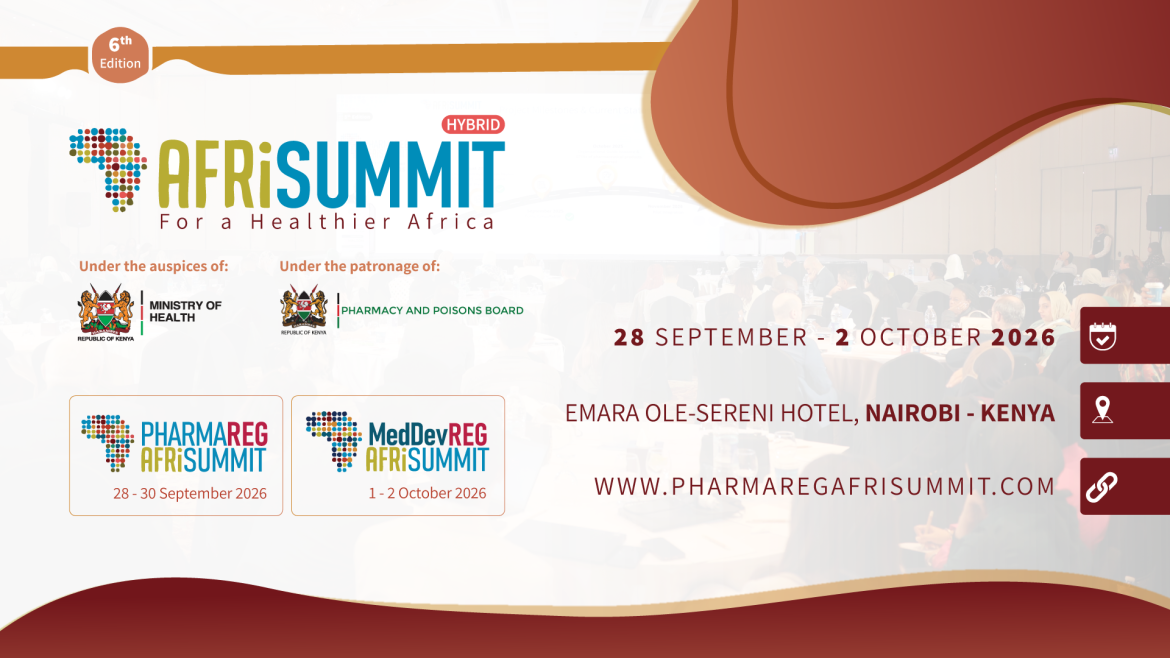
AfriSummit 2026, the sixth edition of the regulatory affairs summit for Africa’s pharmaceutical, medical device, IVD and diagnostics sectors, will bring regulators, industry leaders and healthcare stakeholders from across the continent to Nairobi from 28 September to 2 October 2026. The five-day gathering at Emara Ole-Sereni Hotel will, for the first time, be held in East Africa, placing Kenya at the centre of discussions on the regulatory systems, local manufacturing capacity and health-product markets shaping Africa’s healthcare sector.
Held under the auspices of the Ministry of Health, Kenya, and under the patronage of the Pharmacy and Poisons Board (PPB), Kenya, AfriSummit 2026 is expected to bring together 16+ National Regulatory Authorities and Notified Bodies, alongside 100+ speakers and 450+ decision-makers from more than 25 countries. The programme will be divided into two dedicated summits, with PharmaReg AfriSummit running from 28 to 30 September, followed by MedDevReg AfriSummit from 1 to 2 October, providing separate but connected platforms for pharmaceutical and medical device regulatory communities.
The timing of the summit comes as African countries are seeking to strengthen domestic health-product manufacturing, improve regulatory capacity and reduce vulnerabilities in international supply chains. In August 2026, African health ministers endorsed the Regional Strategy on Regulation of Medical Products in the African Region 2026–2035, which aims to strengthen national regulatory systems governing medicines, vaccines, diagnostics and medical devices. The strategy identifies fragmented national regulatory authorities, shortages of skilled personnel, insufficient financing, weak legal and governance frameworks, limited digitalisation and information-sharing systems, and the continued circulation of substandard and falsified medical products among the challenges facing the continent.

Against this backdrop, AfriSummit’s focus on regulatory affairs places the event within a wider continental effort to make health-product markets safer, more predictable and better integrated. Dr. Mona Al Moussli, Chairman of AfriSummit, said regulatory systems across Africa are entering an important period of development, with greater emphasis on local manufacturing, stronger national regulatory capacity and reliance. She said the summit is intended to create a space where regulators and industry can discuss these priorities directly and identify ways to advance them.
Regulatory harmonization and reliance are becoming increasingly important as African countries attempt to reduce duplication and shorten the time required for health products to reach patients. The World Health Organization and the African Medicines Agency signed a Framework Agreement for Collaboration in May 2026 aimed at advancing regulatory harmonization, convergence and reliance, while strengthening safety surveillance and regulatory capacity across the continent. The agreement also supports local production and regulatory preparedness during public health emergencies.
The regulatory agenda at AfriSummit will address WHO Global Benchmarking Tool maturity, local manufacturing, clinical research, harmonization, medical device and IVD oversight, the role of AI, traceability, and the challenge of substandard and falsified health products. These issues increasingly intersect with commercial decisions for manufacturers and healthcare companies, particularly as governments seek to build domestic production capacity while maintaining international standards for safety, efficacy and quality.
Kenya provides a relevant setting for those discussions. In June 2026, the country launched the Kenya Health Products and Technologies Local Manufacturing Strategy 2026–2030, a five-year roadmap aimed at expanding local production of medicines, vaccines, diagnostics and medical devices while strengthening the regulatory systems that oversee their quality. The strategy places regulatory capacity alongside manufacturing and supply-chain development, reflecting the increasing recognition that industrial policy and health regulation need to advance together.
For manufacturers, the regulatory environment is therefore becoming an increasingly important component of investment decisions. Predictable approval processes, technical capacity within National Regulatory Authorities, harmonised requirements and effective post-market surveillance can influence the cost and speed of entering African markets. Greater reliance between regulators can also reduce duplicated assessments and create opportunities for companies to serve multiple markets through more coordinated regulatory pathways.
The summit’s focus on medical devices and IVDs is particularly relevant as African health systems adopt more digital technologies, diagnostic platforms and specialised medical equipment. These products require regulatory systems capable of assessing increasingly complex technologies, while ensuring that innovation does not outpace the capacity to evaluate safety, performance and quality.
Artificial intelligence is consequently expected to feature among the regulatory discussions. The growing use of AI in diagnostics, clinical research, medical technologies and health-data systems raises questions around validation, transparency, accountability, data governance and post-market monitoring. Regulators will increasingly need technical capabilities that allow them to assess both conventional health products and technologies whose risks and performance characteristics may change as software and algorithms evolve.
Traceability will also remain central to discussions on the movement of health products through increasingly complex supply chains. The circulation of substandard and falsified medical products continues to pose risks to patients and undermine confidence in legitimate manufacturers and pharmaceutical markets. Digital identification and traceability systems can provide regulators and supply-chain participants with greater visibility over products as they move from manufacturing facilities through distributors and healthcare providers to patients.
AfriSummit will also feature a dedicated one-day workshop on eCTD Training, providing practical guidance on electronic regulatory submissions in line with evolving African and international requirements. The shift towards electronic regulatory processes is part of the broader digitalisation of regulatory systems and could contribute to more standardised and efficient submission and review processes where the necessary infrastructure and technical skills are available.
Dr. Najiba Al Shezawy, Co-Chairman of AfriSummit, said the diversity of the summit’s audience remains central to its purpose, with the objective of encouraging meaningful exchange, building relationships and supporting a stronger and more connected regulatory ecosystem across Africa.
The participation of global healthcare companies and technology providers further illustrates the commercial importance of Africa’s evolving regulatory landscape. The World Health Organization joins AfriSummit as the Continental Strategic Partner, while Haleon is Principal Sponsor, VISIOTT TPS Titanium Sponsor and AstraZeneca Platinum Sponsor. Abbott, Julphar, Dolls Pharma, Novo Nordisk, Antares Vision Group and Schlafender Hase participate as Gold Sponsors, alongside technology and regulatory organisations involved across the wider programme.
The summit also brings together organisations spanning pharmaceuticals, medical devices, digital health, traceability and supply-chain technology. EVOTEQ joins as Technology Partner, cormeo GmbH as Workshop Sponsor, Biocon Limited and Xenopia Group as Silver Sponsors, while Dawa Life Sciences, LSPedia and PRA Consultancy participate in designated sponsorship and strategic roles. DP World, Tiga Healthcare Technologies, Biovac, Opella, SoftClans and LIVY SARLU are Associate Sponsors, while Nextrans Solutions and Domino are Valued Exhibitors. Axmed, Jeyflex and Centre for Testing and Research Services L.L.C (CTRS) are Satchel Sponsors, with Anti-Counterfeit Authority as Awareness Partner and GS1 Kenya as Standards & Traceability Partner.
For Kenya, hosting the event also comes as the country positions health as a driver of investment, industrialisation and economic growth. The Ministry of Health has recently emphasised local manufacturing, health-product security, digital health, regulation and sustainable healthcare financing as components of a more resilient health system. The government has also been engaging development partners and investors around strengthening domestic health capacity and reducing vulnerabilities associated with fragmented and unpredictable financing.

The wider continental context is equally significant. WHO estimates that only eight African countries currently have well-functioning and stable regulatory systems capable of effective oversight and quality assurance for health products, while the African Medicines Agency has now been established as a continental institution. Strengthening national authorities, improving regulatory reliance and building a connected continental system remain central to the next phase of Africa’s health-product agenda.
AfriSummit 2026 therefore arrives at a point when regulatory affairs are increasingly becoming part of Africa’s broader health-security and industrialisation conversation. The challenge is no longer limited to increasing the volume of medicines, diagnostics and medical devices available in African markets. Countries must also ensure that products are safe, effective, traceable and appropriately regulated, while creating systems that are efficient enough to support local manufacturers and attract investment.
Across five days of focused sessions, regulator-industry engagement and networking, AfriSummit 2026 will connect stakeholders shaping the next phase of Africa’s healthcare regulatory landscape. Its Nairobi edition provides a platform for regulators, manufacturers, technology companies and policymakers to examine how stronger regulatory systems can support local production, faster access to quality-assured health products and a more integrated African healthcare market.