


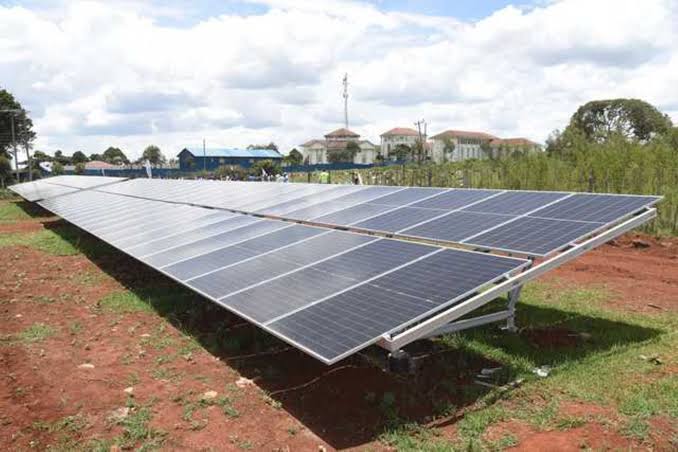
Kenyan businesses added 72.8 megawatts (MW) of solar power for their own use in the year ended June 2026, accelerating a shift towards captive generation as companies seek to reduce electricity costs, improve supply reliability and manage operational risks. The expansion lifted Kenya’s total captive electricity generation capacity to 676.6 MW from 603.8 MW a year earlier, with solar accounting for more than half of that capacity, according to data from the Energy and Petroleum Regulatory Authority (EPRA).
The increase comes as Kenya’s electricity demand continues to grow while businesses face pressure to control energy costs and maintain reliable production. EPRA data shows that total electricity generation reached 15,692.81 gigawatt-hours (GWh) in the 2025/26 financial year, while peak demand rose to 2,514.28 MW. At the same time, renewable sources accounted for 81.16% of Kenya’s total installed electricity generation capacity when interconnected, captive and off-grid systems are considered.

Solar is becoming an increasingly important part of that private generation landscape. Captive solar photovoltaic capacity rose from 300.5 MW in June 2025 to 373.3 MW in June 2026, an increase of 24.22%, while total captive generation increased by 12.05%. Solar represented 55.17% of captive generation capacity, ahead of bioenergy at 23.91%.
According to EPRA, the growth reflects continued uptake of distributed renewable energy systems by commercial and industrial consumers seeking to meet part of their electricity requirements independently. The trend is particularly significant for manufacturers and other large electricity users, for whom power interruptions, tariff movements and reliance on backup generation can directly affect production costs and competitiveness.
A growing group of Kenyan companies has already invested in captive solar systems. Business Daily reported installations or moves towards self-generation by firms including Bio Food Products, TotalEnergies Kenya, Maisha Mabati Mills, Simba Cement, Unilever Tea Kenya, British American Tobacco, Africa Logistics Properties, Bidco, Mabati Rolling Mills, Centum Real Estate and Devyani Food Industries. Coca-Cola has also received regulatory approval for solar plants at its Embakasi and Kisumu facilities with a combined capacity of 3.98 MW.
For individual companies, the economics can be substantial. Unilever Kenya, which recently completed a solar installation at its facility, expects the system to generate about 1,500 megawatt-hours annually and save roughly KSh30 million a year on its electricity bill, according to the company’s East Africa managing director.
The growth of captive solar therefore represents more than a shift in the source of electricity. It is changing how some businesses approach energy procurement, capital expenditure and operational resilience. Instead of relying entirely on electricity purchased from the national grid, companies can deploy solar assets directly at factories, warehouses, offices and other facilities, turning electricity generation into part of their long-term infrastructure planning.
That shift also has implications for Kenya Power, the state-owned electricity distributor. Industrial and commercial customers are among the utility’s most important revenue sources, meaning sustained migration towards self-generation could gradually alter the structure of electricity demand and sales.
Business Daily reported that electricity consumed by customers newly connected to Kenya Power fell to 161.7 GWh in the year to June 2026, from 202.98 GWh a year earlier. Revenue from that customer segment declined by KSh1.07 billion to KSh4.05 billion despite the utility connecting 412,249 new customers during the period, more than half of whom were commercial customers.
The figures do not, however, indicate a broad contraction in Kenya’s electricity market. Kenya Power reported that total electricity sales increased by 12.05% to 12,777 GWh during the financial year, while total revenue rose to KSh238.24 billion. The distinction is important because captive generation can reduce purchases from the grid at individual sites even as overall electricity demand continues to expand.
For Kenya’s wider energy system, the growth of distributed solar presents both an opportunity and a structural challenge. More private renewable generation can reduce the amount of electricity businesses need to draw from the grid during daylight hours and can help companies reduce exposure to fuel-based backup generation. It can also bring new private capital into electricity infrastructure without requiring all investment to pass through public utilities or government budgets.
But the trend raises questions about how the national grid will be financed and used as larger commercial consumers increasingly generate part of their own power. Kenya Power must continue investing in transmission and distribution infrastructure even if some high-value customers reduce their dependence on grid electricity. This creates a policy challenge around tariffs, network charges, distributed generation and the allocation of infrastructure costs across consumers.
The development also highlights the changing nature of energy finance in Africa. Commercial and industrial solar projects are increasingly being treated as productive assets rather than solely as environmental investments because their value can be linked directly to electricity costs, business continuity and long-term operating expenditure. This creates opportunities for banks, infrastructure funds, leasing companies and energy-service providers to finance distributed energy systems through power purchase agreements, asset financing and other structures that reduce the upfront capital burden on businesses.
Kenya’s experience is relevant beyond its borders. Across Africa, companies operating in manufacturing, agriculture, mining, logistics, hospitality and commercial real estate are increasingly exposed to the cost and reliability of electricity. Where national grids face capacity, financing or distribution constraints, captive renewable energy can provide businesses with an additional source of supply while reducing exposure to diesel and other fossil fuel-based backup systems.
The scale of Kenya’s captive generation remains relatively small compared with the national electricity system, but its growth is becoming difficult to treat as a marginal development. Captive capacity of 676.6 MW represented 16.97% of the country’s total installed electricity generation capacity by June 2026. Solar alone accounted for 373.3 MW.
For policymakers, the question is therefore shifting from whether businesses will invest in self-generation to how distributed generation can be integrated into the broader electricity market. Kenya already has a regulatory framework for renewable energy and net metering, while EPRA has identified distributed renewable systems as an increasingly important component of the energy sector.
The longer-term significance lies in whether these investments complement or gradually substitute parts of the traditional utility model. For businesses, solar can improve control over a critical operating cost. For Kenya’s electricity sector, however, the growth of captive power means the grid must remain financially sustainable, flexible and valuable enough to serve customers whose energy needs are becoming increasingly diversified.

For other African economies, Kenya offers an emerging example of how private investment can help expand renewable energy capacity while responding to immediate commercial pressures. The development also shows why the continent’s energy transition cannot be assessed only through national generation statistics. Increasingly, part of Africa’s new power infrastructure is being built behind the meter, financed by businesses and driven as much by competitiveness and energy security as by climate objectives.


