


African countries insure only about 3% to 5% of losses from disasters, compared with roughly 40% globally, leaving governments to absorb more than 90% of annual losses estimated at between $7 billion and $15 billion. The gap is forcing policymakers, insurers and development financiers to reconsider how governments fund recovery before climate and disaster shocks put further pressure on already constrained public finances.
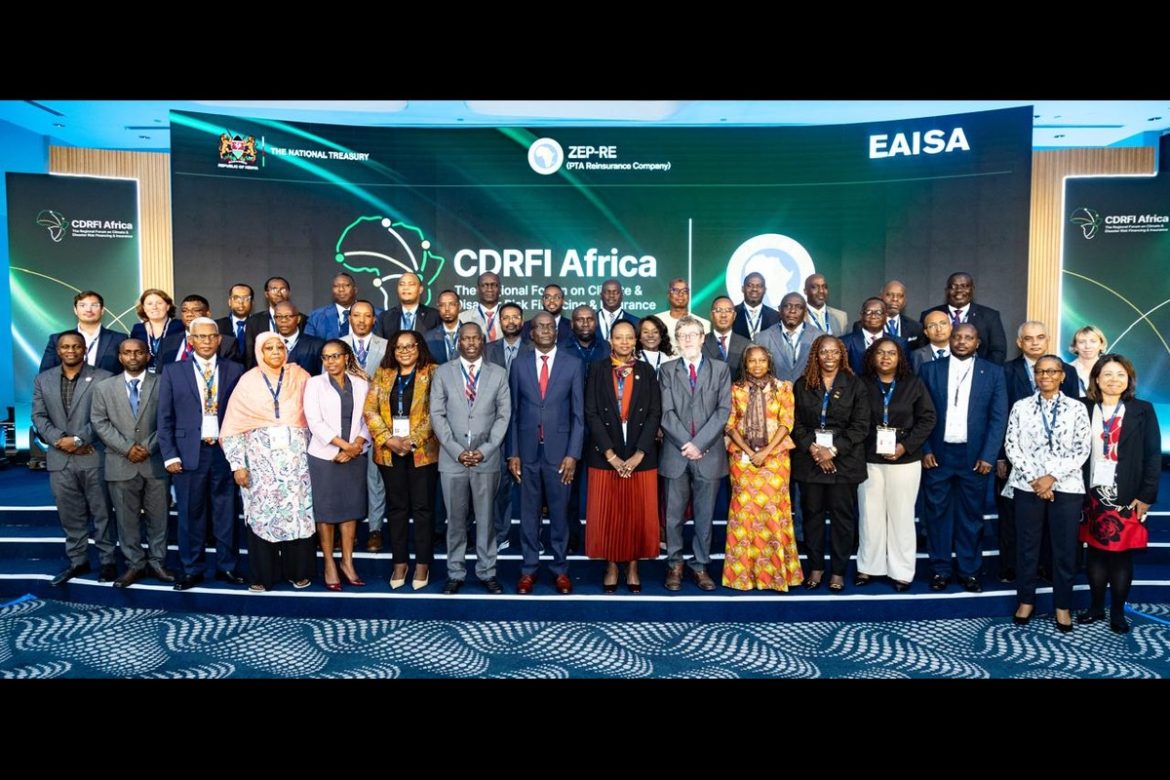
The figures were highlighted at the inaugural Climate and Disaster Risk Financing and Insurance Africa Forum in Nairobi, where policymakers, insurance regulators, development partners and industry executives are examining ways to increase the insurability of climate and disaster risks, particularly those affecting critical public infrastructure.
The forum, convened by ZEP-RE with the East Africa Insurance Supervisors Association and hosted by Kenya’s National Treasury, is focused on moving African countries away from reliance on emergency budget reallocations towards financing arrangements established before disasters occur. More than 20 countries are represented at the meeting, alongside international development and insurance-sector partners.

The issue is becoming increasingly important as climate-related shocks place pressure on public investment, infrastructure and government budgets. Floods, droughts, cyclones and other extreme events can damage roads, water systems, electricity infrastructure, schools and health facilities while simultaneously reducing government revenues and increasing demands for public spending.
Kenya’s Principal Secretary for Economic Planning, Dr Bonface Makokha, said governments need to know which assets are exposed to disaster risks and how their recovery would be financed before a shock occurs. The argument reflects a broader shift in disaster-risk financing towards pre-arranged mechanisms that can provide liquidity quickly while limiting disruption to development spending.
ZEP-RE Managing Director and Group CEO Hope Murera has similarly argued that disasters should not automatically become fiscal crises. She said insurance and reinsurance need to operate alongside risk reduction, climate information systems and sound public financial management rather than being treated as standalone products.
For governments, the distinction is significant. Conventional disaster response often requires reallocating money from existing programmes, increasing borrowing or waiting for external assistance. Those approaches can delay reconstruction while diverting resources away from infrastructure, health, education and other development priorities.
Pre-arranged disaster-risk financing provides another option. Countries can combine budget reserves, contingent credit, insurance, risk pools and investments in disaster-risk reduction according to the frequency and severity of different risks. This layered approach means that smaller and more frequent shocks can be handled through domestic resources, while larger events can trigger insurance or contingent financing mechanisms.
The World Bank has promoted similar approaches through its disaster-risk financing work, including instruments that allow governments to secure liquidity before disasters occur. In Kenya, the National Treasury launched a Disaster Risk Financing Strategy for 2026–2030 in June, with the objective of strengthening the financial capacity of national and county governments and shifting the country from reactive crisis financing towards proactive, risk-informed preparedness.
The strategy is particularly relevant as Kenya faces multiple overlapping risks. The country is exposed to droughts, floods and other climate-related hazards, while the World Meteorological Organization has reported that El Niño conditions are firmly established in 2026 and are expected to persist into early 2027. The potential economic effects extend across agriculture, water, infrastructure, energy and food prices.
Kenya is also already using rapid financing mechanisms to respond to emerging shocks. In September, the World Bank said Kenya was working towards accessing approximately $400 million through its Rapid Response Option to address pressures associated with regional health risks, El Niño-related disruptions and higher energy prices. The facility allows eligible countries to redirect a portion of undisbursed financing towards urgent crisis response.
The financing gap, however, cannot be closed simply by increasing insurance penetration. Insurance Development Forum Secretary General Ekhosuehi Iyahen has pointed to weaknesses in risk data, modelling, market capacity and wider development conditions as barriers to expanding protection.
This creates a critical link between insurance and information. Insurers need reliable data on the location, value and vulnerability of infrastructure before they can price risks accurately. Governments therefore need asset registers, hazard maps, climate projections and loss databases that allow insurers and financiers to understand the probability and potential cost of different events.
Africa has made progress in this area, but significant gaps remain. The African Development Bank has noted that more than 1,695 climate-related disasters were recorded across Africa over the past five decades, causing hundreds of thousands of deaths and tens of billions of dollars in economic damage. Its Africa Disaster Risk Financing Programme also highlights the continent’s very low level of insurance coverage for climate-related risks.
Better data could also make new insurance products more viable. Parametric insurance, for example, pays when predefined indicators such as rainfall, wind speed or temperature cross an agreed threshold rather than requiring traditional loss assessments. This can potentially accelerate payouts following disasters and reduce administrative costs, although the design of the triggers remains critical because actual losses can differ from the predefined parameters.
Regional risk pools offer another avenue. Climate risks often cross national borders, while individual African insurance markets may not have enough capital or data to absorb large systemic events. Pooling risks across several countries can diversify exposure and increase underwriting capacity.
Africa already has experience with regional approaches through institutions such as the African Risk Capacity, which provides sovereign disaster-risk insurance and early-response mechanisms to member states. The broader challenge is to extend similar principles to infrastructure, public assets and other areas where a single major disaster can generate significant fiscal pressure.
The CDRFI Africa Forum is also examining the possibility of incorporating risk-transfer mechanisms into sovereign lending through so-called shock-resilient loans. Such structures could provide governments with additional fiscal space following predefined disasters, potentially allowing debt-service payments to be deferred or financing to be redirected when major shocks occur.
For development financiers, these mechanisms could become increasingly relevant as climate risks intersect with debt constraints. A government already carrying high debt levels has less capacity to borrow after a disaster. Having insurance, contingent financing or pre-arranged liquidity available before the event can reduce the need for expensive emergency borrowing.
The issue is therefore broader than the insurance sector. It concerns the resilience of public finances and the ability of governments to protect development gains when disasters occur.
The 2025 Zanzibar Declaration, adopted by insurance regulators from 12 countries, established commitments to strengthen protection for critical public infrastructure. Participants at the Nairobi forum are now looking at how those commitments can move into implementation through stronger regulation, better risk information, improved modelling and new financial products.
For Africa’s infrastructure pipeline, the implications are significant. Roads, ports, airports, energy systems, water infrastructure and public buildings represent billions of dollars in long-term investment. Their economic value depends not only on construction and operation but also on the ability to restore them quickly after extreme events.

Insurance can therefore become part of the investment architecture rather than an administrative requirement added after an infrastructure project has been designed. A project with credible disaster-risk coverage may provide lenders and investors with greater clarity over how losses would be absorbed and how operations would resume following a shock.
But expanding coverage will require more than new insurance products. Governments need to identify exposed assets, improve risk data, strengthen building and infrastructure standards, develop domestic insurance capacity and create regulatory frameworks that allow insurers to innovate while protecting policyholders.
The financial question is ultimately one of timing. African governments will continue to face climate and disaster shocks, but the fiscal consequences depend partly on whether financing is arranged before or after the event.
The Nairobi discussions point towards a broader shift in thinking: disaster preparedness is increasingly becoming a public-finance issue as much as an emergency-management or insurance issue. For a continent facing growing climate risks and substantial infrastructure needs, closing the protection gap could help determine whether future disasters become temporary disruptions or prolonged setbacks to economic development.


