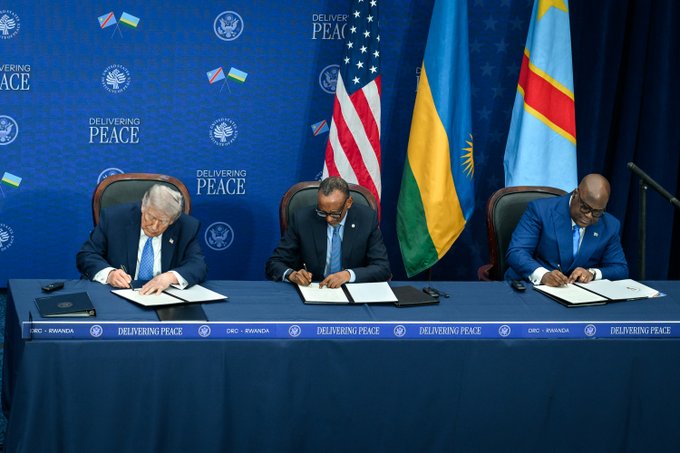

The United States, the Democratic Republic of Congo, and Rwanda have formalized a new framework linking mineral governance, regional security, and industrial investment, signaling a major shift in how critical resources in Central Africa will be managed. Signed in Washington on Friday, the agreements combine the Regional Economic Integration Framework (REIF/CIER) with two Strategic Partnership Agreements (SPAs) between the United States and each African government, creating a single structure where access to minerals, governance reforms, and security cooperation are interdependent.

The deal is designed to strengthen state authority in eastern DRC, reduce reliance on informal and illicit mineral networks, and secure reliable supplies of cobalt, copper, tungsten, and other strategic resources for global markets.
The framework establishes a mechanism in which companies seeking to operate in DRC and Rwanda must engage directly with national authorities. In eastern DRC, where small-scale and artisanal mining has long been dominated by armed groups, revenue from mineral extraction has frequently bypassed government oversight.
Read also: Morocco champions Africa-Centric ESG standards to unlock sustainable mining investment
By formalizing access through Kinshasa and Kigali, the new framework aims to curtail financial flows to militias and increase predictability for investors. Congolese officials have emphasized that this shift is intended to consolidate state authority in regions historically undermined by informal supply chains, while also creating safer and legally traceable pathways for mineral exports.
The United States has tied these governance reforms to security cooperation. Under the SPAs, Washington will support security sector reforms and infrastructure projects, including improved transport corridors and border oversight, linking them directly to access for American companies.
Firms such as KoBold Metals and Starlink are already participating in pilot operations, including shipments of tungsten concentrate from Rwanda’s Nyakabingo mine to a refinery in Pennsylvania. These operations reflect an attempt to create fully traceable supply chains, ensuring that resources reaching U.S. markets are sourced legally and meet international standards.
The development of the Lobito Corridor, a transport route from the mineral-rich interior of the DRC to Atlantic ports, is central to this plan, providing an export pathway that bypasses unregulated intermediaries and strengthens regional integration.

Analysts note that the framework also represents a strategic alternative to China’s entrenched presence in the DRC’s copper and cobalt belts. By embedding transparency, traceability, and security requirements, the United States is establishing conditions that could limit operational space for companies unwilling or unable to comply with higher governance and reporting standards. This is particularly significant given that DRC supplies roughly 70 percent of global cobalt, essential for batteries and electronics, and about 10 percent of copper. Any shift in control over these supply chains has implications not just for global markets but for industrial policy in Africa and beyond.
Rwanda’s role in the framework is equally notable. With its mining sector concentrated on tungsten and tin, Kigali has emphasized legal compliance and export traceability to attract foreign investment while curbing artisanal mining networks. The new agreements link these economic incentives to regional security, requiring collaboration with the DRC on border management, transport infrastructure, and policing in mineral zones. For both countries, the approach signals a coordinated attempt to balance state authority, economic development, and geopolitical influence.
Beyond the immediate parties, the framework has regional and global implications. Saudi Arabia, which has ambitions in mineral processing through Manara Minerals, may face limited access if U.S.-managed corridors become the dominant export route. The European Union, relying on regulatory standards for supply chain due diligence, may see slower gains in securing minerals for its industries.
Japan, which has been engaged in the Lobito Corridor through JOGMEC, could align more closely with the new U.S.-backed system, gaining early access to traceable supply chains. For African states, these dynamics highlight both opportunities and the need to ensure local benefits from mineral extraction are preserved, including tax revenues, jobs, and industrial capacity.
However, security remains a critical unknown. Eastern DRC continues to experience armed conflict in South Kivu and North Kivu, where local militias exploit mineral wealth to fund operations. If violence persists, the framework’s effectiveness could be compromised, disrupting transport corridors and threatening both investor confidence and community stability. Regional analysts emphasize that without sustained improvements in security and law enforcement, the operational and governance goals embedded in the agreements may not be achievable, despite their comprehensive design.
The framework also touches on environmental and social considerations. Increased formalization of mining activity provides an opportunity to implement environmental standards and labor protections in areas long affected by informal and hazardous extraction practices.
In Rwanda, where tungsten mining has been linked to deforestation and water contamination, the agreements require traceability protocols that could indirectly support environmental management.
In the DRC, improvements in transport infrastructure and border oversight can reduce illegal cross-border trade, potentially decreasing uncontrolled environmental degradation from unregulated mining sites.

The new agreements mark a notable shift in how global powers interact with African resource governance. By tying access to minerals with state authority, security cooperation, and industrial investment, the United States is establishing a model that blends economic and geopolitical objectives with sustainable governance.
For Central Africa, the framework has the potential to stabilize key mineral-producing regions, reduce the power of non-state armed actors, and create transparent pathways for investment. The success of this approach, however, will ultimately depend on the commitment of Kinshasa and Kigali to enforce reforms, the ability of local security forces to maintain stability, and the willingness of private companies to operate under stricter governance and reporting requirements.
If implemented effectively, the agreement could become a blueprint for integrating resource governance, industrial policy, and security across Africa, offering a pathway for both economic development and regional stability. The next phase will test whether the promises of traceable supply chains, strengthened state authority, and U.S.-backed investment can withstand the challenges of ongoing conflict and the complex realities of the Central African mineral sector.
Engage with us on LinkedIn: Africa Sustainability Matters
Engage with us on LinkedIn: Africa Sustainability Matters