


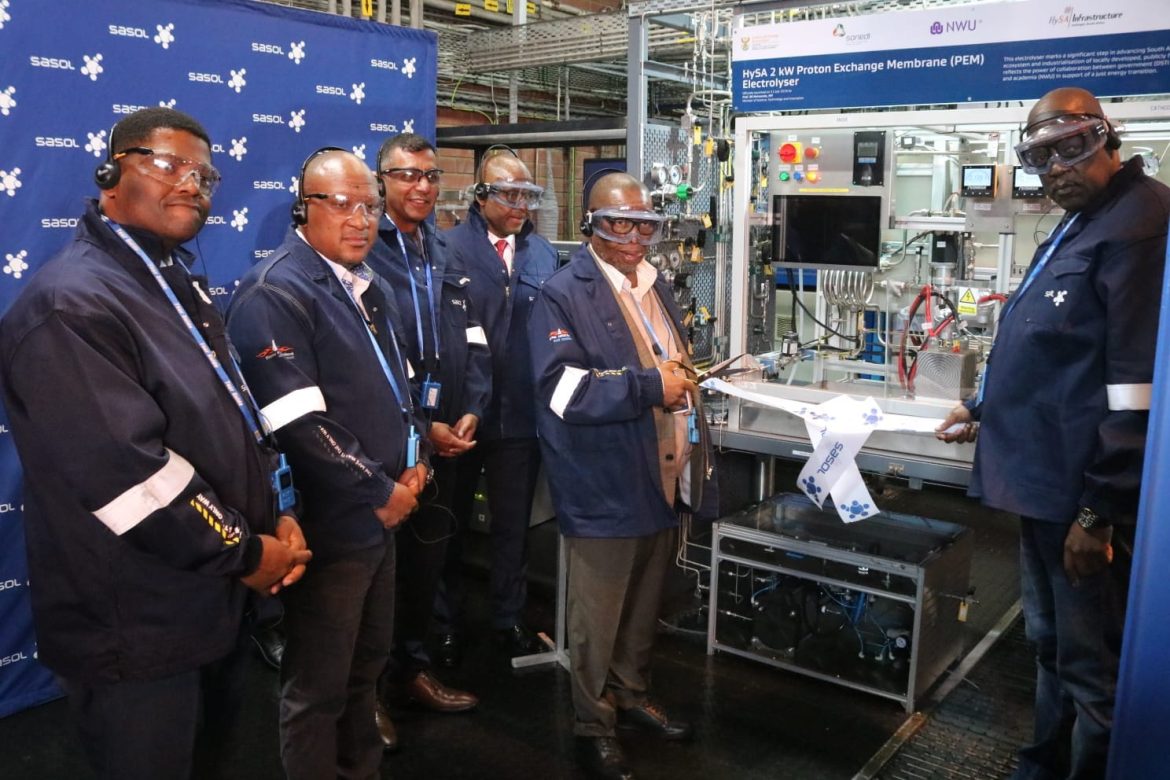
South Africa has taken a significant step towards building a domestic green hydrogen manufacturing industry after Sasol unveiled the country’s first locally manufactured hydrogen electrolyzer, marking a shift from exporting critical minerals to producing higher-value clean energy technologies. The 2-kilowatt electrolyzer, inaugurated on 31 July under the Hydrogen South Africa (HySA) programme, will be used to test hydrogen production technologies, strengthen local technical expertise and support the country’s long-term ambition of becoming a global green hydrogen hub.
The milestone comes despite South Africa’s longstanding dominance in the production of platinum and iridium two critical minerals that serve as essential catalysts in proton exchange membrane (PEM) electrolyzers used to produce green hydrogen. While the country supplies the majority of global platinum group metals used in hydrogen technologies, it had not previously manufactured an electrolyzer domestically.
Developed through the Hydrogen South Africa (HySA) programme, the electrolyzer is the product of collaboration between the Department of Science, Technology and Innovation, the South African National Energy Development Institute (SANEDI), North-West University and Sasol. The system will be installed at Sasol’s research and technology campus in Sasolburg, where it will operate under real-world conditions powered by variable renewable energy.
The facility will provide an industrial testing platform for hydrogen production while supporting research, innovation and workforce development in one of the fastest-growing segments of the global clean energy economy. According to Sasol, the project is intended to bridge the gap between laboratory research and commercial deployment by enabling engineers and researchers to optimise locally developed electrolyzer technologies before they are scaled up for industrial use.
“This inauguration is a powerful example of what can be achieved when government, academia and industry work together,” said Sarushen Pillay, Executive Vice President at Sasol. “Hydrogen is an essential element for producing sustainable fuels and chemicals, and this programme provides a unique industrial platform to advance locally developed electrolyzer technology.”
The launch represents more than a technological milestone. It reflects South Africa’s broader industrial strategy of moving higher up the hydrogen value chain by manufacturing clean energy technologies domestically rather than exporting raw mineral resources alone. According to the International Energy Agency (IEA), global demand for electrolyzers is expected to increase substantially as countries accelerate investments in green hydrogen to decarbonise heavy industry, aviation, shipping, steelmaking and chemical production. Electrolyzers use electricity preferably from renewable energy sources to split water into hydrogen and oxygen without producing carbon emissions.
As demand grows, countries capable of manufacturing electrolyzers alongside producing hydrogen are expected to capture significantly greater economic value through industrial production, technology exports and skilled employment. South Africa is uniquely positioned in this emerging market. The country holds approximately 75 per cent of the world’s known platinum reserves and remains the leading producer of platinum group metals, including iridium. These minerals are indispensable components in hydrogen electrolyzers and fuel cells, technologies expected to underpin the global transition to low-carbon energy systems over the coming decades.
Mining already contributes approximately six per cent of South Africa’s gross domestic product, and policymakers increasingly view hydrogen technologies as an opportunity to diversify mineral exports into advanced manufacturing. The new electrolyzer therefore represents an important first step toward localising parts of the hydrogen technology supply chain while supporting industrial development and value addition within the country.
Its commercial significance extends well beyond the pilot project. Sasol is a member of the HySHiFT Consortium, which plans to develop a 200-megawatt electrolyzer at its Secunda operations to produce green hydrogen for sustainable aviation fuel production. The consortium brings together Sasol, Linde, ENERTRAG and HydRegen Energy to develop one of South Africa’s largest planned green hydrogen facilities.
The project aligns with South Africa’s Hydrogen Society Roadmap, which identifies green hydrogen as a strategic growth sector capable of supporting industrial decarbonisation, export diversification and job creation. According to the Labour Market Intelligence Report 2024, South Africa aims to install at least 15 gigawatts of electrolyzer capacity over the coming decades as part of its national hydrogen strategy. Achieving that objective would require substantial investment in renewable electricity generation, transmission infrastructure, water resources and manufacturing capacity, alongside regulatory reforms designed to encourage private-sector investment.
For Africa, the significance of South Africa’s latest milestone extends beyond national industrial policy. The continent possesses some of the world’s strongest renewable energy resources, including abundant solar and wind potential across Southern, Eastern and North Africa. Combined with critical mineral reserves, these resources position several African countries to become competitive producers of green hydrogen and hydrogen-derived products such as green ammonia and sustainable aviation fuel. However, analysts increasingly argue that Africa’s economic opportunity lies not only in exporting hydrogen but also in developing domestic manufacturing capabilities that create skilled employment, strengthen industrial ecosystems and increase export revenues.
Manufacturing electrolyzers locally represents one such opportunity. According to the African Development Bank, industrialisation linked to the energy transition could help African economies capture greater value from critical minerals while reducing dependence on imported clean energy technologies.
The development also supports South Africa’s broader decarbonisation agenda. Sasol remains one of the country’s largest industrial greenhouse gas emitters because of its coal-to-liquids operations. The company has committed to reducing emissions through renewable energy, green hydrogen and sustainable fuels, making hydrogen technology a central component of its long-term transition strategy.
Beyond hydrogen production, platinum and iridium also play an essential role in hydrogen fuel cells, which convert hydrogen into electricity for transport, stationary power generation and industrial applications. This places South Africa at both ends of the hydrogen value chain—from mining critical minerals to manufacturing technologies and producing clean hydrogen itself.
Industry observers note that although the newly launched 2-kilowatt electrolyzer is modest in scale, demonstration projects of this nature are often necessary precursors to commercial deployment. They enable testing under local operating conditions, support technology refinement and help develop the specialised engineering and technical skills required for larger industrial projects.
As governments worldwide continue investing in hydrogen infrastructure to achieve net-zero emissions targets, South Africa’s decision to manufacture its first electrolyzer domestically signals an important evolution in its clean energy strategy. Rather than remaining solely a supplier of critical minerals, the country is beginning to position itself as a producer of the technologies expected to drive the global hydrogen economy.
For Africa, the development highlights a broader industrial opportunity. Countries endowed with renewable energy resources and strategic minerals may increasingly seek to build domestic manufacturing capacity alongside resource extraction, strengthening economic resilience while supporting the continent’s transition towards a more diversified and low-carbon industrial future.


