

Why do we rate what is more important to focus on in sustainability policy? Why do some issues receive urgency, financing, enforcement, and global attention while others are treated as secondary?
In Doughnut Economics: Seven Ways to Think Like a 21st-Century Economist, Kate Raworth argues that conventional economics, focused narrowly on GDP growth, is ill-suited to address inequality and ecological collapse. Her “doughnut” model proposes two concentric rings: an inner social foundation below which people fall into deprivation, and an outer ecological ceiling beyond which humanity overshoots planetary limits. Between them lies a safe and just space where all can thrive within Earth’s means.
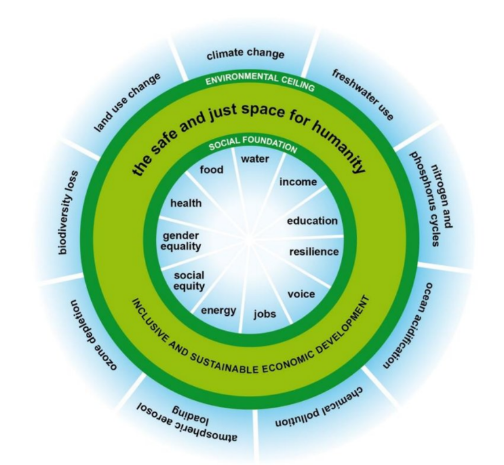
The model is powerful because it integrates justice and sustainability. But there is a growing imbalance in how it is being operationalized. Many institutions rigorously measure and enforce ecological ceilings, carbon budgets, biodiversity thresholds, and emissions trajectories, while treating the social foundation with far less precision and accountability.
In Africa, the social foundation is already fragile.
Youth unemployment remains high. In Kenya alone, according to the Federation of Kenya Employers, youth unemployment among 15 to 34-year-olds is 67%. Informal labour dominates urban economies. Energy access gaps persist. Climate shocks repeatedly push vulnerable households into deeper poverty.
In such contexts, enforcing ecological ceilings without simultaneously strengthening land rights systems, benefit-sharing mechanisms, community governance structures, and youth employment pathways risks reproducing historical exclusion under a climate banner.
Read also: Why Green Islamic Finance fits Africa’s climate and infrastructure needs
If conservation limits land access without secure tenure reforms, communities lose livelihoods. If fossil fuel transitions occur without industrial policy, countries lose revenue without gaining resilience. If renewable energy expands without affordability frameworks, it becomes a middle-class privilege rather than a public good.
This is not an argument against environmental ambition. It is an argument against environmental reductionism.
Climate change, biodiversity loss, and environmental degradation always affect vulnerable communities first. It intensifies social inequality. When drought hits, it is pastoralists who lose livestock. When floods come, it is informal settlements that wash away. When ecosystems collapse, it is smallholder farmers and informal workers who absorb the shock.

Too often in sustainability discourse, especially regarding Africa, the conversational microscope is fixed almost exclusively on the environment. The urgency of ecological ceilings dominates headlines, funding flows, and institutional frameworks.
Sustainability rests on three pillars: social, environmental, and economic. The idea that one pillar, particularly the environmental, is inherently more important than the others is not only misguided, but it is also dangerous.
When environmental protection is elevated above social justice and economic inclusion, we drift toward what scholars describe as eco-authoritarianism: the belief that strong, even coercive governance is justified to enforce environmental protection.
Eco-authoritarianism is rarely declared openly in policy language. But it reveals itself in action. It appears when conservation displaces communities without fair compensation. For example, the Ogiek People of Kenya’s Mau Forest. It appears when climate targets are enforced without job transition pathways. It appears when global mitigation demands are placed on countries that have not yet secured basic social foundations for their citizens.
This is where Kate Raworth’s concept of Doughnut Economics offers clarity.
There is a real and growing imbalance in sustainability governance. Ecological metrics are becoming more sophisticated, more enforceable, and more institutionalized than social equity metrics.
Africa cannot afford that imbalance.
The continent contributes minimally to global emissions yet faces disproportionate climate vulnerability. Policymakers must therefore resist frameworks that prioritize ecological compliance over social stability. A just transition in Africa must be distributive and regenerative, not extractive and technocratic.
Read also: Historic Argungu Fishing Festival 2026 revives 92-year peace tradition in Northern Nigeria
Strengthening land rights systems ensures that climate projects do not dispossess communities. Designing benefit-sharing mechanisms ensures that green investments build local wealth. Investing in community governance ensures that adaptation strategies are participatory rather than imposed. Creating youth employment pathways ensures that sustainability becomes an opportunity rather than a restriction.
If the doughnut is to mean anything in Africa, it must protect both rings equally.
Engage with us on LinkedIn: Africa Sustainability Matters