


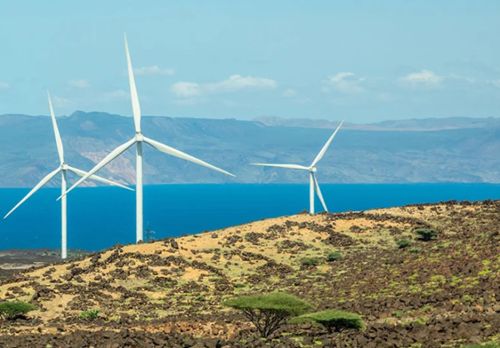
Ethiopia has moved closer to developing its first utility-scale wind farm financed and operated by an independent power producer after the African Development Bank (AfDB) approved up to US$110 million in financing for the 300-megawatt Aysha Wind Farm. The financing, approved by the Bank’s Board of Directors on 15 July, represents a major milestone for Ethiopia’s electricity sector and reinforces efforts to diversify one of Africa’s largest renewable energy systems beyond its heavy dependence on hydropower.
The project, located in Ethiopia’s Somali Regional State and being developed by AMEA Power, is expected to mobilise substantial private investment while contributing to Ethiopia’s broader ambition of expanding reliable, climate-resilient electricity generation. The African Development Bank also intends to mobilise an additional US$381.1 million from development finance institutions and private investors, bringing the total estimated project investment to approximately US$508 million.
Once completed, the Aysha Wind Farm will generate an estimated 1,189 gigawatt-hours (GWh) of electricity annually, enough to strengthen power supply across Ethiopia while reducing the country’s growing exposure to climate-related risks affecting hydropower generation. The financing package demonstrates the increasing role of blended finance in unlocking renewable energy investment across Africa. According to the African Development Bank, the approved financing consists of an US$80 million senior loan from the Bank, US$20 million from the Clean Technology Fund (CTF) and US$10 million from the Sustainable Energy Fund for Africa (SEFA). The blended financing structure has been designed to improve the project’s bankability and attract additional commercial lenders and institutional investors.
Developed under Ethiopia’s Independent Power Producer (IPP) framework, the project will include the construction of a five-kilometre transmission line and upgrades to the existing Aysha II substation. Electricity generated by the facility will be supplied to the state-owned utility Ethiopian Electric Power (EEP) under a 25-year Power Purchase Agreement (PPA), providing long-term revenue certainty for investors while supporting Ethiopia’s national electricity expansion plans. Commenting on the approval, Wale Shonibare, Director of Energy Financial Solutions, Policy and Regulation at the African Development Bank, said the project demonstrates how collaboration between governments, financiers and private developers can overcome investment barriers.
“Aysha shows what is possible when governments, development partners and private sponsors work together to solve bankability challenges head-on,” he said.
The approval follows several months of negotiations involving the African Development Bank, the International Finance Corporation (IFC), Ethiopian authorities and AMEA Power, which announced earlier this year that financing discussions were nearing completion. Beyond expanding electricity generation, the project addresses one of the most significant structural challenges facing Ethiopia’s energy sector: overreliance on hydropower. According to the International Energy Agency (IEA), Ethiopia possesses one of Africa’s largest renewable energy resources, with significant potential across hydropower, wind, solar and geothermal energy. However, the country’s electricity generation remains overwhelmingly dependent on hydropower, which accounts for approximately 90% of installed electricity capacity.
This reliance has supported Ethiopia’s ambition to become one of Africa’s leading exporters of clean electricity, but it has also increased vulnerability to changing rainfall patterns and prolonged droughts associated with climate change. The commissioning of the Grand Ethiopian Renaissance Dam (GERD), with installed capacity exceeding 5 gigawatts, has significantly expanded Ethiopia’s electricity generation capability. However, according to the World Bank, increasing climate variability across the Horn of Africa is making diversification of electricity sources increasingly important for maintaining long-term energy security. Wind energy offers an important complement to hydropower because seasonal wind patterns often differ from rainfall cycles, enabling electricity generation during periods when hydropower production may decline.
According to the International Renewable Energy Agency (IRENA), integrating wind and solar generation alongside hydropower improves overall power system resilience while reducing exposure to climate-induced generation fluctuations. The Aysha project therefore represents more than an additional source of electricity. It strengthens Ethiopia’s long-term strategy of developing a diversified renewable energy portfolio capable of supporting industrialisation, urbanisation and regional electricity exports. Electricity demand across Ethiopia continues to grow rapidly. According to the World Bank, Ethiopia remains one of Africa’s fastest-growing economies despite recent economic and political challenges. Expanding access to reliable electricity is considered central to achieving the country’s industrial development ambitions under its long-term economic transformation strategy.
Although electricity access has improved considerably during the past decade, millions of Ethiopians still lack reliable power, particularly in rural areas. The International Energy Agency estimates that Sub-Saharan Africa continues to account for the majority of the world’s population without access to electricity, highlighting the importance of sustained investment in renewable generation and transmission infrastructure. The Aysha project also illustrates how Africa’s renewable energy transition is increasingly being driven by partnerships between governments, multilateral development banks and private investors. According to the African Development Bank’s New Deal on Energy for Africa, achieving universal electricity access across the continent will require annual investments exceeding US$25 billion, significantly above current financing levels. Blended finance mechanisms—combining concessional capital with commercial investment are becoming increasingly important for reducing investment risks associated with large infrastructure projects in emerging markets.
The involvement of the Clean Technology Fund and the Sustainable Energy Fund for Africa reflects this broader financing trend. Both facilities were established to catalyse private investment in clean energy projects that might otherwise struggle to reach financial close because of perceived political, regulatory or market risks. According to Climate Policy Initiative, concessional finance continues to play a critical role in mobilising private capital for renewable energy across Africa, particularly in frontier markets where commercial financing remains limited.
For AMEA Power, the Aysha project further strengthens its growing renewable energy portfolio across Africa. The Dubai-based independent power producer has expanded investments in solar and wind projects across Egypt, South Africa, Côte d’Ivoire, Togo, Burkina Faso and other African markets, reflecting increasing investor confidence in the continent’s renewable energy sector. For Ethiopia, successful delivery of the project could strengthen confidence in its Independent Power Producer framework and encourage additional private investment across renewable energy technologies, including solar, wind and geothermal power.
The broader implications extend beyond Ethiopia. According to the African Development Bank, Africa possesses some of the world’s richest renewable energy resources yet accounts for only a small share of global renewable electricity investment. Unlocking greater private participation will therefore be essential if African countries are to meet rapidly growing electricity demand while advancing climate commitments and industrial development objectives.
The Aysha Wind Farm illustrates how renewable energy diversification is becoming an increasingly important component of climate adaptation as well as economic policy.
As climate change intensifies rainfall variability across East Africa, electricity systems heavily dependent on hydropower face increasing operational uncertainty. Expanding wind, solar and geothermal generation enables countries to reduce those risks while strengthening energy security and supporting sustainable economic growth.
For Africa, projects such as Aysha demonstrate the evolving role of development finance institutions in mobilising investment for infrastructure that simultaneously supports climate resilience, industrial competitiveness and universal energy access. If successfully implemented, the project could provide a model for future renewable energy partnerships across the continent, illustrating how blended finance, institutional reforms and private sector participation can accelerate Africa’s transition towards more diversified, reliable and sustainable electricity systems.


