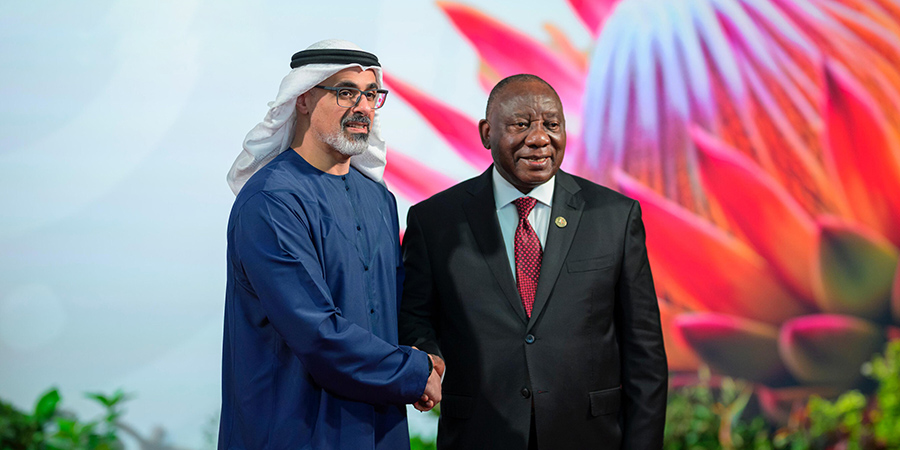
The United Arab Emirates recently pledged $1 billion to build and expand artificial intelligence infrastructure across Africa, a commitment announced by Abu Dhabi Crown Prince Sheikh Khaled bin Mohamed at the G20 Summit in Johannesburg on November 22.
The investment aims to deliver compute power, technical training and cross-border research partnerships to governments and businesses across the continent, addressing a critical shortage of AI-ready infrastructure that has slowed growth in key industries.
The announcement arrived at the first G20 Summit ever held on African soil, aligning the who, what, when, where and why in a single gesture. The UAE, now ranked among the world’s most advanced AI nations, wants to help Africa build its own technical backbone.
Read also: Inside G20 Declaration: Landmark commitments on Africa’s energy, debt, and climate agenda
The summit’s venue, the Johannesburg Expo Centre, was symbolic: a gathering of the world’s largest economies in a region where the absence of data centers, stable electricity, and affordable connectivity has long limited digital progress. Behind the stagecraft was a simple fact. Africa’s AI capacity is constrained not by ideas or demand but by the scarcity of the hardware and energy required to run modern systems. The UAE chose this moment, and this place, to say it intends to change that.
Inside the agreement, the $1 billion commitment is not a single cheque but a framework for long-term digital infrastructure development. Officials familiar with the negotiation describe a blended approach: new data centers in countries that can support them, dedicated compute access for public institutions, training programmes for engineers, and partnerships intended to draw African researchers into global AI collaborations.
The model closely mirrors the UAE’s domestic strategy, where state-backed companies built vast campuses that power everything from medical research to financial analytics. By extending that model outward, the UAE is replicating a system it already knows how to scale.

To understand the significance of this for Africa, one must start with what currently exists. Across all 54 countries, the continent hosts less than one percent of global data center capacity. The imbalance is stark when compared to Africa’s population of more than 1.4 billion people and its rapidly expanding digital economy.
In Nigeria, a start-up developing a local-language translation model must typically rent compute from servers based in Europe because domestic capacity remains inadequate.
In Kenya, a health-tech platform that provides remote diagnostics faces delays because latency to overseas clouds can slow down image processing.
In Ghana and Malawi, agriculture analytics teams often run their simulations in foreign facilities because domestic energy and bandwidth costs make local computation impractical. The UAE agreement attempts to tackle these real operational constraints at their source.
Read also: G20 and African states adopt joint communiqué on economic growth and job creation
Electricity remains another binding limitation. Around 600 million Africans still live without reliable access to power, a figure that fundamentally shapes where the UAE’s investment can be deployed first. Data centers consume large amounts of electricity and require predictable supply.
Countries like South Africa, Kenya and Rwanda, despite their challenges; offer comparatively stable grids and regulatory environments, making them early contenders for infrastructure placement.
Nigeria’s enormous market makes it an inevitable priority, but persistent grid instability means any deployment there will depend on hybrid power solutions or independent generation. These are the sorts of engineering decisions buried inside the agreement that will determine who benefits earliest and most extensively.

What the UAE brings to this field is volume. Its domestic infrastructure includes tens of thousands of high-performance computing units and data capacity that, according to independent assessments, is second only to the United States.
The country’s partnerships with Western technology firms have helped it build a supply chain for advanced chips at a time when such components are scarce globally. By tying Africa into this network, the UAE is effectively offering bandwidth, hardware and engineering capability that African governments would struggle to secure at similar cost. It is an economic proposition as much as a technological one.
The development implications stretch across several sectors. In healthcare, AI-assisted diagnostics can reduce the long travel times patients face to reach specialist care. Sub-Saharan Africa averages just over two physicians per 10,000 people, far below global norms. With local compute, scans, pathology slides and clinical data can be analyzed in seconds rather than uploaded to servers thousands of kilometers away.
In education, AI tutoring tools can help address the continent’s massive teacher shortage, UNESCO estimates that Africa will need 17 million new teachers to achieve universal schooling. These tools only work effectively when they can process student data quickly and securely, conditions that are difficult to guarantee when servers are offshore.
In agriculture, predictive analytics that guide planting decisions or detect pests early will become more reliable once the systems generating those insights run within the continent rather than abroad.
There is also a geopolitical layer tied to the global competition for AI supremacy. Africa holds some of the world’s richest reserves of cobalt, manganese and platinum-group metals, all essential for advanced electronics and data center hardware. The UAE’s investment positions it as a preferred partner in a region where China and the United States have long been vying for influence.
Unlike many Western or Chinese offerings, the UAE frames its initiative as a South–South partnership, emphasizing mutual economic benefit rather than aid.
For sustainability specialists, the investment reflects a deeper shift in development finance. The infrastructure enabling digital economies is no longer an optional add-on but a foundational piece of national planning, much like roads, ports or power grids. AI infrastructure intertwines with energy policy, mineral governance, environmental resilience and workforce development.
The UAE’s bet acknowledges that the countries shaping AI will also shape the next phase of global economic growth. Africa, with its young population and resource base, sits at a strategic crossroads. Without compute capacity, its digital ambitions remain constrained. With it, the continent becomes a significant player in the global AI economy rather than a peripheral consumer.
Engage with us on LinkedIn: Africa Sustainability Matters