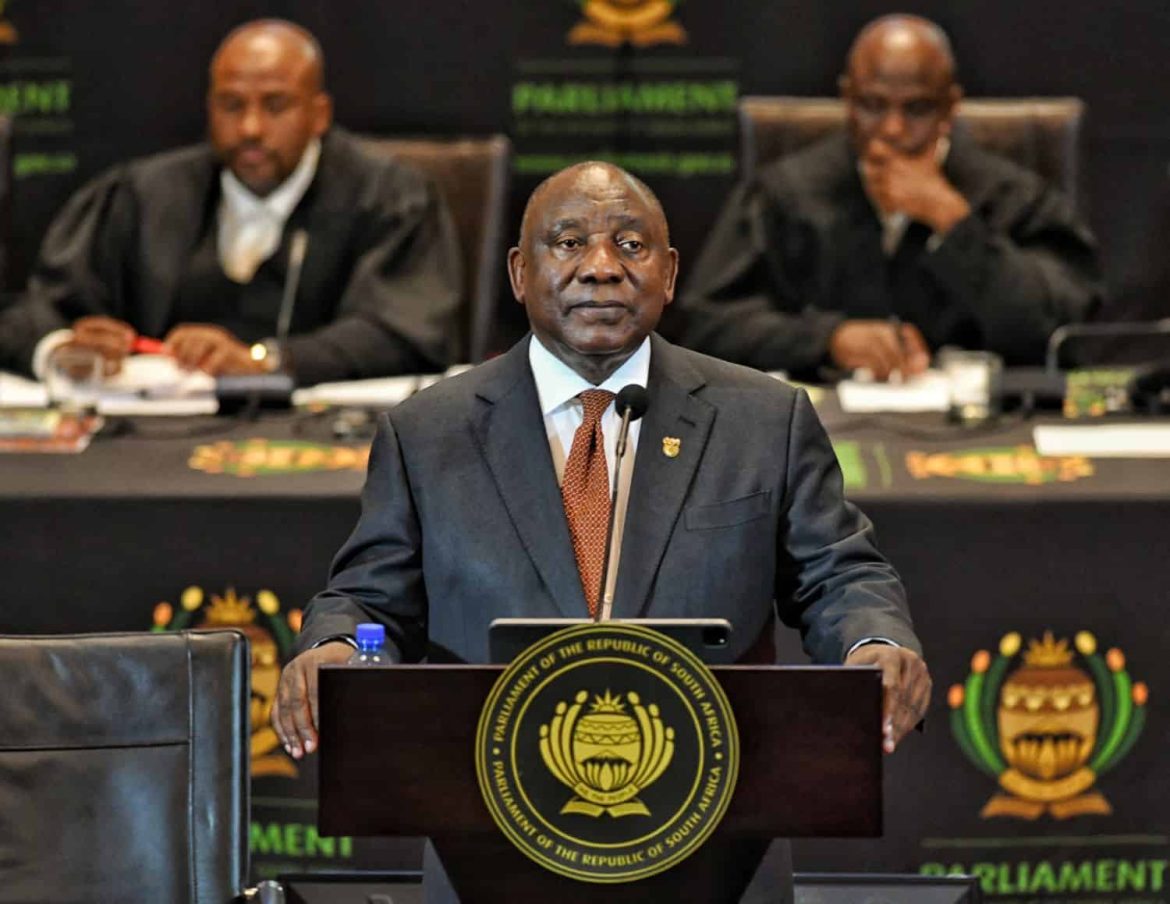
South Africa’s business leadership has urged President Cyril Ramaphosa to use this year’s State of the Nation Address to frame water insecurity, energy instability and climate risk as core economic priorities, arguing that the country’s growth trajectory now hinges on how decisively it manages what they describe as a systemic “triple threat” to national stability.
In a statement issued in Cape Town on 10 February, the National Business Initiative (NBI) said the convergence of water shortages, unreliable electricity supply and escalating climate shocks is no longer an environmental concern at the margins of policy, but a structural constraint on productivity, fiscal space and investor confidence . The intervention comes ahead of the State of the Nation Address and the forthcoming Africa’s Green Economy Summit, where government and international investors are expected to assess South Africa’s reform momentum.
NBI chief executive Shameela Soobramoney argued that supply-side disruptions linked to drought, infrastructure decay and power outages are already feeding through into higher operating costs, disrupted supply chains and reduced output. According to the organisation, climate-related disasters are also generating mounting fiscal shocks, increasing pressure on public finances already constrained by debt-servicing costs.
Read also; Africa’s Green Economy Summit returns with $5bn investment pipeline and expanded project showcase
South Africa’s recent experience underscores that linkage. Prolonged load-shedding has cut industrial output and weakened GDP growth, while deteriorating municipal water systems have affected manufacturing, mining and agriculture in several provinces.
Floods in KwaZulu-Natal in 2022 and 2023 required billions of rand in reconstruction spending, diverting resources from other priorities. In this context, the NBI argues that the perceived trade-off between environmental sustainability and economic growth is misplaced.
Instead, the group is calling for what it terms a national “delivery compact” between government and business, focused on measurable improvements in water security and electricity reliability, supported by transparent data and clear accountability lines . The proposal draws on previous business-government cooperation, including support for reforms under Operation Vulindlela, which targeted structural bottlenecks in energy, logistics and telecommunications.
The intervention also comes at a sensitive juncture in South Africa’s energy transition. The country remains heavily reliant on coal for electricity generation, even as it has committed to decarbonisation under its climate pledges and secured international financing through the Just Energy Transition framework.
The NBI emphasised that expanding renewable energy capacity must proceed rapidly, but without undermining near-term energy reliability. Managing existing generation assets, including fossil-fuel plants, remains necessary to stabilise the grid while new infrastructure is built .
For African economies more broadly, the South African debate reflects a wider tension. Many countries face parallel infrastructure deficits and climate exposure, yet must also attract capital in an increasingly competitive global market for green investment. According to development finance institutions, investor appetite depends not only on resource potential, but on policy certainty, regulatory clarity and execution capability.
The NBI identified specific signals it believes would unlock greater private investment: finalising an independent national transmission company, accelerating the development of a competitive electricity market, and clarifying renewable energy generation targets . It also pointed to opportunities to leverage South Africa’s mineral endowment and industrial base to build local manufacturing capacity for electric vehicles and related components, linking decarbonisation to export competitiveness and employment.
Those choices carry fiscal and governance implications. Establishing an independent transmission entity requires regulatory reform and balance-sheet restructuring, while expanding grid infrastructure demands significant capital outlay. At the same time, failure to address infrastructure fragility risks deeper economic erosion, including declining municipal revenues, higher borrowing costs and social instability linked to service delivery failures .
As delegates gather for Africa’s Green Economy Summit, South Africa’s position will be closely watched by investors assessing the bankability of projects across the continent. The NBI’s message is that credibility now depends less on new strategies than on coordinated implementation.