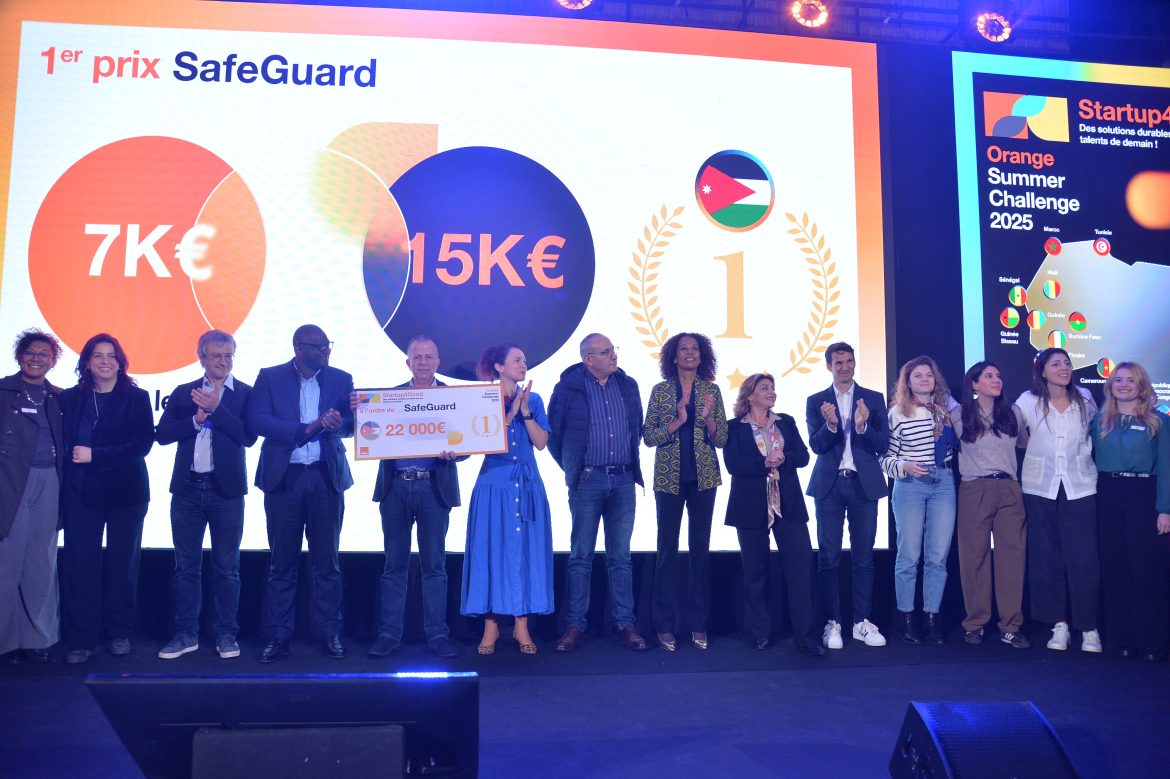
Orange Middle East and Africa awarded three start-ups from Jordan, Madagascar and Tunisia at the Orange Summer Challenge 2025 ceremony held in Casablanca on February 4, 2026, marking the culmination of a three-month innovation programme that supported 369 young entrepreneurs across 14 countries.
The winners will share €50,000 in grant funding alongside technical and business support through the Orange Digital Centers network, as the telecoms group deepens its push into impact-driven digital entrepreneurship across Africa and the Middle East.
The annual competition, now in its 16th year, is designed to help early-stage founders convert technology concepts into commercially viable solutions addressing social and environmental challenges. For the 2025 edition, participants developed 56 start-up projects under the “Startup4Good” theme, focusing on sectors including agriculture, health, education and environmental management.
According to Orange Middle East and Africa, the programme combined mentoring, coaching and access to technical infrastructure, with support from partners including Amazon Web Services, Meta, the United Nations Development Programme, The Hashgraph Association and Dar Blockchain.
The first prize was awarded to SafeGuard, a Jordanian start-up that has developed a smart device aimed at preventing workplace accidents through automated risk detection. In many African and Middle Eastern economies, occupational safety enforcement remains uneven, particularly in construction and manufacturing. Technology-enabled monitoring tools could help firms reduce injuries, insurance costs and productivity losses, although widespread adoption will depend on affordability and regulatory alignment.
Second prize went to GasNika from Madagascar, which converts organic waste into biogas while producing fertiliser as a by-product. Waste management and energy access remain structural challenges across sub-Saharan Africa, where urbanisation is accelerating and landfill capacity is limited.
According to the World Bank, African cities generate more than 125 million tonnes of municipal solid waste annually, a figure expected to rise sharply. Small-scale biogas solutions offer municipalities and farming communities a way to address both energy shortages and soil degradation, though scaling such models typically requires blended finance and stable policy frameworks.
DripIn, a Tunisian start-up, secured third prize for its artificial intelligence-enabled system designed to detect water leaks and optimise consumption through connected devices. Water losses from aging infrastructure can exceed 30% in some African cities, straining already limited supply systems and municipal budgets. Digital leak detection technologies are increasingly viewed as cost-effective tools for utilities seeking to reduce non-revenue water and improve service reliability without large-scale capital expenditure.
Read also: Afreximbank selects eight startups for inaugural accelerator programme to boost intra-african trade
Orange’s Digital Centers operate in 18 countries across Africa and the Middle East and form part of the group’s broader digital transformation strategy. The region accounted for €7.7 billion in revenue in 2024, making it the company’s primary growth market. Beyond telecommunications, Orange has expanded into mobile financial services, with its Orange Money platform serving more than 100 million customers in 17 countries as of end-2024.
For African economies, the significance of such programmes lies less in prize funding than in ecosystem development. Early-stage innovators often face constraints in access to capital, mentorship and market linkages. Corporate-backed accelerators can partially bridge that gap, although long-term impact depends on whether supported ventures secure follow-on investment and integrate into mainstream supply chains.
As governments across the continent seek to stimulate employment and diversify economies beyond commodities, technology entrepreneurship is increasingly positioned as a driver of productivity and resilience. The Orange Summer Challenge illustrates how large telecom operators are leveraging their infrastructure and regional footprint to nurture start-ups aligned with environmental and social priorities.
The durability of these gains, however, will depend on the ability of emerging firms to move from pilot phase to scalable business models within Africa’s complex regulatory and financing landscape.