


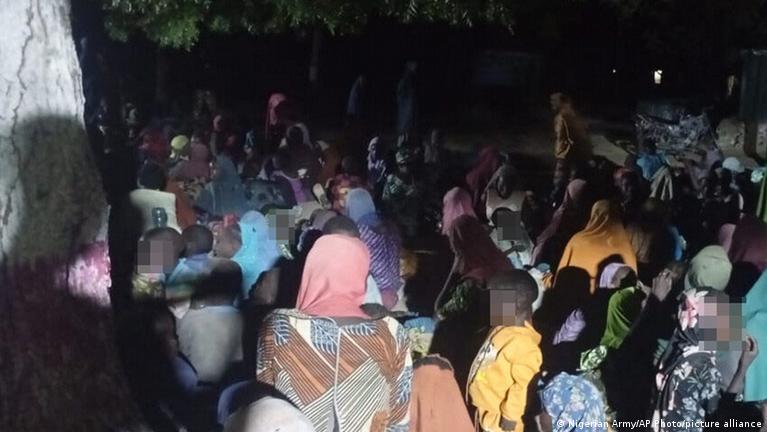
Nigeria’s military has rescued 360 people abducted by Boko Haram during an operation in the Mandara Mountains of Borno State, authorities announced this week, marking one of the largest hostage recovery missions in recent months as the country continues to confront a prolonged insurgency that has disrupted lives, economies and development across the Lake Chad Basin region.
According to military officials, the operation was conducted in Southern Borno, a region that remains a strategic stronghold for Boko Haram and other armed extremist groups operating across Northeastern Nigeria. Army spokesperson Haruna Sani said the rescued individuals were recovered during a military offensive targeting insurgent position in the mountainous terrain bordering neighbouring countries. While most of the abductees were safely evacuated, two infants reportedly died from exhaustion during the rescue due to the difficult conditions and prolonged captivity endured by those held by the militants.
The rescued civilians have since been transferred to secure locations where they are receiving medical treatment and humanitarian assistance. Military authorities described the operation as a significant tactical achievement that disrupted insurgent activities and weakened Boko Haram’s operational capacity in one of its traditional areas of influence.
 The rescue comes as Nigeria continues to grapple with one of Africa’s most complex security challenges. More than a decade of insurgency, armed banditry and kidnapping-for-ransom operations have created persistent instability across large parts of northern Nigeria. The conflict, initially concentrated in Borno State, has expanded over time to affect neighbouring states and countries across the wider Lake Chad region.
Boko Haram and its splinter faction, the Islamic State West Africa Province (ISWAP), remain among the most active extremist groups operating in the region. Although Nigerian security forces have recorded several tactical successes in recent years, including joint operations with international partners, insurgent groups continue to demonstrate an ability to regroup, recruit and launch attacks against civilian and military targets.
Last month, Nigerian authorities reported that a joint operation involving Nigerian and United States security cooperation resulted in the deaths of 175 ISWAP fighters. While such operations have disrupted militant networks, analysts note that security gains remain uneven across a vast and difficult operating environment characterised by porous borders, limited infrastructure and longstanding socio-economic vulnerabilities.
The broader implications of insecurity extend well beyond immediate humanitarian concerns. Northern Nigeria represents a critical agricultural and commercial region whose stability is closely linked to national economic performance. Persistent violence has displaced millions of people, disrupted farming activities, weakened local markets and increased pressure on government resources allocated to security and emergency response.
According to development economists, insecurity imposes significant fiscal costs on governments through increased defence spending, humanitarian support and reconstruction efforts. Resources directed toward conflict management often compete with funding needs for healthcare, education, energy infrastructure and climate resilience programmes. In countries facing tight fiscal conditions, prolonged conflict can constrain development planning and slow progress toward broader economic transformation goals.
The humanitarian consequences are equally significant. Communities affected by insurgency frequently experience disruptions to education, healthcare delivery and basic public services. Children and young people are particularly vulnerable to the long-term effects of displacement and interrupted schooling, factors that can undermine workforce development and future productivity.
The security situation in Northeastern Nigeria also has regional implications. The Lake Chad Basin connects Nigeria with Chad, Cameroon and Niger, making cross-border cooperation essential for addressing insurgent activity. Armed groups operating in the region have exploited weak border controls and fragile local economies, creating challenges that no single country can resolve independently.
For investors and development partners, security remains a critical consideration in assessing economic opportunities across affected regions. While Nigeria continues to attract investment in sectors such as technology, financial services and energy, insecurity in parts of the north contributes to higher operating costs, increased risk premiums and delayed infrastructure projects. Stability is increasingly viewed not only as a security objective but also as a prerequisite for sustainable economic growth and long-term development.
The latest rescue operation demonstrates the continued capacity of Nigerian security forces to conduct large-scale interventions against armed groups. However, the persistence of abductions and insurgent activity highlights the difficulty of translating tactical military successes into lasting security gains. Analysts argue that long-term stability will likely require a combination of military pressure, economic development, institutional strengthening and community-based interventions aimed at addressing the root causes of conflict.
 For Africa, Nigeria’s experience underscores the close relationship between security, governance and economic resilience. As governments across the continent seek to attract investment, expand infrastructure and accelerate development, the ability to protect communities and maintain institutional stability remains fundamental to achieving those objectives.
The rescue of 360 captives offers a measure of relief for affected families and communities. Yet the broader challenge facing Nigeria remains the creation of conditions in which economic opportunity, public services and social stability can flourish without the persistent threat of violence. How effectively that challenge is addressed will shape not only Nigeria’s development trajectory but also the stability and prosperity of a region that plays a pivotal role in Africa’s future.


