


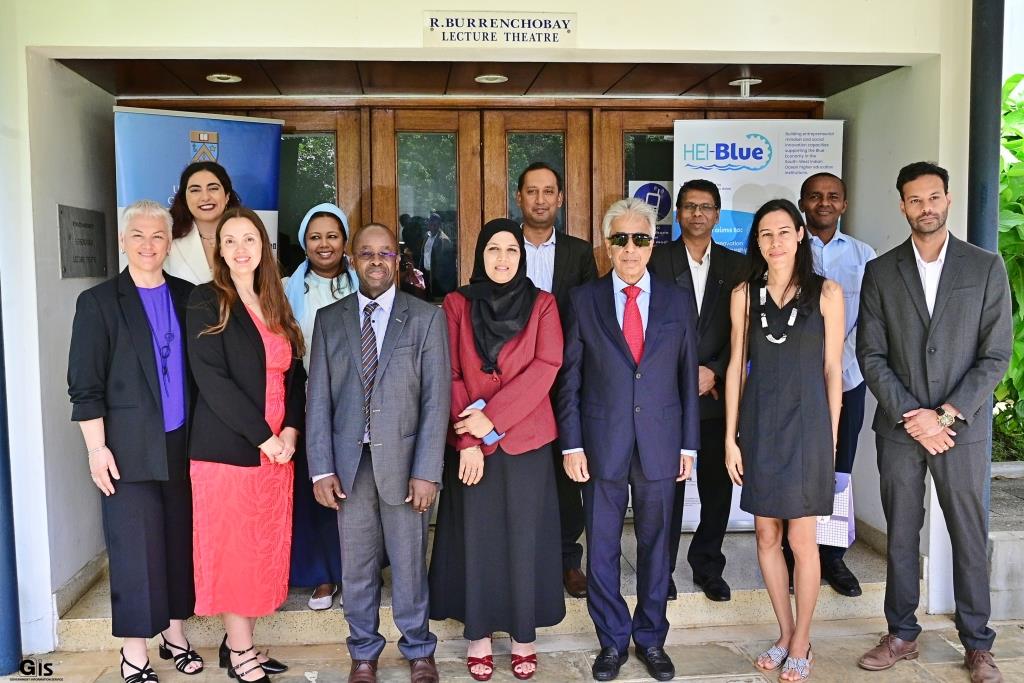
Mauritius has launched the HEI-Blue Bootcamp, a regional innovation programme aimed at advancing sustainable blue economy solutions through higher education partnerships, entrepreneurship and cross-border collaboration, as governments and institutions across the Indian Ocean seek new pathways for economic growth while safeguarding marine ecosystems.
The five-day programme, which commenced in Réduit on 20 April 2026, brings together 28 students from universities in Mauritius, Madagascar, Comoros, Seychelles, Spain and Portugal. Organisers say the initiative is designed to transform academic research and entrepreneurial ideas into practical solutions addressing challenges in marine resource management, sustainable fisheries, coastal resilience and ocean-based economic development.
 The launch reflects a growing recognition among African coastal and island states that the blue economy is becoming an increasingly important pillar of economic diversification, climate adaptation and sustainable development. For Mauritius, whose Exclusive Economic Zone (EEZ) is significantly larger than its land territory, the ocean represents both a strategic economic asset and a critical environmental resource requiring long-term stewardship.
Speaking at the launch, Mauritius’ Minister of Agro-Industry, Food Security, Blue Economy and Fisheries, Dr. Arvin Boolell, described the programme as part of the country’s broader ambition to position itself as a “Big Ocean State.” The concept reflects Mauritius’ efforts to leverage its maritime resources through innovation, research and sustainable investment while balancing economic opportunities with environmental protection.
The initiative comes at a time when African countries are increasingly exploring blue economy strategies as traditional growth sectors face mounting pressures from climate change, resource constraints and global economic uncertainty. According to development institutions, Africa’s oceans, seas, lakes and coastal ecosystems support millions of livelihoods through fisheries, tourism, maritime transport and emerging sectors such as aquaculture and marine biotechnology. However, these resources are also under growing pressure from overfishing, pollution, habitat degradation and rising ocean temperatures.
By placing universities and young entrepreneurs at the centre of the programme, the HEI-Blue Bootcamp seeks to address one of the key challenges facing the blue economy transition: the need for specialised skills, innovation capacity and commercially viable solutions. Participants are expected to work on projects that combine scientific knowledge with entrepreneurial approaches capable of addressing real-world environmental and economic challenges.
The programme forms part of a wider Erasmus+ capacity-building initiative supported by European partners. Representatives from the European Union highlighted the importance of strengthening collaboration between higher education institutions, governments and private-sector actors to equip young people with the skills needed to participate in emerging blue economy industries. Such partnerships are increasingly viewed as essential for transferring knowledge, fostering innovation and creating opportunities for sustainable enterprise development.
For Small Island Developing States across Africa and the Indian Ocean, the programme carries particular significance. Countries such as Mauritius, Seychelles and Comoros face disproportionate exposure to climate-related risks, including coastal erosion, sea-level rise, changing fish migration patterns and extreme weather events. These challenges have direct implications for food security, public finances, infrastructure and employment, particularly in communities dependent on marine resources.
Efforts to strengthen innovation within the blue economy are therefore increasingly linked to climate resilience and economic security. Investments in sustainable fisheries management, marine conservation, ocean research and climate-resilient coastal infrastructure are being viewed not only as environmental priorities but also as economic necessities. Programmes that encourage young innovators to develop solutions in these areas may help strengthen regional capacity to respond to future environmental and economic shocks.
Mauritius has also signalled its intention to strengthen institutional support for the sector. Among the initiatives highlighted during the bootcamp launch are plans to establish a dedicated Faculty of Business and Blue Economy, aimed at bridging the gap between academic research and industry needs. Such investments reflect a broader trend across Africa where governments are seeking to align education systems more closely with emerging economic opportunities linked to sustainability and environmental management.
The initiative aligns closely with the African Union’s Agenda 2063, which identifies the blue economy as a strategic driver of sustainable growth, regional integration and job creation. The continental framework emphasises the importance of harnessing marine and coastal resources in ways that generate economic value while protecting ecosystems that support long-term development.
The HEI-Blue Bootcamp also illustrates how regional cooperation is becoming increasingly important in addressing shared environmental challenges. Marine ecosystems and fisheries resources frequently transcend national boundaries, requiring collaborative approaches to management, research and innovation. By bringing together participants from multiple countries, the programme seeks to foster networks and partnerships that could contribute to more coordinated responses to regional sustainability challenges.
 As Africa’s coastal economies continue to expand and climate pressures intensify, the ability to develop innovative, science-based and commercially viable solutions will become increasingly important. The HEI-Blue Bootcamp represents an effort to cultivate that capacity by positioning young entrepreneurs, researchers and future business leaders at the centre of the blue economy transition.
For Mauritius, the programme reinforces its ambition to serve as a regional hub for ocean innovation and sustainable maritime development. More broadly, it reflects a growing understanding across Africa that the future of economic resilience in many coastal and island states will depend not only on access to marine resources, but on the knowledge, institutions and innovation systems required to manage them sustainably.


