


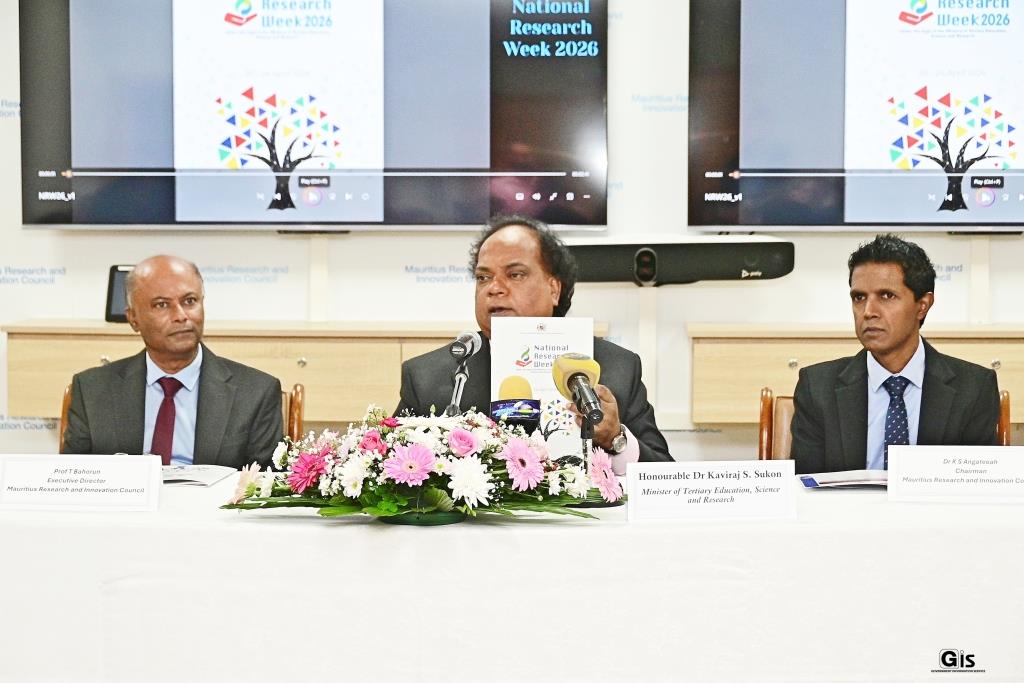
Mauritius is positioning research and innovation at the centre of its economic transformation strategy as preparations gather pace for National Research Week 2026, a flagship initiative designed to strengthen collaboration between academia, industry, government and civil society while accelerating the translation of scientific knowledge into practical development outcomes.
The event, scheduled to take place from 20 to 24 April 2026, was officially launched in Ebène by Mauritius’ Minister of Tertiary Education, Science and Research, Dr Kaviraj Sharma Sukon, alongside representatives of the Mauritius Research and Innovation Council (MRIC). Organisers say the programme will serve as a national platform to connect researchers, entrepreneurs, policymakers and international partners around the theme “Research for Innovation, Society and Sustainability,” reflecting Mauritius’ broader ambition to build a knowledge-based economy capable of competing in an increasingly technology-driven global environment.
 The initiative comes as countries across Africa seek to strengthen domestic innovation ecosystems, improve research commercialisation and reduce dependence on imported technologies. While African nations collectively account for a growing share of the world’s young population, investment in research and development remains significantly below global averages. Policymakers increasingly view stronger links between universities and industry as essential for boosting productivity, supporting industrial diversification and creating higher-value employment opportunities.
Speaking during the launch, Dr Sukon highlighted the importance of transforming research from an academic exercise into a practical driver of economic growth. According to the minister, stronger partnerships between higher education institutions and private sector actors can help convert scientific discoveries into commercially viable products, services and technologies capable of addressing national development priorities while generating new business opportunities.
The 2026 edition of National Research Week marks an expansion of participation to include both public and private higher education institutions. According to the Ministry of Tertiary Education, Science and Research, this broader approach is intended to create a more integrated research ecosystem that encourages knowledge sharing and interdisciplinary collaboration across sectors.
The Mauritius Research and Innovation Council, which is coordinating the programme, has positioned the event as a strategic mechanism for fostering dialogue between researchers and decision-makers while promoting innovation-led development. Throughout the week, thematic sessions hosted by leading academic institutions will explore areas including biotechnology, digital transformation, climate resilience, education, human development and emerging technologies.
Attention will be given to the challenge of commercialising research outputs, an issue that continues to affect many developing economies. The opening day of the programme will focus on industry-academia engagement under the theme “From Discovery to Deals: Turning Research Excellence into Economic Impact,” underscoring efforts to move research findings beyond laboratories and into markets where they can contribute to economic growth and competitiveness.
The emphasis on commercialisation reflects a broader global trend in which governments are seeking greater returns on public investment in research. According to international development agencies, stronger innovation ecosystems can play a critical role in supporting entrepreneurship, attracting investment and increasing economic resilience. For small island economies such as Mauritius, leveraging research and innovation is increasingly viewed as a pathway towards diversification and reduced vulnerability to external economic shocks.
The initiative also highlights the growing importance of international collaboration in research and development. Dr Sukon noted that attracting global researchers and strengthening partnerships with international institutions can expand access to funding, facilitate technology transfer and enhance the global visibility of Mauritian research. Such collaborations are becoming increasingly important as countries seek solutions to shared challenges including climate change, food security, public health and digital transformation.
For Africa more broadly, the programme reflects a growing recognition that scientific research and technological innovation are essential components of sustainable development. The continent faces complex challenges ranging from climate adaptation and urbanisation to energy access and industrialisation, many of which require locally developed solutions supported by strong research institutions and innovation networks.
The focus on sustainability within National Research Week is particularly significant as African governments seek to balance economic growth with environmental stewardship. Research in areas such as renewable energy, climate adaptation, sustainable agriculture and resource efficiency is increasingly shaping policy decisions and investment priorities across the continent. By creating opportunities for collaboration between researchers, businesses and policymakers, Mauritius aims to ensure that scientific knowledge contributes directly to practical development outcomes.
The initiative aligns closely with the aspirations of the African Union’s Agenda 2063, which identifies science, technology and innovation as critical enablers of economic transformation and continental competitiveness. Agenda 2063 calls for stronger investment in research institutions, greater collaboration between universities and industry, and increased participation in global knowledge networks as part of efforts to build resilient and inclusive economies.
 For Mauritius, National Research Week 2026 represents more than a scientific gathering. It signals a broader effort to position research and innovation as strategic assets capable of supporting sustainable economic growth, enhancing competitiveness and addressing societal challenges. The success of such initiatives will ultimately depend on the ability of institutions, businesses and policymakers to convert research excellence into tangible economic and social value.
As countries across Africa seek to strengthen their innovation ecosystems and accelerate knowledge-driven development, Mauritius’ approach offers an example of how targeted collaboration between academia, industry and government can help build a more resilient and sustainable economic future.


