


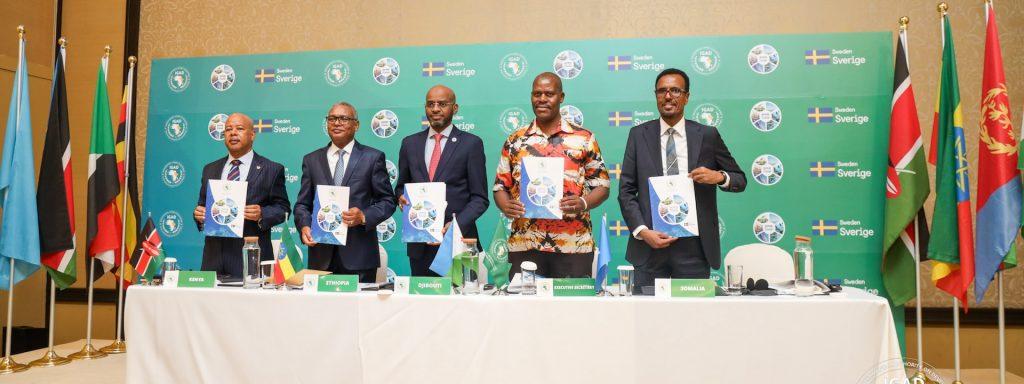
The Intergovernmental Authority on Development (IGAD) is seeking to accelerate implementation of its regional blue economy agenda as governments, development institutions, researchers, businesses and civil society organisations gather in Mombasa, Kenya, for the 11th Our Ocean Conference, marking the first time the global event has been hosted on the African continent. The conference has provided IGAD with a platform to advance regional cooperation on sustainable fisheries, marine conservation, aquatic food systems, climate resilience and coastal economic development, while strengthening partnerships aimed at unlocking the economic potential of marine and inland water resources across the Horn of Africa.
Led by Dr. Eshete Dejen, Head of the Sustainable Environment Protection Unit within IGAD’s Agriculture and Environment Division (AED), the regional delegation is using the conference to position the bloc’s blue economy strategy within broader discussions on sustainable ocean governance and economic transformation. The gathering in Mombasa comes at a time when African countries are increasingly recognising oceans, lakes and other aquatic ecosystems as strategic assets capable of supporting economic growth, food security, employment creation and climate adaptation.
 According to IGAD officials, the organisation’s participation reflects a shift from policy formulation towards implementation, with growing emphasis on translating regional frameworks into practical interventions. Areas of focus include sustainable fisheries management, marine spatial planning, aquatic biodiversity conservation, marine protected areas, plastic pollution prevention and the promotion of blue foods as part of regional food and nutrition security strategies.
The economic significance of the blue eeconomy continues to grow across Africa as governments seek to diversify growth drivers and strengthen resilience against climate and environmental shocks. Coastal and marine resources support millions of livelihoods through fisheries, tourism, maritime transport and related industries, while inland water bodies remain critical sources of food, income and ecosystem services for communities throughout Eastern Africa. However, these resources face mounting pressures from overexploitation, pollution, habitat degradation and climate change, increasing the need for coordinated governance and investment.
During the conference, IGAD held discussions with representatives from the Swedish Agency for Marine and Water Management (SwAM) and the Regional Environment Team at the Embassy of Sweden in Nairobi. The engagements focused on expanding collaboration in areas including marine spatial planning, marine protected area management, plastic pollution reduction and gender-responsive blue economy development. Such partnerships are becoming increasingly important as regional organisations seek technical expertise and financing support to strengthen institutional capacity and improve implementation outcomes.
The discussions also reflect a broader trend across Africa, where governments and regional economic communities are seeking to align environmental stewardship with economic development objectives. Marine spatial planning, for example, is increasingly viewed as a tool for reducing conflicts between competing ocean users while improving investment certainty in sectors such as fisheries, tourism, offshore energy and maritime infrastructure. Similarly, marine protected areas are being integrated into economic planning frameworks as governments recognise the long-term value of ecosystem preservation for sustaining fisheries and supporting tourism revenues.
IGAD’s participation in a side event organised by the African Union Commission’s Agriculture, Rural Development, Blue Economy and Sustainable Environment Department further underscored the growing continental focus on implementation. While many African countries have adopted Blue Economy strategies over the past decade, challenges remain in mobilising financing, strengthening governance systems and translating policy ambitions into measurable economic and environmental outcomes.
The regional bloc has sought to address these challenges through its Regional Blue Economy Strategy and Implementation Plan, endorsed by IGAD ministers in 2022. The framework provides a roadmap for strengthening governance, promoting sustainable resource use, enhancing investment coordination and expanding regional cooperation among member states. With financial support from Sweden, IGAD has also assisted member countries in developing national blue economy strategies aligned with regional priorities.
The emphasis on implementation carries broader implications for economic development across the Horn of Africa and Eastern Africa. Improved management of marine and aquatic resources has the potential to strengthen food systems, support export industries, create employment opportunities and enhance climate resilience in vulnerable coastal and inland communities. At the same time, stronger governance frameworks may help attract investment into sectors that have historically been underdeveloped despite significant resource potential.
 The conference in Mombasa also highlights Africa’s growing role in shaping global discussions on ocean governance. As coastal economies across the continent seek to expand sustainable use of marine resources, regional institutions such as IGAD are increasingly positioning themselves as coordinators of cross-border cooperation on environmental management, resource conservation and economic integration.
For Africa, the significance of the blue economy extends beyond environmental management. It represents an emerging development pathway capable of contributing to trade, food security, employment and regional stability. The ability of regional organisations and governments to convert policy commitments into effective implementation may therefore influence not only environmental outcomes but also the broader trajectory of economic growth and resilience across the continent in the coming decades.


