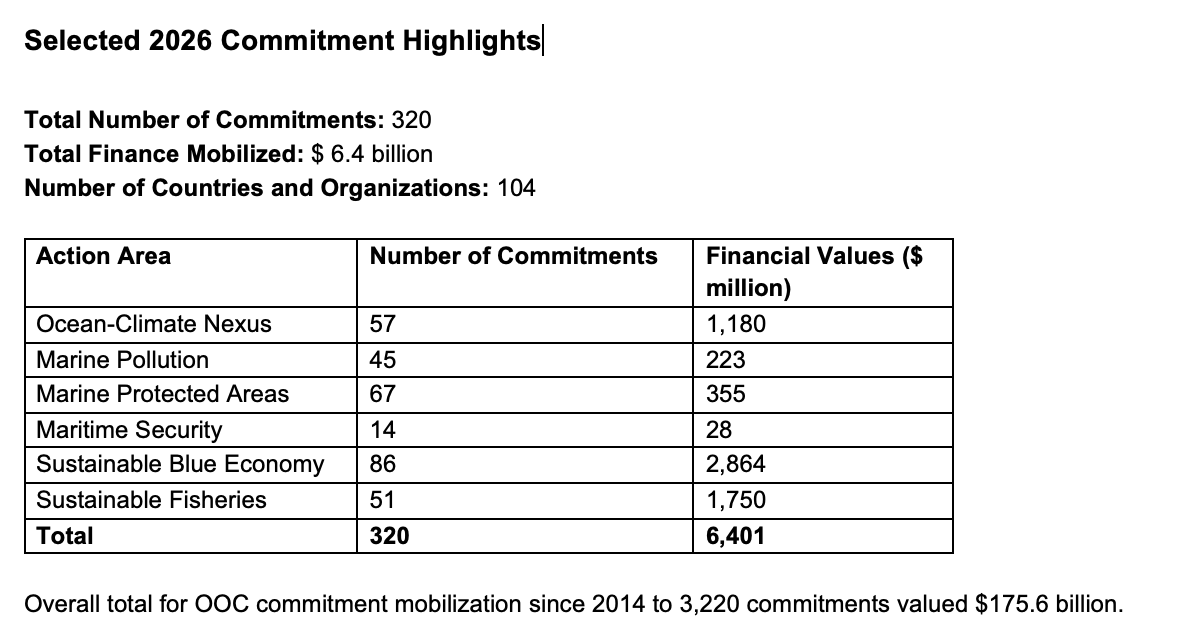
More than 100 governments, businesses, development institutions and civil society organizations pledged $6.4 billion through 320 new commitments to advance ocean conservation, sustainable fisheries, climate resilience and blue economy development at the 2026 Our Ocean Conference (OOC), which concluded in Mombasa, Kenya, on June 18. The gathering marked a historic milestone as the first Our Ocean Conference to be hosted on African soil since the initiative was launched in 2014. The event underscored the continent’s growing influence in global ocean governance and highlighted the increasing recognition that Africa’s economic future is closely tied to the sustainable management of its marine and coastal resources.
Held in Kenya’s principal port city, the conference brought together more than 5,000 participants, including heads of state, ministers, multilateral development institutions, scientists, business leaders, Indigenous representatives, youth organizations and conservation groups. Discussions focused on translating international ocean commitments into measurable investments, policy reforms and practical implementation strategies. Since its inception, the Our Ocean Conference has evolved into one of the world’s most influential platforms for mobilizing financing and accountability around ocean sustainability. According to conference organizers, commitments announced through previous editions have helped drive investments in marine protected areas, sustainable fisheries, climate adaptation initiatives and efforts to combat marine pollution.
This year’s conference generated significant financial commitments from governments and international institutions. Among the largest announcements was a pledge by the World Bank Group to invest $1 billion over the next two years to help developing countries build sustainable and resilient blue economies. The commitment reflects growing recognition among development financiers that oceans are increasingly central to economic development, food security and climate resilience. Canada announced an investment of $682 million through its Small Craft Harbours Program to strengthen coastal infrastructure, support fishing communities and improve economic opportunities in rural maritime regions. Meanwhile, French Polynesia unveiled plans to expand protections within the Tainui Atea Marine Protected Area, the largest marine protected area globally, through the establishment of more than 27,000 square kilometres of regulated fishing zones, coastal protection areas and seamount conservation measures.
As host nation, Kenya announced approximately 42 commitments valued at an estimated $1 billion. Among the most notable is a $200 million initiative to install electronic monitoring systems on all industrial fishing vessels operating in Kenyan waters. The measure is intended to strengthen fisheries management, improve transparency and combat illegal, unreported and unregulated (IUU) fishing activities. The focus on fisheries governance reflects a broader challenge facing African coastal economies. According to international estimates, illegal, unreported and unregulated fishing costs African countries between $11 billion and $13 billion annually through lost revenues, depleted fish stocks and weakened food security. For many coastal communities, fisheries remain a critical source of employment, nutrition and household income.
Africa’s growing prominence in ocean governance is underpinned by the continent’s extensive maritime assets. The continent is home to 38 coastal and island states and controls more than 13 million square kilometres of exclusive economic zones. These waters contain significant fisheries resources, offshore energy potential, shipping routes and blue carbon ecosystems such as mangroves and seagrass meadows that play a crucial role in climate mitigation. Speaking during the conference, Kenya’s Cabinet Secretary for Mining, Blue Economy and Maritime Affairs, Hassan Ali Joho, emphasized the importance of translating commitments into tangible outcomes.
“This conference is about turning words into commitments, commitments into action, and action into a legacy we can be proud of,” he said.
Beyond financing announcements, the conference highlighted a broader shift toward African-led solutions in marine conservation and sustainable ocean development. According to an analysis by the World Resources Institute (WRI), which serves as the Secretariat of the Our Ocean Conference, approximately 78 percent of commitments made in Africa since the conference began are either complete or currently in progress. Historically, many ocean-related commitments affecting Africa originated from external partners and development agencies. However, the Mombasa conference showcased a growing trend toward locally driven financing mechanisms, implementation frameworks and policy leadership. Youth participation emerged as one of the defining features of the conference. Running alongside the main programme, the OOC11 Youth Leadership Summit brought together young scientists, entrepreneurs, conservationists and innovators from across Africa and beyond.
One of the featured events focused on youth-led ecosystem restoration initiatives in Kenya, showcasing projects aimed at restoring mangrove forests and coastal wetlands. These ecosystems provide critical climate resilience benefits by protecting coastlines from erosion, supporting biodiversity and acting as natural carbon sinks. Organizers noted that youth engagement is becoming increasingly important as Africa’s population continues to expand, with more than 70 percent of Africans currently under the age of 35.
According to Wanjira Mathai, Managing Director for Africa and Global Partnerships at the World Resources Institute, the ocean economy represents a critical opportunity for Africa’s rapidly growing youth population.
“Africa is home to the world’s youngest and fastest-growing population. For many young Africans, the ocean is not simply an environmental issue. It is a source of jobs, food security and economic opportunity,” she said.
The growing emphasis on the blue economy reflects changing perceptions of oceans within African development strategies. Once viewed primarily through the lens of conservation, marine resources are increasingly recognized as drivers of economic growth, trade, tourism, renewable energy development and climate resilience. Kenya has emerged as one of Africa’s most prominent advocates for sustainable ocean development. As host of the United Nations Environment Programme (UNEP) and a founding member of the High Level Panel for a Sustainable Ocean Economy, the country has played an increasingly active role in shaping international discussions on marine pollution, sustainable fisheries and ocean governance.
https://www.aecweek-registration.com/2026/
The outcomes of the Mombasa conference suggest that oceans are becoming more deeply integrated into Africa’s development agenda. With coastal populations expanding, climate risks intensifying and demand for marine resources increasing, policymakers are placing greater emphasis on ensuring that economic growth is aligned with the long-term sustainability of ocean ecosystems. While the true impact of the conference will depend on implementation, financing disbursement and accountability mechanisms, the scale of commitments announced in Mombasa demonstrates that ocean sustainability is no longer a niche environmental concern. For Africa, it is increasingly viewed as a strategic economic priority linked to food security, employment, climate adaptation and long-term development.