


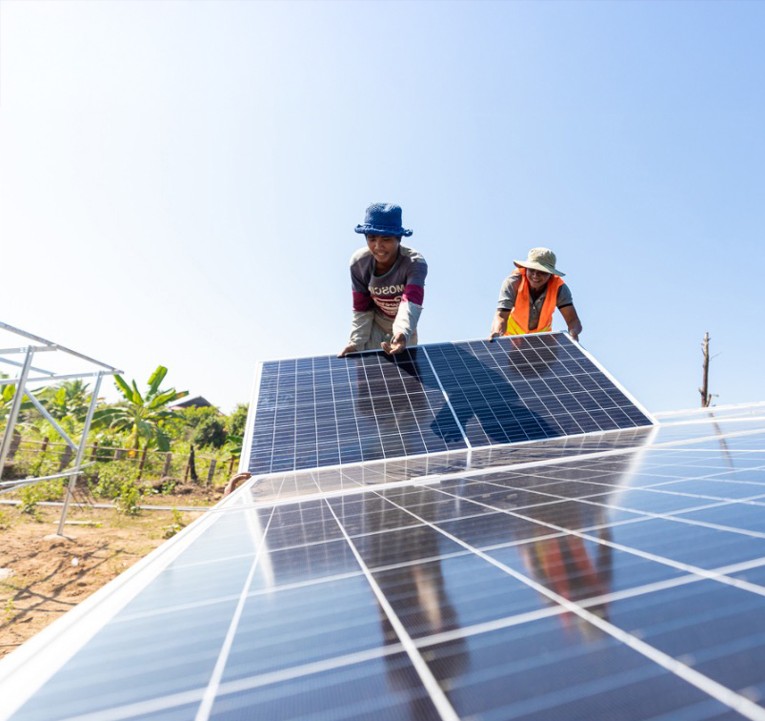
A new investment vehicle focused on decentralized renewable energy has secured $176 million in commitments to accelerate electricity access across sub-Saharan Africa, highlighting growing efforts by development finance institutions, philanthropic organizations and private investors to address one of the continent’s most persistent infrastructure challenges.
Zafiri, an investment platform managed by Inspired Evolution, announced the funding during the Africa Energy Forum held in Cape Town, South Africa, on June 17. The vehicle aims to channel long-term equity capital into companies providing mini-grids, solar home systems and clean cooking technologies, sectors widely regarded as essential for reaching populations beyond the reach of national electricity grids. The fund intends to connect more than 10 million people to electricity by 2030 and is targeting a final fundraising close of $300 million within the next 12 months. More than half of the capital raised will be directed toward decentralized energy solutions, reflecting increasing recognition that off-grid and distributed renewable energy systems will play a central role in closing Africa’s electricity access gap.
The announcement comes as African governments, development institutions and private investors face mounting pressure to accelerate electrification efforts. According to the International Energy Agency (IEA), nearly 600 million people in Africa still lack access to electricity, accounting for more than 80% of the global population without power. The majority of those affected live in rural and remote communities where extending conventional transmission and distribution networks remains technically difficult and financially expensive.
“Zafiri aims to tackle one of the most persistent barriers to energy access by scaling equity investments in distributed renewable energy companies serving communities across sub-Saharan Africa,” said Ghita Benabderrazik, Managing Director of Innovative Finance at the Rockefeller Foundation.
The initiative brings together an influential group of development finance institutions and impact investors. Founding investors include the International Finance Corporation (IFC), the African Development Bank (AfDB), the Rockefeller Foundation, the Trade and Development Bank (TDB), the Nordic Development Fund (NDF), the MacArthur Foundation and FirstRand.Their participation reflects growing consensus that achieving universal electricity access in Africa will require significantly larger flows of risk-tolerant capital capable of supporting early-stage and growth-stage energy companies. While debt financing for renewable energy projects has expanded considerably over the past decade, industry participants increasingly identify the shortage of equity capital as a critical bottleneck. Equity investments provide companies with the financial flexibility needed to expand operations, absorb market risks and invest in customer acquisition without the immediate repayment obligations associated with debt.

According to the IEA’s Financing Electricity Access in Africa report, insufficient equity financing remains one of the most significant barriers limiting the growth of mini-grid operators and solar home system providers across the continent. The agency argues that “patient capital”—long-term equity financing with extended return horizons—is essential if Africa is to achieve universal access to electricity by 2035. The challenge is particularly acute because decentralized energy providers often serve low-income rural populations where revenue generation develops gradually over time. Although demand for electricity is strong, companies frequently require several years to achieve profitability, making conventional commercial financing difficult to secure.
This financing gap has emerged at a time when decentralized renewable energy technologies are becoming increasingly important components of national electrification strategies. The African Development Bank estimates that grid expansion alone will be insufficient to achieve universal electricity access across the continent. In many rural communities, mini-grids and stand-alone solar systems can deliver power faster and at significantly lower cost than traditional grid infrastructure. Countries including Kenya, Nigeria, Tanzania, Rwanda, Uganda and Ethiopia have increasingly integrated off-grid solutions into national energy plans. Kenya has become one of Africa’s leading markets for solar home systems, while Nigeria has launched several large-scale mini-grid initiatives designed to serve underserved rural communities and productive economic sectors.
Beyond household electrification, decentralized energy systems are increasingly supporting agricultural processing, cold storage, healthcare facilities, schools and small businesses. Access to reliable electricity enables enterprises to extend operating hours, improve productivity and reduce dependence on costly diesel generators, which remain widely used across many African economies. The implications extend beyond energy access alone. According to the World Bank, inadequate electricity supply costs some African economies between 2% and 4% of gross domestic product annually through lost productivity, reduced industrial output and increased operating costs for businesses. As a result, improving access to affordable and reliable energy is increasingly viewed as an economic development priority rather than solely a social objective.
The focus on clean cooking solutions within the Zafiri portfolio also reflects growing concern over the health and environmental consequences of traditional cooking methods. The International Energy Agency estimates that nearly one billion Africans still rely on firewood, charcoal and other biomass fuels for cooking, contributing to deforestation, household air pollution and adverse health outcomes.Investment in cleaner cooking technologies could therefore generate benefits across multiple sectors, including public health, environmental management and climate mitigation. For investors, decentralized renewable energy is increasingly emerging as a commercially viable asset class. Improvements in solar technology, battery storage systems, digital payment platforms and remote monitoring tools have significantly improved operational performance and reduced costs over the past decade.
Mobile money ecosystems, particularly in East Africa, have also transformed the economics of off-grid energy by enabling pay-as-you-go business models that allow low-income households to access electricity services without substantial upfront costs. Nevertheless, substantial challenges remain. Currency volatility, regulatory uncertainty, affordability constraints and limited local capital markets continue to affect project economics across many countries. Industry stakeholders argue that blended finance structures combining public, philanthropic and private capital will remain necessary to crowd in larger pools of commercial investment.
https://www.aecweek-registration.com/2026/
The launch of Zafiri illustrates how development finance institutions are increasingly seeking to bridge these financing gaps through innovative investment structures capable of absorbing higher risks while mobilizing private-sector participation. For Africa, the significance of the initiative lies not only in the amount of capital raised but also in its focus on one of the continent’s most underserved investment segments. As governments pursue ambitious electrification targets, the availability of patient equity capital may prove as important as technology or infrastructure in determining whether millions of households and businesses gain access to reliable power over the coming decade. With the fund targeting a final close of $300 million and aiming to connect more than 10 million people by 2030, its progress will be closely watched by policymakers, investors and energy developers seeking scalable models for accelerating Africa’s energy transition while supporting inclusive economic growth.


