


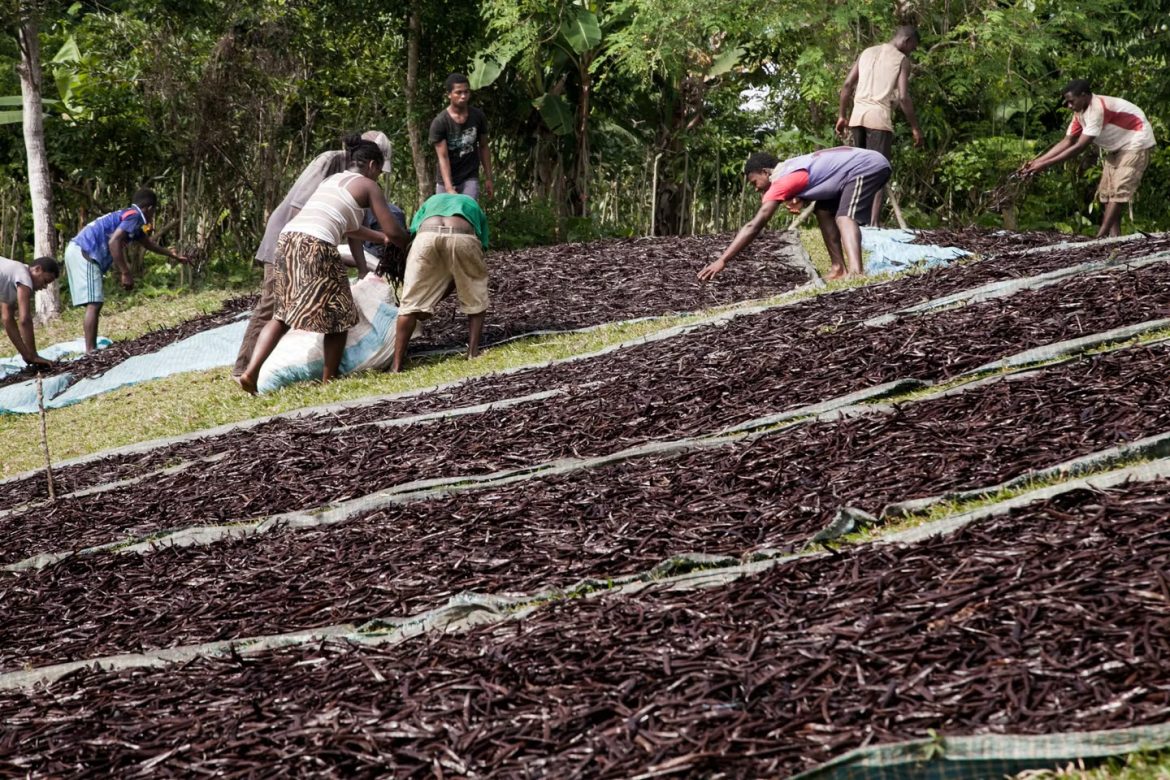
Madagascar’s government-backed vanilla industry alliance is preparing to spend up to $38 million to purchase 600 tonnes of processed vanilla from exporters in an effort to reduce excess inventories and stabilize falling prices, but industry leaders warn the intervention is unlikely to resolve the deeper structural challenges facing the world’s largest vanilla-producing nation. The initiative, approved in mid-June by the Alliance de Vanille Malgache (AVM), comes as Madagascar’s vanilla sector grapples with one of its most severe market downturns in two decades. International prices have fallen sharply amid record production levels, weakening demand and growing stockpiles, raising concerns about the long-term sustainability of one of the country’s most important agricultural export industries.
Under the scheme, AVM will use up to 40% of its cash reserves, estimated at approximately $38 million, to acquire 600 tonnes of processed vanilla, commonly known as black vanilla. Participating exporters will be required to commit to purchasing 3,000 tonnes of green vanilla from producers, a measure intended to stimulate activity across the value chain while supporting farmer incomes. According to Madagascar’s Minister of Trade and Consumption, Haingotiana Andriamadison, who also serves as President of the AVM, the intervention is designed to address growing inventories that have weighed heavily on global prices.
“The vanilla sector is suffering from excessive stock accumulation. This situation has triggered a broad decline in prices on international markets,” Andriamadison said when outlining the rationale behind the initiative.
The scale of the challenge reflects a wider imbalance between production and demand. Data published by the Central Bank of Madagascar showed that the country’s average vanilla export price fell by 40.2% during the fourth quarter of 2025 to $38 per kilogram, compared with $63.60 per kilogram during the same period a year earlier. Madagascar exported approximately 4,300 tonnes of vanilla during the 2023/2024 season, according to a report presented to the Council of Ministers in March 2025. That volume was more than double the average annual exports recorded between 2017 and 2020, while estimated global demand stood at only about 2,500 tonnes.
The resulting oversupply has created significant downward pressure on prices and weakened the bargaining position of exporters, processors and producers across the industry. For Madagascar, the implications extend beyond the vanilla sector itself. Vanilla remains one of the country’s most valuable agricultural exports and a critical source of foreign exchange earnings. The industry supports hundreds of thousands of rural households, particularly in the northeastern Sava region, where vanilla cultivation underpins local economies and employment. A prolonged downturn therefore risks reducing export revenues, weakening rural incomes and placing additional pressure on communities that depend heavily on the crop for their livelihoods.
However, industry representatives argue that the AVM’s intervention addresses symptoms rather than underlying causes. Georges Geeraerts, President of the Groupement des Exportateurs de Vanille de Madagascar (GEVM), questioned whether transferring ownership of inventories would materially change market dynamics. According to Geeraerts, the 600 tonnes of vanilla acquired by AVM will remain part of global supply and could eventually re-enter the market. Without a clearly defined strategy regarding the timing and pricing of future sales, the initiative risks postponing rather than resolving the oversupply problem.

He also noted that the requirement for exporters to purchase 3,000 tonnes of green vanilla represents only a relatively modest share of national production and may therefore have limited impact on overall market balances. Operational challenges present additional concerns. Madagascar’s vanilla value chain is fragmented, involving farmers, preparers, processors, exporters and international traders. Many exporters focus primarily on processed vanilla rather than purchasing green vanilla directly, while preparers control substantial inventories yet remain largely outside the framework of the new intervention.
Questions also remain regarding inventory verification, traceability, product quality assessment and valuation methodologies, all of which are essential for ensuring transparency and market confidence. Beyond immediate inventory management, industry participants increasingly argue that Madagascar must address broader competitiveness challenges that are reshaping international agricultural trade. Global food manufacturers and buyers are placing greater emphasis on traceability, sustainability standards, contaminant controls and compliance with increasingly stringent regulatory requirements, particularly within the European Union. Failure to meet these requirements could further constrain market access for Malagasy exports regardless of future price movements.
Geeraerts believes that investments in traceability systems, digitalization, quality control, market intelligence and international promotion would generate more durable benefits for the industry than temporary stock-purchasing measures. His assessment reflects a growing consensus among market participants that rebuilding confidence among international buyers may prove more important than reducing inventories alone. The challenge is particularly significant because vanilla markets are historically cyclical. Periods of high prices often encourage increased production, eventually creating surpluses that trigger sharp corrections.
A similar cycle unfolded in the early 2000s. Vanilla prices climbed to approximately $500 per kilogram in 2003, encouraging production expansion not only in Madagascar but also in emerging producing countries such as Uganda, India and Papua New Guinea. As supply surged, demand weakened and prices collapsed to around $25 per kilogram by 2005. Today’s market conditions bear similarities to that period, although the current downturn is occurring against a more complex backdrop of regulatory change, shifting consumer preferences and increased competition among producing countries. Uganda, in particular, has emerged as an increasingly important competitor in global vanilla markets, while buyers have become more diversified in their sourcing strategies following years of price volatility. According to market participants, the current oversupply could persist longer than previous cycles due to the substantial inventories accumulated during years of elevated prices.
Aust & Hachmann Canada, one of the world’s leading vanilla traders, noted in a market update published in May that the scale of current stock accumulation may prolong the correction. The company advised buyers to secure medium-term supply requirements while market prices remain relatively low, suggesting that meaningful recovery could take several years. For African agricultural exporters, Madagascar’s experience offers a broader lesson about commodity dependence and market concentration. The volatility affecting vanilla mirrors challenges faced by producers of cocoa, coffee, cashew nuts and other export crops across the continent, where fluctuations in global demand and supply can have significant consequences for public revenues, employment and rural development.

https://www.aecweek-registration.com/2026/
As Madagascar seeks to restore balance to its vanilla market, the effectiveness of the AVM intervention is likely to depend not only on inventory management but also on the industry’s ability to strengthen traceability, improve quality standards, diversify markets and rebuild confidence among global buyers. Without those structural reforms, analysts warn that price pressures could persist even if inventories temporarily decline.
The outcome will be closely watched across global agricultural markets, where Madagascar remains the dominant supplier of natural vanilla and a critical participant in a value chain that links African farmers to food, beverage, cosmetics and fragrance industries worldwide.


