


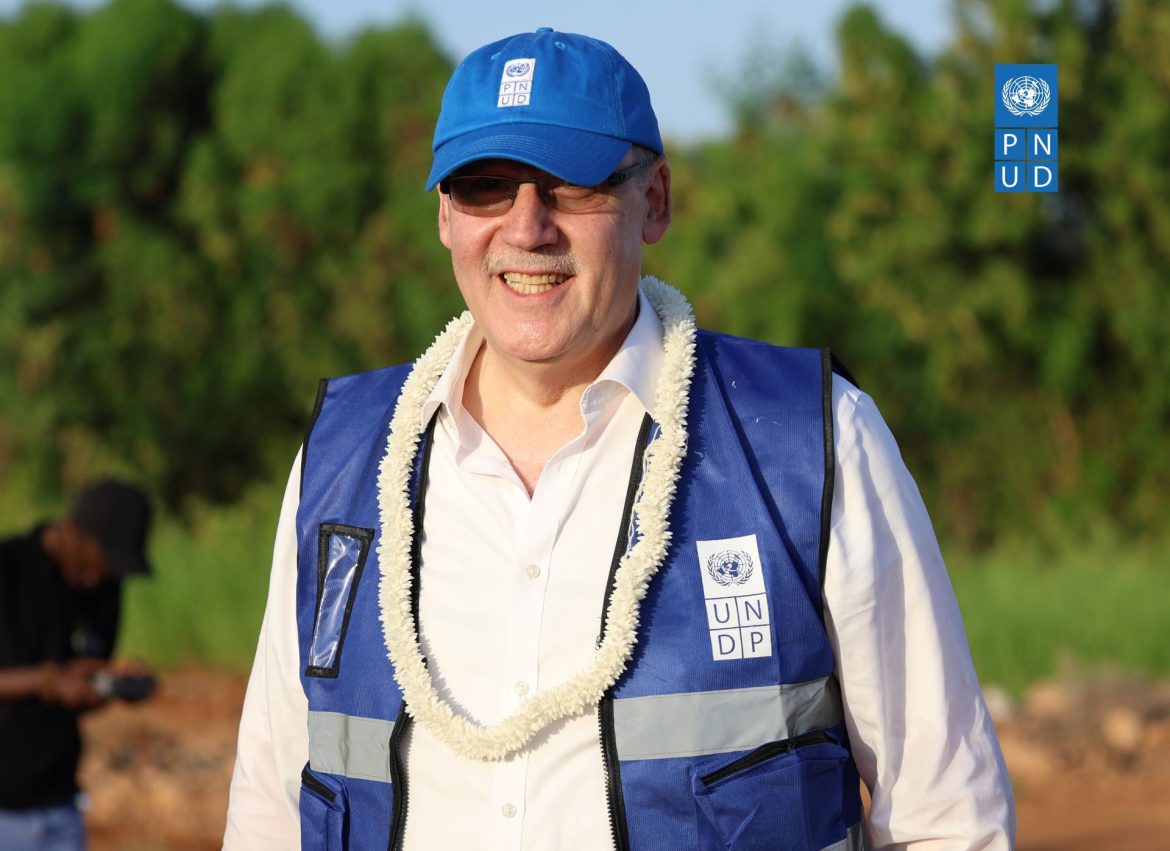
The United Nations Development Programme (UNDP) has reinforced its strategic partnership with the Government of Djibouti through a high-level mission aimed at accelerating sustainable development, strengthening climate resilience and expanding economic opportunities for young people. Led by Dr. Abdallah Al-Dardari, United Nations Assistant Secretary-General and Director of the UNDP Regional Bureau for Arab States, the three-day visit brought together government leaders, development partners, private sector representatives and civil society to align development priorities under Djibouti’s National Development Plan 2025–2030 and Vision 2035.
The mission signals a renewed commitment to supporting one of the Horn of Africa’s most strategically positioned economies as it seeks to diversify beyond its traditional logistics and port sectors while addressing persistent challenges related to youth unemployment, environmental degradation and climate vulnerability. According to UNDP, the discussions focused on integrated financing, environmental sustainability, regional cooperation and human capital development, areas increasingly recognised as fundamental to long-term economic resilience across Africa.
For Djibouti, whose economy has recorded relatively strong growth in recent years driven largely by transport and logistics linked to international trade routes, the next phase of development depends on creating broader economic opportunities that generate employment while protecting natural resources. Although the country’s strategic location along one of the world’s busiest maritime corridors has positioned it as an important gateway for regional commerce, unemployment particularly among young people remains one of the country’s most pressing socio-economic challenges.
According to the World Bank, Djibouti’s youthful population presents both a significant opportunity and a major policy challenge. Creating sufficient quality jobs requires stronger private sector development, investment in digital skills, entrepreneurship support and improved access to affordable energy. These priorities featured prominently throughout the UNDP mission, reflecting broader continental efforts to ensure that economic growth translates into inclusive development.
One of the defining outcomes of the visit was the emphasis placed on integrated planning rather than isolated development interventions. Government officials and UNDP representatives reviewed implementation pathways for Djibouti’s National Development Plan 2025–2030, exploring financing mechanisms capable of mobilising both domestic and international investment. Discussions also examined opportunities for South-South cooperation, including adapting lessons from Jordan’s successful development of special economic zones around the Dead Sea to unlock sustainable economic potential around Djibouti’s Lake Assal, one of Africa’s most unique geological and tourism assets.
Environmental sustainability formed another central pillar of the mission. Climate change continues to intensify environmental pressures across the Horn of Africa through rising temperatures, prolonged droughts, water scarcity and ecosystem degradation. According to UNDP, discussions with the Ministry of Environment and Sustainable Development reviewed progress under projects supported by the Global Environment Facility (GEF), including conservation of the Day Forest, one of Djibouti’s most important biodiversity hotspots.
Protecting such ecosystems carries implications beyond environmental conservation. Healthy forests support water regulation, biodiversity protection and climate adaptation while contributing to rural livelihoods. As climate risks continue to increase across East Africa, ecosystem restoration is increasingly viewed as an economic investment that reduces future disaster costs and strengthens long-term resilience.
The mission also highlighted practical examples of community-led climate action already delivering measurable results. In Djibouti’s Arta region, local organisations supported through the GEF Small Grants Programme demonstrated how environmental restoration can simultaneously improve livelihoods. Community groups have planted more than 500 Avicennia marina mangrove trees while introducing biochar production techniques that create employment, improve soil quality and reduce pressure on natural forests. Environmental education campaigns have also expanded awareness among schoolchildren, helping build climate literacy from an early age.
Another project showcased the economic benefits of combining renewable energy with agriculture. Solar-powered irrigation systems have enabled farmers to increase vegetable production, improve household incomes and strengthen local food security despite increasingly variable rainfall patterns. According to development experts, such integrated solutions illustrate how renewable energy investments can generate multiple socio-economic benefits while improving resilience to climate change.
Youth development emerged as perhaps the strongest theme of the visit. During meetings with government officials and parliamentarians, UNDP acknowledged that sustained economic growth alone will not be sufficient unless accompanied by deliberate investments in education, innovation and employment creation.
The mission culminated in the signing of a tripartite Declaration of Intent involving the National Assembly, the Ministry of Youth and Culture and UNDP to establish the “Portfolio for Youth Well-being and Prosperity.” Rather than treating education, employment and social inclusion as separate policy areas, the initiative seeks to integrate them into a coordinated framework capable of addressing multiple barriers faced by young people simultaneously.
UNDP further announced the provision of 200 Coursera learning licences, enabling young Djiboutians to access internationally recognised digital and professional training. According to Dr. Abdallah Al-Dardari, strengthening digital skills represents an important component of preparing young people for rapidly evolving labour markets shaped by technological change and the global green transition.
Private sector engagement was another important aspect of the mission. During a business roundtable organised jointly by the Djibouti Chamber of Commerce and the Embassy of France, discussions focused on sustainable finance, digital transformation, workforce development and corporate responsibility. UNDP encouraged businesses to participate more actively in achieving the Sustainable Development Goals through responsible investment, innovation and stronger support for youth employability.
This approach reflects an increasingly important shift in international development policy across Africa. Rather than relying exclusively on public investment, governments and development partners are seeking to mobilise greater private capital while strengthening the business environment for sustainable investment. According to the African Development Bank, private sector participation will be essential if African countries are to finance infrastructure, expand renewable energy, create employment and achieve the Sustainable Development Goals.
For Africa, Djibouti’s partnership with UNDP demonstrates how climate resilience, environmental protection and economic development are becoming increasingly interconnected. Investments in ecosystem restoration, renewable energy, youth employment and institutional capacity are no longer viewed as separate policy objectives but as mutually reinforcing components of long-term economic transformation.
The visit also reinforces the growing importance of integrated development planning at a time when African governments face mounting fiscal pressures, climate risks and demographic change. Countries that successfully combine environmental sustainability with economic diversification, digital transformation and human capital development are likely to strengthen their resilience against future economic and climate-related shocks.
As implementation of Djibouti’s National Development Plan 2025–2030 gathers momentum, continued collaboration between government institutions, multilateral organisations, development finance partners and the private sector is expected to remain central to delivering measurable outcomes. According to UNDP, sustained investment in climate resilience, youth empowerment and sustainable enterprise development could strengthen Djibouti’s position as both a regional economic hub and a model for integrated sustainable development within the Horn of Africa.


