


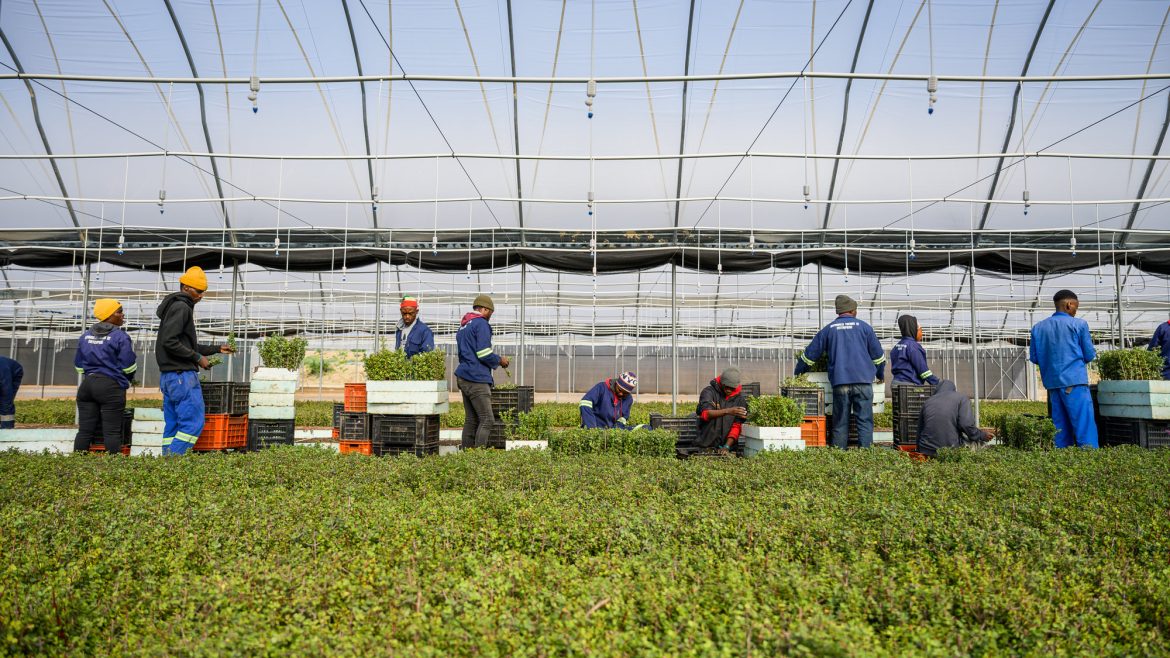
Amazon has committed to one of the world’s largest private-sector investments in nature-based carbon removal, backing a landscape restoration programme in South Africa’s Eastern Cape that aims to rehabilitate more than 50,000 hectares of degraded land, create approximately 11,000 jobs by 2030 and strengthen Africa’s emerging carbon economy through large-scale ecosystem restoration.
The investment centres on restoring the Albany Thicket, one of South Africa’s unique ecological landscapes that has suffered decades of degradation through unsustainable land use, overgrazing and vegetation loss. According to Amazon, the project will plant approximately 180 million spekboom cuttings by the end of 2028, using a native succulent renowned for its exceptional ability to capture atmospheric carbon while restoring degraded ecosystems.
 The initiative represents more than a climate intervention. It reflects growing investor interest in Africa’s natural capital as governments, development finance institutions and private companies increasingly recognise ecosystem restoration as an economic asset capable of generating employment, attracting climate finance and strengthening rural livelihoods alongside environmental recovery.
The programme forms part of Amazon’s broader Climate Pledge commitment to achieve net-zero carbon emissions across its operations by 2040. To support implementation, the company has agreed to purchase 1.95 million tonnes of carbon removal credits generated through the project over more than a decade, providing long-term revenue certainty that underpins one of South Africa’s largest private-sector nature restoration investments.
According to Amazon, this advance commitment enabled the World Bank to structure an innovative Spekboom Outcome Bond, creating confidence among investors by establishing a guaranteed future market for verified carbon removal credits. The financing model illustrates how blended finance mechanisms are increasingly being deployed to scale voluntary carbon markets while reducing investment risk for ecosystem restoration projects.
The project arrives as global demand for high-quality carbon removal credits continues to expand alongside corporate net-zero commitments. Unlike emissions avoidance credits, carbon removal credits are designed to represent measurable quantities of carbon dioxide permanently removed from the atmosphere. As scrutiny over carbon market integrity intensifies, investors have increasingly prioritised projects supported by rigorous scientific verification and internationally recognised certification standards.
Amazon said the restoration programme will generate credits meeting both the ABACUS methodology and the Climate, Community & Biodiversity (CCB) certification standards, while the project has already received an ‘AA.pre’ rating from independent carbon ratings agency BeZero Carbon. The rating indicates a high likelihood that future credits will represent genuine and verifiable carbon dioxide removal.
Beyond carbon markets, the restoration programme is expected to produce substantial economic benefits for one of South Africa’s most economically vulnerable regions. Amazon estimates that more than US$500 million will flow into surrounding communities through wages, procurement, landowner payments and community investments during implementation.
The employment component is particularly significant in the Eastern Cape, where unemployment remains persistently above the national average. Restoration activities are expected to support thousands of temporary and permanent jobs across nursery operations, planting, ecological monitoring, environmental management and project administration. The programme also includes training initiatives designed to strengthen local enterprises specialising in ecological restoration, potentially creating long-term skills that can support South Africa’s expanding environmental services sector.
According to Amazon Chief Sustainability Officer Kara Hurst, the programme demonstrates how nature-based solutions can simultaneously contribute to climate mitigation and local economic development.
The ecological restoration itself centres on spekboom, a resilient indigenous succulent scientifically recognised for its exceptional carbon sequestration capacity under semi-arid conditions. Unlike conventional reforestation initiatives that depend on tree planting, spekboom is naturally adapted to the Eastern Cape’s climate, allowing it to survive prolonged drought while improving soil quality and creating favourable conditions for broader ecosystem recovery.
Scientists have found that mature spekboom ecosystems can absorb carbon dioxide at rates comparable to young tropical forests under certain conditions. Equally important, the plant improves soil moisture, stabilises degraded landscapes and facilitates the gradual return of native vegetation, insects, birds and mammals that have declined as natural habitats deteriorated.
The ecological significance of the species has attracted international recognition. The United Nations has designated spekboom restoration as one of its World Restoration Flagship initiatives, recognising its contribution to ecosystem recovery under the UN Decade on Ecosystem Restoration.
The Albany Thicket itself represents one of Southern Africa’s biodiversity hotspots. Despite decades of degradation, the restoration landscape continues to support at least 165 documented plant and animal species, several of which are considered vulnerable. Restoring vegetation is expected to strengthen biodiversity conservation while improving watershed protection, reducing soil erosion and increasing resilience to increasingly frequent droughts associated with climate change.
For Africa more broadly, the project highlights the continent’s growing role within global climate finance. African ecosystems; including forests, wetlands, mangroves and dryland vegetation are increasingly viewed as strategic natural assets capable of delivering measurable carbon removal while supporting biodiversity conservation and rural development. However, experts have consistently argued that scaling nature-based solutions requires reliable financing mechanisms capable of rewarding long-term stewardship rather than short-term resource extraction.
The Eastern Cape restoration model demonstrates how carbon markets, biodiversity conservation and rural economic development can become mutually reinforcing when supported by transparent governance, scientific verification and long-term private-sector investment. As demand for credible carbon removal grows globally, similar financing structures could become increasingly relevant across Africa’s degraded landscapes, where restoration opportunities coexist with significant development needs.
 The programme also reinforces South Africa’s broader ambitions to position itself as a leader in climate finance and ecosystem restoration. By combining carbon markets with employment creation and biodiversity recovery, the initiative illustrates how environmental restoration can contribute to broader economic resilience while supporting national climate commitments.
Although the long-term ecological outcomes will depend on successful implementation over many years, the project reflects a growing recognition that restoring natural ecosystems is increasingly being treated not simply as an environmental obligation but as an investable component of sustainable economic development. For African countries seeking to balance climate action with inclusive growth, the Eastern Cape initiative offers an emerging example of how natural capital, when supported by credible financing and local participation, can generate measurable environmental and economic returns simultaneously.


