


Before the article, one clarification is important. This story centres on policy recommendations made during a public lecture rather than the announcement of new legislation. The article therefore attributes proposals and forward-looking statements directly to the speakers while placing them within the broader context of Africa’s emerging nature-based economy.
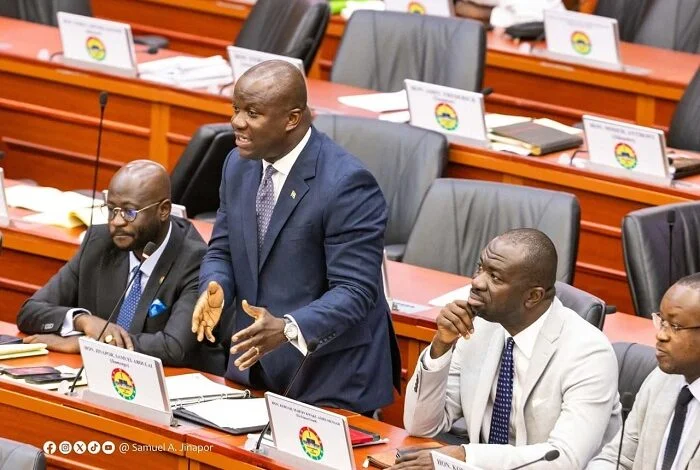
Africa’s ability to unlock investment in nature-based solutions, carbon markets and ecosystem restoration will depend increasingly on stronger environmental legislation, according to Ghana’s former Minister for Lands and Natural Resources, Samuel Abu Jinapor, who has urged governments across the continent to strengthen legal frameworks that support climate resilience, sustainable economic growth and green job creation.
Speaking during a public lecture organised by the Research and Innovation Directorate of the University of Ghana and the Africa Centre for Nature-Based Climate Action (AC4NCA) to commemorate the 2026 Day of Scientific Renaissance of Africa in Accra, Jinapor argued that while several African countries have developed policies supporting carbon markets and environmental conservation, many still require robust legal frameworks capable of attracting long-term private investment and ensuring policy continuity.
 According to Jinapor, research institutions must play a more direct role in shaping national development by ensuring scientific findings inform legislation, public policy and commercial innovation rather than remaining confined to academic publications. He said stronger links between research, government and private capital would enable African countries to convert scientific knowledge into commercially viable climate solutions capable of improving livelihoods and generating sustainable economic value.
His remarks come as governments across Africa seek to expand participation in voluntary carbon markets and nature-based climate finance while balancing conservation priorities with economic development objectives. International demand for high-quality carbon credits, ecosystem restoration projects and sustainable land management has grown alongside corporate net-zero commitments, creating new opportunities for countries rich in forests, wetlands and biodiversity.
Jinapor pointed to Ghana’s evolving carbon market framework as an example of how policy can create economic incentives for conservation. According to him, the country has established mechanisms allowing local communities to benefit financially from environmental protection through carbon trading initiatives. He disclosed that approximately US$5 million has already been distributed through benefit-sharing arrangements supporting communities and research activities under Ghana’s carbon market programme.
He also highlighted Ghana’s position as one of the first countries globally, together with Indonesia, to issue Forest Law Enforcement, Governance and Trade (FLEGT) licences for legally sourced timber exports. The certification framework, developed in partnership with international markets, seeks to strengthen governance within the forestry sector while improving access to premium export markets for sustainably harvested timber.
The discussion reflected broader debates surrounding Africa’s role in global climate mitigation. Nature-based solutions, including forest conservation, wetland restoration, sustainable agriculture and mangrove protection, are increasingly recognised as cost-effective mechanisms for reducing greenhouse gas emissions while strengthening biodiversity, improving water security and supporting rural economies. However, attracting investment into these sectors requires predictable regulatory environments, transparent governance systems and credible monitoring frameworks capable of meeting international standards.
According to Balla Moussa Sidibé, Regional Director for West and Central Africa at the International Union for Conservation of Nature (IUCN), Africa’s long-term development prospects are closely tied to its ability to preserve natural ecosystems rather than exploiting them solely for short-term economic returns. He said forests, wetlands, healthy soils and mangroves should be viewed as productive national assets capable of supporting food security, climate resilience and employment if managed sustainably.
Sidibé identified the Congo Basin as one of the world’s most strategically important ecosystems because of its role in carbon storage, biodiversity conservation and regional rainfall regulation. Protecting the basin, he argued, carries implications extending beyond Africa by contributing to global climate stability while supporting millions of livelihoods across Central Africa.
The discussion also examined the institutional conditions necessary for scaling nature-based investment. Panel participants called for stronger collaboration between governments, universities and research institutions, arguing that countries confronting similar environmental challenges would benefit from greater scientific cooperation and shared technical expertise. They further emphasised that research partnerships should operate on principles of transparency, trust and equitable benefit-sharing to maximise development outcomes.
Recent flooding in parts of Accra also featured prominently during the discussions. Participants argued that the degradation of wetlands, including the Densu Delta and Sakumo Ramsar Sites, together with inadequate land-use planning, has significantly reduced the city’s natural flood protection capacity. Wetlands function as critical ecological infrastructure by absorbing excess water, reducing flood intensity and supporting biodiversity, yet increasing urban encroachment continues to undermine these natural defence systems.
The Director of the Research and Innovation Directorate at the University of Ghana, Professor David Dodoo-Arhin, described the Day of Scientific Renaissance of Africa as an important platform for strengthening research partnerships capable of addressing the continent’s development priorities. He called for deeper collaboration between academia, government and industry to ensure scientific research generates practical solutions supporting economic transformation and sustainable development.
 The debate illustrates the increasingly prominent role of environmental governance within Africa’s economic policy agenda. As governments seek to attract climate finance, expand carbon markets and develop green industries, legal certainty is emerging as a critical determinant of investor confidence. Well-designed environmental legislation can help reduce regulatory risk, improve natural resource governance and strengthen public trust while supporting the transition toward more resilient and diversified economies.
For Africa, where ecosystems underpin agriculture, water resources, tourism and rural livelihoods, strengthening environmental institutions is becoming not only a conservation objective but also an economic strategy. The continent’s growing participation in global carbon markets and nature-based finance is likely to depend increasingly on the ability of governments to translate scientific evidence into durable legal frameworks that protect natural capital while creating inclusive economic opportunities.


