


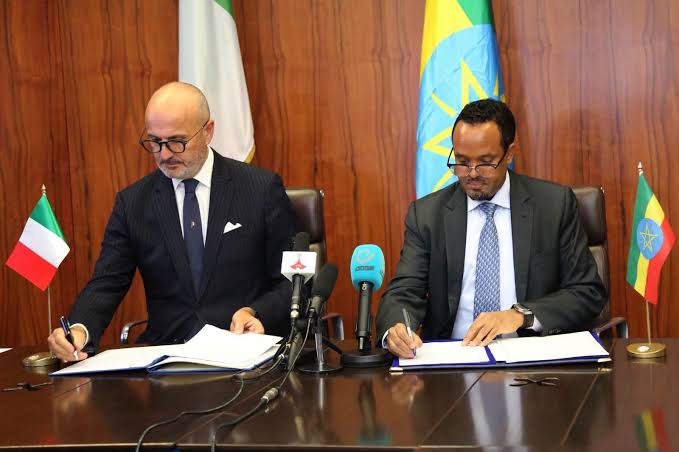
Ethiopia has secured €80 million (approximately US$91 million) in financing from Italy to accelerate its economic reform programme, strengthen fiscal stability and expand investments in renewable energy and climate resilience, reinforcing international support for one of Africa’s largest economic transformation agendas.
The financing package, announced by the Ministry of Finance of Ethiopia on June 29, combines budget support with climate financing to help the country implement structural economic reforms while improving resilience to climate-related risks affecting agriculture, water resources and energy systems. The commitment forms part of a broader 2026–2028 bilateral cooperation programme agreed between Giorgia Meloni and Abiy Ahmed, with total financing expected to reach €150 million over the three-year period. The latest funding reflects a growing trend among international development partners to combine macroeconomic reform support with climate finance, recognising that economic resilience and environmental sustainability are increasingly interconnected, particularly in developing economies vulnerable to external shocks and climate change.
According to the Ethiopian Ministry of Finance, €70 million will be provided through the Italian Revolving Fund for Development Cooperation (FRCS) as direct budget support. The financing is intended to strengthen implementation of Ethiopia’s Homegrown Economic Reform Programme and its Ten-Year Development Plan by improving fiscal sustainability, enhancing public financial management and creating conditions for stronger private-sector investment. The remaining €10 million, financed through the Italian Climate Fund, will support reforms aimed at promoting renewable energy, climate finance and carbon market development. The funding is expected to strengthen Ethiopia’s transition towards a greener economy while improving the country’s capacity to adapt to increasingly severe climate-related challenges. The investment will prioritise strategic sectors including energy, agriculture and water resources. According to the Ministry, the programme will support efforts to expand electricity access, improve agricultural productivity, strengthen agricultural markets and enhance water resource management, all of which remain central to Ethiopia’s long-term development strategy.

The financing arrives at a pivotal moment for Ethiopia’s economy. After more than two decades of rapid economic expansion driven largely by public infrastructure investment, the country has been implementing wide-ranging macroeconomic reforms to address structural imbalances that have emerged over time. According to the International Monetary Fund (IMF), years of heavy public investment financed through external borrowing and domestic lending by state-owned financial institutions contributed to persistent foreign exchange shortages, elevated inflation, rising public debt and limited access to credit for private businesses. These challenges constrained economic competitiveness despite sustained growth in infrastructure development and industrial investment.
In response, Ethiopia has embarked on one of the continent’s most comprehensive economic reform programmes. Measures introduced over the past two years include greater exchange rate flexibility, liberalisation of the foreign exchange market, reforms to banking regulations, strengthened fiscal consolidation and ongoing public debt restructuring. Collectively, these initiatives seek to improve macroeconomic stability while creating a more attractive environment for domestic and international investment.
Budget support from Italy is expected to reinforce these reforms by providing fiscal space that enables the government to continue implementing structural adjustments without undermining essential public services or long-term development priorities. Beyond macroeconomic reforms, the financing underscores the increasing importance of climate resilience within Africa’s development agenda. Ethiopia remains among the countries most exposed to climate variability despite contributing only a small fraction of global greenhouse gas emissions. Recurrent droughts, increasingly severe flooding, declining soil fertility and biodiversity loss continue to affect agricultural production, water availability and rural livelihoods.
Agriculture remains a cornerstone of Ethiopia’s economy, employing a significant proportion of the population while contributing substantially to national income and export earnings. Consequently, strengthening climate resilience within the agricultural sector has become a national economic priority rather than solely an environmental objective. Investment in water management infrastructure is similarly critical. Climate change has intensified variability in rainfall patterns across the Horn of Africa, increasing both flood risks during wetter seasons and prolonged drought conditions during periods of below-average precipitation. Improving water resource management therefore supports food security, industrial production and energy generation simultaneously.
Renewable energy also forms a central pillar of Ethiopia’s development strategy. The country already generates the overwhelming majority of its electricity from renewable sources, particularly hydropower, while expanding investments in wind, solar and geothermal energy. However, increasing electricity access remains a significant challenge, particularly in rural communities where millions of households continue to lack reliable power. According to the International Renewable Energy Agency (IRENA), expanding renewable energy infrastructure across Africa represents one of the continent’s largest investment opportunities, capable of simultaneously supporting economic growth, improving energy security and reducing emissions. Ethiopia’s renewable energy ambitions align closely with broader continental objectives to increase access to affordable, sustainable and modern energy under the African Union‘s Agenda 2063 and the United Nations Sustainable Development Goals.
The inclusion of climate finance and carbon market development within the Italian funding package also reflects the evolution of international development cooperation. Increasingly, development partners are supporting countries in establishing regulatory frameworks capable of attracting private climate investment alongside public finance. Carbon markets, if effectively governed, could provide additional revenue streams for conservation, renewable energy and climate adaptation initiatives.
For Italy, the financing reinforces its expanding partnership with African countries under the broader Mattei Plan, which seeks to strengthen economic cooperation across energy, infrastructure, agriculture and sustainable development. Ethiopia, as Africa’s second-most populous country and one of the continent’s fastest-growing economies over the past two decades, represents a strategically important partner within Italy’s engagement across the Horn of Africa. The financing also demonstrates the growing integration of development finance with climate objectives. Rather than treating economic reforms and climate adaptation as separate policy agendas, international partners increasingly recognise that resilient economies require both sound macroeconomic management and investments capable of reducing vulnerability to environmental shocks.

https://www.aecweek-registration.com/2026/
For Africa more broadly, Ethiopia’s agreement illustrates how blended financing approaches are becoming increasingly important for supporting sustainable development. Countries across the continent face simultaneous demands to stabilise public finances, strengthen economic competitiveness, expand infrastructure, improve energy access and adapt to accelerating climate risks. Addressing these interconnected challenges requires financing models that combine fiscal support with targeted investments in climate resilience and institutional reform.
As African governments continue implementing structural reforms while pursuing low-carbon development pathways, partnerships that align economic transformation with climate resilience are likely to play an increasingly significant role in mobilising international capital. Ethiopia’s latest agreement with Italy reflects this evolving approach, demonstrating how development finance can simultaneously strengthen macroeconomic stability, support renewable energy expansion and improve resilience to one of the defining challenges confronting the continent’s future.


