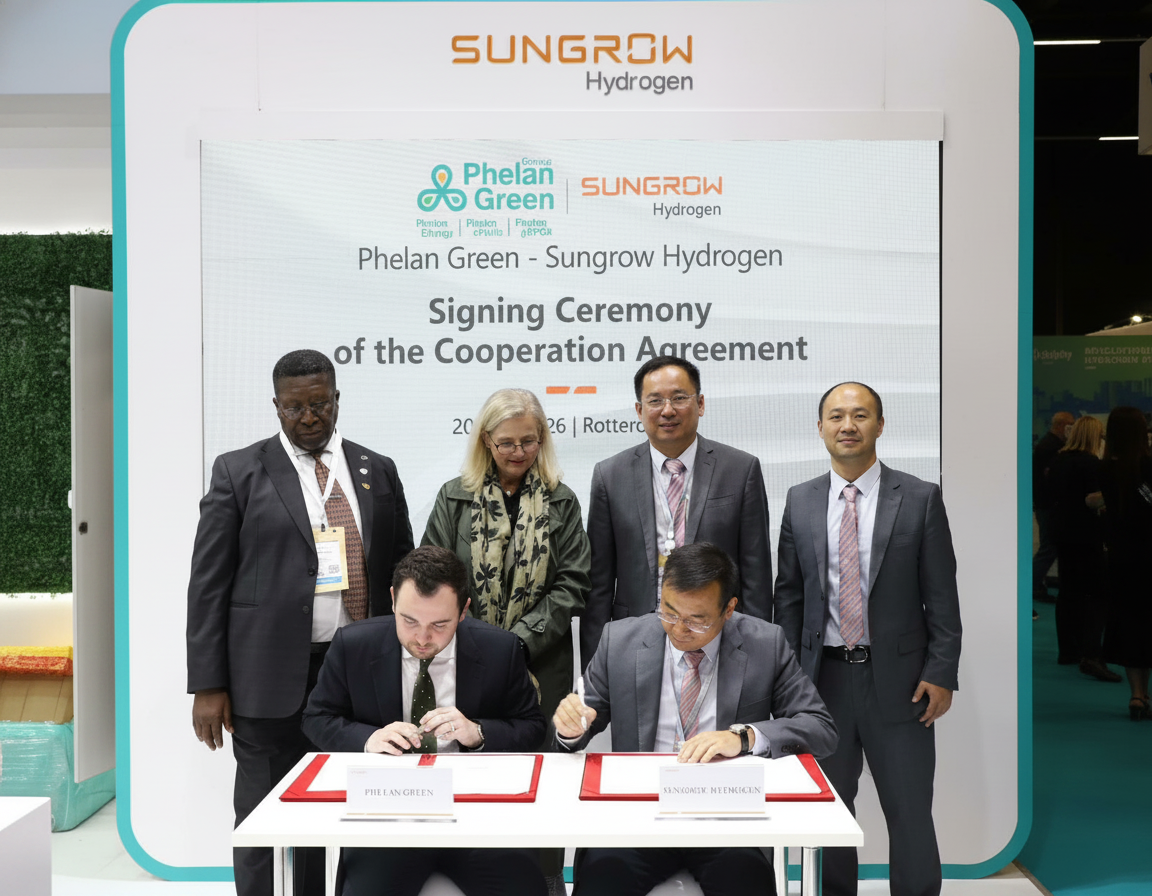
South Africa has taken a significant step towards positioning itself as a global supplier of sustainable aviation fuels after Phelan Green Group signed Africa’s largest electrolyser procurement agreement, supporting the first phase of an 800-megawatt (MW) green hydrogen-powered sustainable aviation fuel project planned for Saldanha Bay. The landmark agreement, announced during the World Hydrogen Summit in Rotterdam, will see Sungrow Hydrogen supply 200MW of electrolysers for the project’s initial development phase. The order represents the largest electrolyser contract ever placed on the African continent and ranks among the largest single electrolyser agreements awarded globally to Sungrow Hydrogen.
The transaction marks an important milestone for South Africa’s emerging green hydrogen industry, reflecting growing investor confidence in the country’s renewable energy potential and its ambition to become a competitive exporter of low-carbon fuels to international markets. The agreement was signed by Blair Phelan and Peng Chaocai during a ceremony attended by Samantha Graham-Maré and Vusimuzi Madonsela, underscoring the project’s strategic importance to South Africa’s industrial and energy transition agenda.
The agreement supports the first phase of an ambitious 800MW electro-sustainable aviation fuel (eSAF) facility that aims to establish one of Africa’s largest green hydrogen-derived fuel production platforms. Construction is expected to begin later this year, subject to final project approvals and financing. The development builds upon the South African government’s 2023 decision to designate the Phelan Green Hydrogen platform as a Strategic Integrated Project (SIP), recognising its potential contribution to industrial development, infrastructure investment, export growth and employment.
According to the developers, the project is expected to generate substantial regional economic activity while strengthening South Africa’s position within the rapidly expanding global market for sustainable aviation fuels. Electrolysers are central to green hydrogen production. Powered by renewable electricity, they separate water into hydrogen and oxygen through electrolysis, producing hydrogen without direct carbon emissions. That green hydrogen is subsequently combined with captured biogenic carbon dioxide through industrial synthesis processes to produce synthetic liquid hydrocarbons suitable for use as sustainable aviation fuel. Unlike conventional jet fuel, electro-sustainable aviation fuel is designed to significantly reduce lifecycle greenhouse gas emissions when produced using renewable electricity and sustainable carbon sources.
Demand for these fuels is expected to increase substantially over the coming decade as aviation regulators introduce mandatory blending requirements aimed at reducing emissions from one of the world’s most difficult sectors to decarbonise. In particular, the European Union has adopted the ReFuelEU Aviation Regulation, requiring fuel suppliers to progressively increase the proportion of sustainable aviation fuels supplied at European airports. Germany has also introduced national sustainable aviation fuel mandates that further accelerate demand for synthetic fuels. These regulatory frameworks have created strong commercial incentives for large-scale eSAF production facilities capable of supplying European markets.
According to the International Air Transport Association (IATA), achieving net-zero emissions in aviation by 2050 will require substantial expansion of sustainable aviation fuel production. SAF is expected to contribute the majority of emissions reductions needed by the global aviation sector, making investment in production capacity increasingly important for both airlines and fuel suppliers. South Africa’s comparative advantages are attracting growing attention within this emerging industry. The country possesses some of Africa’s highest-quality renewable energy resources, particularly wind and solar, enabling relatively low-cost electricity generation. Since renewable electricity accounts for a significant proportion of green hydrogen production costs, competitive energy pricing could improve the economics of synthetic fuel manufacturing.
The choice of Saldanha Bay further strengthens the project’s export potential. Located on South Africa’s west coast, Saldanha Bay offers deep-water port facilities, established industrial infrastructure and designation as a Saldanha Bay Special Economic Zone, providing logistical and investment advantages for export-oriented manufacturing. Developers intend to export the majority of production to regulated international aviation markets, particularly within Europe, where demand is expected to rise steadily as blending mandates become progressively more stringent.
According to Phelan Green Group, the first commercial phase of the project is expected to produce approximately 35,000 tonnes of electro-sustainable aviation fuel annually. The company further estimates that, under projected European Union synthetic aviation fuel blending requirements by 2030, the completed Saldanha Bay facility could eventually supply approximately 6% of projected European demand for synthetic aviation fuel used at EU airports. If realised, this would position South Africa among a relatively small group of countries capable of producing synthetic aviation fuels at commercial scale. Beyond export opportunities, the investment aligns with South Africa’s broader economic diversification strategy. Green hydrogen has emerged as a priority sector under the country’s energy transition agenda, offering opportunities to leverage abundant renewable resources while supporting industrialisation, skills development and export competitiveness.
According to the International Energy Agency, hydrogen and hydrogen-derived fuels are expected to play an increasingly important role in decarbonising sectors where direct electrification remains technically challenging, including aviation, shipping, heavy industry and certain chemical processes. For Africa, this presents an opportunity to move beyond exporting raw natural resources towards supplying higher-value green industrial products. Countries including Namibia, Egypt, Mauritania and Morocco have also announced large-scale green hydrogen initiatives targeting export markets, reflecting growing continental competition to capture emerging clean energy value chains.
However, large-scale green hydrogen development remains capital intensive. Projects require substantial investment in renewable generation, electrolysers, transmission infrastructure, water supply, storage facilities and export logistics. Long-term commercial success will depend on sustained international demand, competitive production costs and continued policy support in importing markets. Financing also remains a critical consideration. While global interest in green hydrogen continues to expand, investors continue to assess regulatory certainty, infrastructure readiness and long-term purchase agreements before committing capital to large industrial developments.
https://www.aecweek-registration.com/2026/
For South Africa, the electrolyser agreement demonstrates tangible progress in moving from project announcements towards implementation. As governments worldwide accelerate efforts to decarbonise aviation, investments such as the Saldanha Bay project highlight Africa’s growing role in supplying the technologies and fuels required for the global energy transition. Rather than simply exporting renewable resources, the continent increasingly has the opportunity to participate in higher-value manufacturing and clean industrial production, strengthening export earnings while supporting domestic industrial development.
If successfully delivered, the project could establish South Africa as one of the world’s emerging production hubs for sustainable aviation fuels and reinforce Africa’s position within rapidly evolving global clean energy supply chains.