


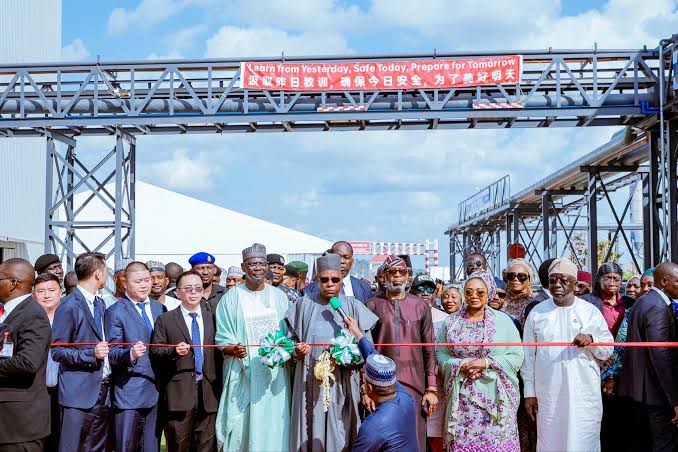
Nigeria has commissioned what the federal government describes as West Africa’s largest lithium processing plant, marking a significant step in the country’s efforts to shift from exporting raw minerals to developing domestic processing capacity as global demand for battery minerals accelerates. Located in Endo community in Nasarawa State, the facility has a daily processing capacity of 6,000 metric tonnes and an annual capacity of three million metric tonnes, positioning Nigeria to play a more prominent role in international critical minerals supply chains while supporting its broader industrialisation agenda.
The inauguration, officiated on behalf of President Bola Tinubu by Vice President Kashim Shettima, reflects Nigeria’s strategy to capture greater economic value from its mineral resources by expanding local beneficiation and manufacturing rather than relying primarily on exports of unprocessed commodities. Government officials argue that strengthening domestic processing capacity will generate employment, attract investment, expand industrial output and reduce the country’s long-standing dependence on commodity exports.
 Addressing the commissioning ceremony, Shettima described the project as part of a broader transformation of Nigeria’s mining sector, emphasising that sustainable economic value lies not in resource extraction alone but in the institutions, industries and skills that convert natural resources into productive assets. He stated that Nigeria’s long-term objective is to transition from mineral extraction to industrial production by expanding value addition across strategic sectors.
The processing facility, operated by Diamond New Energy in partnership with the Nasarawa State Government and Chinese lithium companies Jiuling and Canmax, is expected to create more than 1,000 direct jobs and over 2,000 indirect employment opportunities. According to the project developers, the investment provides an industrial anchor for Nasarawa State, which possesses commercially significant deposits of lithium, gold, copper, lead, zinc, iron ore, gemstones and marble.
Nigeria’s move comes as African governments increasingly seek to capture greater value from critical minerals required for the global energy transition. Lithium has become one of the world’s most strategically important minerals because of its central role in manufacturing rechargeable batteries used in electric vehicles, energy storage systems, consumer electronics and renewable energy infrastructure. As countries pursue decarbonisation strategies, competition to secure reliable supplies of lithium and other battery minerals has intensified significantly.
Read also: https://www.esgnow.co.za/article/nigeria-opens-largest-lithium-processing-plant-in-west-africa
The commissioning follows recent announcements by the Nigerian government regarding additional mineral discoveries, including a polymetallic mineral province in Kaduna State reportedly containing platinum group metals, gold, nickel, copper, lithium and rare earth elements. Authorities have also disclosed estimated lithium reserves of approximately 3.3 million metric tonnes at another mining site near Abuja, reinforcing the country’s ambition to become a major participant in global critical mineral markets.
According to Nigeria’s Minister of Solid Minerals Development, Dele Alake, the government intends to discourage exports of unprocessed minerals while encouraging downstream industries capable of manufacturing batteries, renewable energy components, electric vehicles and other technologies that depend on lithium. The policy reflects a broader industrial strategy aimed at strengthening domestic manufacturing capacity and reducing reliance on imported technology products.
The shift aligns with similar resource governance reforms emerging elsewhere on the continent. Zimbabwe has introduced restrictions on exports of unprocessed lithium to encourage domestic beneficiation, while Namibia has moved to limit exports of selected unprocessed critical minerals. The Democratic Republic of Congo and Zambia continue advancing regional battery manufacturing initiatives built around their extensive reserves of cobalt and copper. Collectively, these policies indicate a growing determination among African governments to convert mineral wealth into industrial development rather than remaining suppliers of raw materials.
However, industry analysts caution that mineral processing alone does not guarantee economic transformation. According to the International Energy Agency (IEA), global refining capacity for critical minerals remains highly concentrated. Between 2020 and 2024, the combined market share of the three largest refining countries increased from approximately 82 per cent to 86 per cent across key energy transition minerals, with China accounting for the overwhelming majority of refining capacity growth for cobalt, graphite and rare earth elements.
This concentration highlights one of Nigeria’s central policy challenges. Although the Nasarawa processing facility represents a significant step toward domestic value addition, the project itself depends heavily on Chinese investment, industrial expertise and processing technology. Jiuling and Canmax, the Chinese companies involved in developing the plant, reportedly account for more than one-fifth of global lithium production capacity, underscoring China’s continued dominance across the international battery supply chain.
The expansion of battery markets reinforces the commercial significance of Nigeria’s investment. According to the IEA, global battery demand within the energy sector exceeded one terawatt-hour for the first time in 2024, driven largely by electric vehicle production. Battery demand from electric vehicles alone surpassed 950 gigawatt-hours during the year, representing an increase of approximately 25 per cent compared with 2023. Under current policy trajectories, the agency projects global electric vehicle battery demand will exceed three terawatt-hours by 2030, while emerging markets outside China are expected to double their share of global battery demand during the same period.
 For Africa, rising demand for critical minerals presents both economic opportunity and strategic responsibility. The continent possesses substantial reserves of lithium, cobalt, manganese, graphite and copper that will be essential for global decarbonisation. However, achieving meaningful economic transformation will depend on developing integrated value chains encompassing refining, component manufacturing, battery production, research, skills development and technology transfer rather than limiting participation to mineral extraction or first-stage processing.
Nigeria’s new lithium processing facility therefore represents an important milestone in the country’s industrial strategy, but its long-term contribution will depend on whether it catalyses broader investments across manufacturing, innovation and workforce development. Strengthening domestic technical capacity, expanding local ownership, encouraging industrial diversification and negotiating technology partnerships will be essential if Nigeria is to convert its growing mineral resource base into sustained industrial competitiveness within the rapidly evolving global energy transition economy.


