


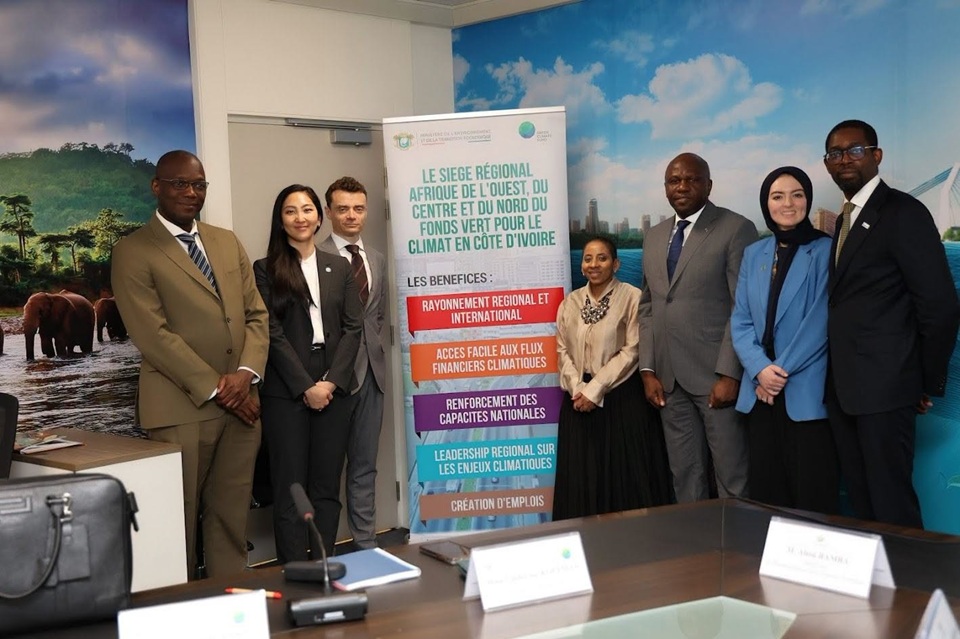
Climate finance continues to play a decisive role in shaping Africa’s agricultural transformation, and Côte d’Ivoire has taken another significant step in strengthening its resilience to climate change after securing a US$50 million financing package from the Green Climate Fund (GCF). Approved during the Green Climate Fund’s 45th Board meeting held in Dushanbe, Tajikistan, on 1 July 2026, the investment will support one of the country’s largest climate-smart agriculture programmes aimed at improving food security, restoring degraded landscapes and helping rural communities adapt to increasingly severe climate risks.
The five-year programme, known as Strengthening Sustainable Land Management and Climate-Resilient Agri-food Systems in Côte d’Ivoire (LARACI), reflects the growing importance of climate finance as an economic development instrument rather than solely an environmental intervention. As climate variability increasingly affects agricultural productivity across Africa, investments that strengthen resilience are becoming central to safeguarding rural incomes, protecting national food systems and reducing long-term fiscal pressures associated with climate-related disasters.
The initiative will be coordinated by Côte d’Ivoire’s Ministry of Environment and Ecological Transition, with implementation led by the Fonds Interprofessionnel pour la Recherche et le Conseil Agricoles (FIRCA). chttp://The CGIAR System Organization will serve as the accredited entity responsible for supporting implementation under the Green Climate Fund framework, bringing international scientific expertise and technical oversight to the programme. The approval comes at a time when African countries are facing mounting pressure to increase agricultural production while simultaneously adapting to worsening climate conditions. Rising temperatures, prolonged droughts, shifting rainfall patterns and land degradation continue to undermine food production across much of the continent, threatening livelihoods in economies where agriculture remains a major source of employment and national income.
According to the programme design, LARACI seeks to address these interconnected challenges through investments that strengthen both agricultural productivity and climate resilience. Rather than focusing solely on increasing yields, the programme integrates sustainable land management, ecosystem restoration, improved climate information services and climate-smart production systems that enable farmers to manage climate risks more effectively. The programme will focus on the regions of N’Zi, Moronou, Iffou, La Mé and Gbêkê, areas where agriculture forms the backbone of local economies but where climate impacts have increasingly disrupted farming systems. Authorities estimate that approximately 147,000 people will benefit directly from programme activities, while another 441,000 people are expected to benefit indirectly through stronger agricultural value chains, improved extension services and enhanced resilience across rural communities.
Beyond direct livelihood improvements, the project also contributes to Côte d’Ivoire’s broader climate commitments. Programme projections indicate emissions reductions of approximately 3.8 million tonnes of carbon dioxide equivalent over its implementation period, highlighting how sustainable agricultural practices can simultaneously support climate adaptation and mitigation objectives. Among the programme’s most significant investments is the expansion of Côte d’Ivoire’s national agrometeorological observation network. Reliable climate data has become increasingly important for African agriculture as weather variability becomes more pronounced. By strengthening weather monitoring systems and improving access to agro-climatic advisory services, farmers are expected to receive more timely information on rainfall patterns, planting windows and climate risks, enabling better production decisions and reducing crop losses.
The initiative also seeks to strengthen agricultural extension services, an area widely recognised as critical for increasing the adoption of climate-smart farming technologies across Africa. Improved extension support will help farmers implement sustainable soil fertility management practices, restore degraded land, adopt agroforestry systems and integrate resilient production technologies into key food value chains, including rice, cassava and yam production. Access to finance represents another important component of the programme. Smallholder farmers across Africa frequently face limited access to affordable capital needed to invest in improved seeds, irrigation, soil restoration and climate-resilient technologies. Through LARACI, participating farmers are expected to gain improved access to climate-smart agricultural finance, enabling investments that can strengthen productivity while reducing exposure to climate-related risks.
The approval also reinforces Côte d’Ivoire’s growing reputation as one of Africa’s leading destinations for international climate finance. Government officials described the Green Climate Fund decision as recognition of the country’s increasing ability to develop large-scale investment programmes that meet international fiduciary, environmental and governance standards required by multilateral climate finance institutions. That recognition extends beyond this latest programme. Earlier this year, Côte d’Ivoire was selected to host the Green Climate Fund’s regional office serving West Africa, Central Africa and part of North Africa, positioning the country as an emerging regional hub for climate governance, project development and sustainable investment mobilisation. The latest financing approval further strengthens that position and signals growing international confidence in the country’s institutional capacity to manage complex climate investment programmes.
For Africa more broadly, the LARACI programme illustrates the evolving nature of climate finance on the continent. Increasingly, climate investments are being designed not simply as environmental projects but as integrated economic development programmes that support food security, employment, infrastructure resilience and natural resource management simultaneously. Agriculture accounts for a significant share of employment across Africa while contributing substantially to GDP in many economies. Yet the sector remains among the most vulnerable to climate change. According to international climate assessments, African farmers experience disproportionate impacts from changing rainfall patterns despite contributing relatively little to global greenhouse gas emissions. This imbalance has strengthened calls for greater international climate finance to support adaptation alongside mitigation efforts.
https://www.aecweek-registration.com/2026/
The Green Climate Fund has emerged as one of the largest multilateral financing mechanisms supporting climate adaptation in developing countries, with agriculture consistently representing one of its priority investment areas. Programmes such as LARACI demonstrate how international climate finance can be structured to support national development priorities while advancing commitments under the Paris Agreement and broader sustainable development objectives. For Côte d’Ivoire, the programme also aligns with wider efforts to improve land management, strengthen agricultural competitiveness and enhance rural resilience as climate pressures intensify. By combining scientific research, institutional capacity, financial resources and community-level implementation, the initiative aims to create agricultural systems that are better equipped to withstand future climate shocks while supporting inclusive economic growth.
As African governments seek greater access to international climate finance, Côte d’Ivoire’s latest approval provides an example of how strong institutional coordination, credible project design and alignment with national development priorities can unlock significant investment. The programme is expected to strengthen resilience not only within farming communities but also across the broader agricultural economy, reinforcing the role of climate-smart agriculture as an increasingly important pillar of sustainable development across Africa.


