


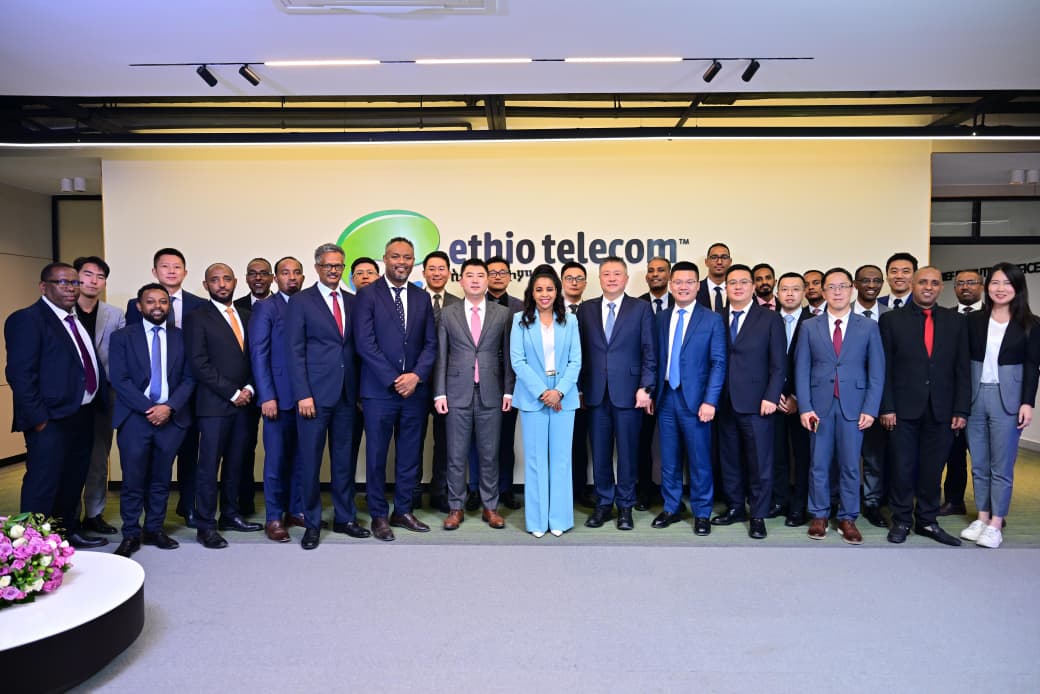
Ethio Telecom and Huawei have agreed to deepen their long-standing strategic partnership as Ethiopia accelerates its digital transformation agenda, with both companies prioritising enterprise digitalisation, small and medium-sized business (SME) growth, artificial intelligence (AI), cloud computing and digital financial services as key pillars of the country’s next phase of economic development. The agreement, announced following high-level discussions between Ethio Telecom Chief Executive Officer Frehiwot Tamru and Huawei Northern Africa President Li Shen, aligns with Ethio Telecom’s Next Horizon: Digital & Beyond 2028 strategy, which seeks to reposition the state-owned operator from a traditional telecommunications provider into a broader technology and digital services company serving both domestic and regional markets.
The expanded collaboration reflects a wider shift taking place across Africa, where telecommunications operators are increasingly evolving into integrated digital platforms supporting governments, businesses and consumers. Rather than focusing solely on expanding network infrastructure, operators are investing in cloud services, enterprise software, cybersecurity, digital payments and AI-enabled services that underpin wider economic modernisation. According to Ethio Telecom, the strengthened partnership will support the development of integrated digital solutions tailored to sectors including finance, manufacturing, agriculture, public services and commerce by combining connectivity with cloud computing, Internet of Things (IoT) technologies, cybersecurity and advanced data services.
 Enterprise digitalisation has become an increasingly important driver of productivity across African economies, particularly as governments pursue industrialisation, digital public services and regional trade integration under the African Continental Free Trade Area (AfCFTA). Ethiopia, one of Africa’s fastest-growing digital markets, has identified digital infrastructure as a central component of its long-term economic transformation strategy. By expanding technology services beyond consumer telecommunications, Ethio Telecom is seeking to position itself as a strategic enabler of private sector competitiveness while supporting the country’s broader digital economy ambitions.
A significant component of the partnership focuses on strengthening digital services for SMEs through deeper integration with Ethio Telecom’s telebirr mobile financial services platform. The companies intend to combine digital payments with business management tools, e-commerce capabilities and other value-added digital services designed to improve operational efficiency and expand market access for small businesses. Digital financial ecosystems have become increasingly important across Africa, where mobile money platforms continue to improve financial inclusion while lowering transaction costs for businesses operating in both formal and informal sectors.
The partnership also places considerable emphasis on developing local innovation capacity. Both organisations agreed to expand collaboration in software development, systems integration, technical support and solution customisation by strengthening local engineering expertise and research partnerships. This reflects a growing recognition across African technology markets that sustainable digital transformation depends not only on importing technology but also on building domestic technical capabilities capable of adapting digital solutions to local economic conditions. Developing local software ecosystems may also strengthen employment opportunities in high-value technology sectors while reducing long-term dependence on external technical support.
Digital inclusion remains another priority area within the expanded agreement. The two companies are exploring mechanisms to improve smartphone affordability and broaden access to digital devices through innovative financing models and market initiatives. Device affordability continues to represent one of the largest barriers to digital participation across Africa despite rapid growth in mobile network coverage. Increasing access to smartphones is expected to support greater adoption of digital financial services, online commerce, digital education and e-government platforms while expanding participation in the wider digital economy.
Beyond commercial objectives, the partnership incorporates broader environmental, social and governance (ESG) priorities through commitments to collaborate on digital literacy, rural connectivity, digital education, sustainable infrastructure and community development initiatives. These programmes recognise that digital infrastructure increasingly functions as both an economic asset and a social development tool, particularly in expanding access to education, healthcare, financial services and public administration in underserved communities.
The companies also agreed to strengthen joint marketing, customer education and digital awareness programmes to encourage wider adoption of digital services, including enterprise solutions and telebirr. Improving awareness and digital capabilities among businesses and consumers is increasingly viewed as an essential complement to infrastructure investment, ensuring that technology deployment translates into measurable productivity gains and broader economic participation.
 Huawei reaffirmed its commitment to supporting Ethio Telecom’s transition into a technology-driven digital services provider while expressing support for Ethiopia’s ambition to expand digital innovation beyond its domestic market into regional African economies. This reflects broader trends within Africa’s telecommunications sector, where operators are increasingly seeking regional growth opportunities by exporting digital platforms, financial technology services and enterprise solutions alongside traditional connectivity.
For Africa, the partnership illustrates the evolving role of telecommunications companies in supporting structural economic transformation. As governments pursue digitalisation as a foundation for industrial competitiveness, financial inclusion and public sector modernisation, investments that integrate connectivity with enterprise technologies, digital finance and local innovation capacity are becoming increasingly significant. Ethiopia’s strategy demonstrates how digital infrastructure is increasingly being positioned not simply as a communications network but as a platform for economic diversification, private sector development and regional technological integration capable of supporting broader continental development objectives.


