


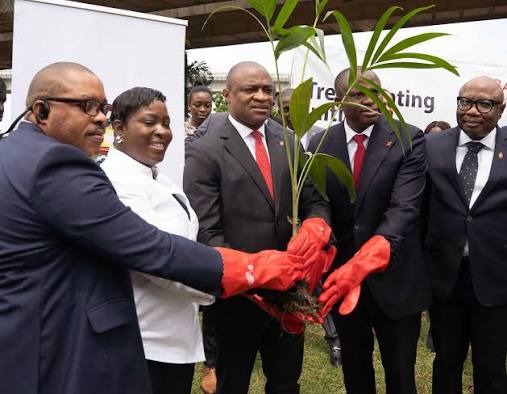
United Bank for Africa (UBA) has been named Nigeria’s Best Bank for Environmental, Social and Governance (ESG) and Best Bank for Retail Banking at the 2026 Euromoney Awards for Excellence, underscoring the growing role of sustainable finance and digital innovation in strengthening Africa’s banking sector. The awards, presented in London, recognised the bank’s expansion of green financing, financial inclusion initiatives and digital banking capabilities at a time when African financial institutions are increasingly expected to balance commercial growth with sustainable development objectives.
The recognition reflects a broader shift across African banking, where ESG performance is becoming an increasingly important factor in attracting investment, managing long-term risk and supporting economic resilience. International investors, regulators and development finance institutions are placing greater emphasis on sustainability disclosures, climate-related financing and social impact, positioning banks as critical intermediaries in financing Africa’s energy transition and inclusive economic growth.
According to Euromoney, UBA distinguished itself through initiatives that integrate sustainability into its lending and operational strategy. These include the introduction of a Green Financing Facility designed to support households and businesses investing in renewable energy solutions, as well as a ₦5 billion financing programme established in partnership with the Bank of Industry to expand access to capital for women-owned enterprises. The publication also cited the bank’s commitment to achieving net-zero emissions by 2050, alongside investments in operational sustainability through the installation of solar-powered energy systems across 50 branches and ESG capacity-building programmes that have trained more than 16,000 employees across the UBA Group.
The awards also recognised the continued expansion of UBA’s retail banking franchise, highlighting how digital innovation is reshaping financial inclusion across the continent. The bank reported serving more than 37 million retail customers by the end of 2025, while retail banking revenue increased more than fourfold to ₦429.5 billion. Among the innovations recognised was LEO, UBA’s artificial intelligence-powered banking platform, which became Africa’s first AI-enabled banking assistant capable of facilitating cross-border money transfers in local currencies through the Pan-African Payment and Settlement System (PAPSS).
The integration of PAPSS into retail banking reflects wider efforts to reduce the cost and complexity of cross-border transactions within Africa. Developed under the African Continental Free Trade Area (AfCFTA), PAPSS seeks to enable payments in local currencies without routing transactions through foreign exchange markets, reducing settlement costs and supporting greater regional trade. Financial institutions capable of integrating these systems are expected to play an increasingly significant role in facilitating intra-African commerce and supporting the continent’s economic integration agenda.
Beyond technological innovation, sustainable finance is becoming an important strategic priority for African banks as governments pursue climate adaptation, renewable energy deployment and industrial decarbonisation. According to international estimates, Africa requires hundreds of billions of dollars in climate-related investment over the coming decades to finance clean energy infrastructure, resilient agriculture, sustainable transport and climate adaptation measures. Commercial banks are expected to become increasingly important partners alongside development finance institutions in mobilising this capital.
Supporting small and medium-sized enterprises, women-led businesses and renewable energy investments also carries broader economic implications. SMEs account for the majority of employment across African economies, while expanding access to clean energy financing can improve energy security, reduce operating costs for businesses and strengthen resilience against volatile fossil fuel markets. Financial institutions that combine commercial lending with sustainability objectives may therefore contribute to wider development outcomes beyond their traditional banking functions.
Read also: https://dailytrust.com/uba-wins-euromoneys-best-esg-retail-banking-awards/
UBA Group Managing Director and Chief Executive Officer Oliver Alawuba described the awards as recognition of the bank’s strategy to combine commercial performance with sustainable development across its markets. He said the institution remained focused on expanding financial inclusion, supporting businesses and communities, and financing Africa’s future through innovative banking solutions.
Group Head of Marketing, Brand and Corporate Communications Alero Ladipo said the recognition reflected the bank’s customer-focused approach, adding that investments in digital services, clean energy financing and entrepreneurial support were designed to deliver long-term value while expanding access to financial services across the continent.
UBA currently operates in 20 African countries in addition to the United Kingdom, the United States, France and the United Arab Emirates, serving more than 45 million customers through its branch network and digital platforms. Its growing international recognition reflects the increasing importance of African financial institutions in mobilising domestic capital, supporting regional trade and financing sustainable economic transformation.
The Euromoney awards also illustrate a broader evolution within Africa’s banking industry. ESG performance is no longer viewed solely as a compliance exercise but as an increasingly important component of corporate strategy, investor confidence and long-term competitiveness. As climate risks, technological disruption and regional integration reshape financial markets, banks capable of aligning commercial objectives with sustainable development priorities are likely to play a central role in financing Africa’s transition towards more resilient and inclusive economies.


