


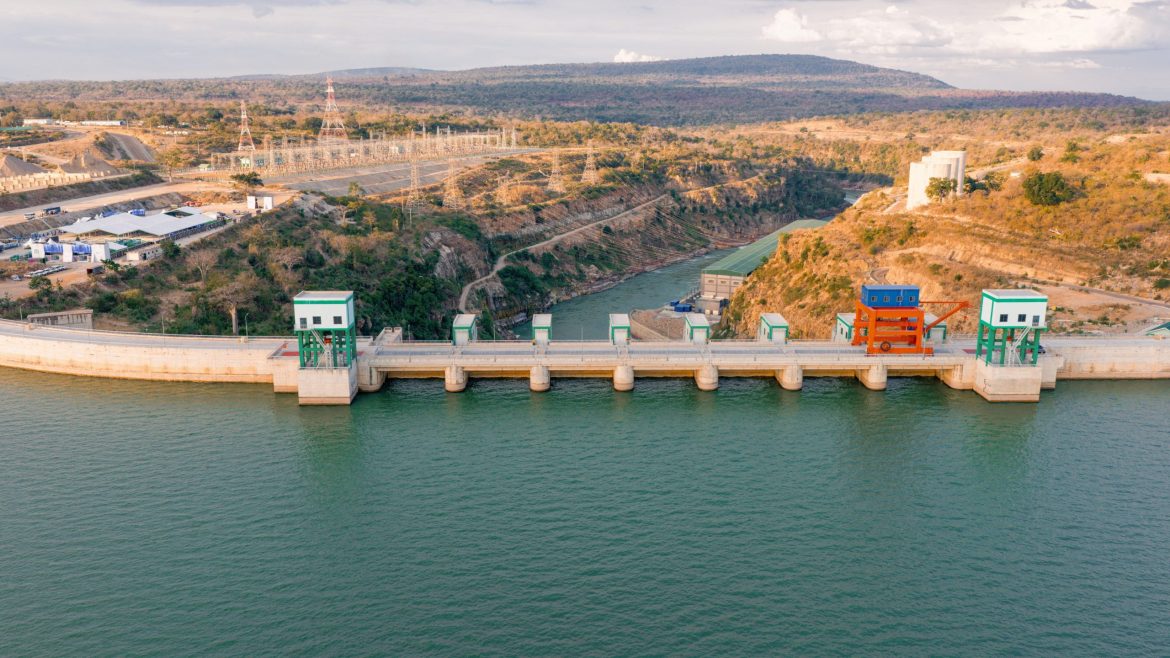
Tanzania has formally inaugurated the 2,115-megawatt (MW) Julius Nyerere Hydropower Project on the Rufiji River, adding one of the largest single generating assets in East Africa to the national grid and shifting the country’s electricity challenge from generation shortages increasingly towards transmission, distribution and the ability to convert additional power into wider economic activity. Inaugurated by President Samia Suluhu Hassan on August 22, the project comprises nine turbines of 235 MW each and represents an investment of about 7.452 trillion Tanzanian shillings, according to the Ministry of Energy.
The project, constructed by Egypt’s Elsewedy Electric and Arab Contractors, is Tanzania’s largest electricity-generation project and has been financed by the Tanzanian government. The plant was completed in March 2025 and had already begun contributing electricity to the national grid before its formal inauguration. Its scale gives Tanzania an asset capable of materially changing the balance between electricity supply and demand at a time when the economy is expanding and electricity consumption is rising.
Tanzania’s peak electricity demand reached about 2,199 MW in February 2026, according to data cited in the country’s 2026/27 energy-sector plans. The government subsequently reported that national installed generation capacity had reached about 4,646 MW, compared with peak demand of 2,271 MW by August, creating an estimated surplus of 2,375 MW. The numbers illustrate the significance of Julius Nyerere. At 2,115 MW, the project alone is close to the level of Tanzania’s peak electricity demand earlier in the year. Its addition substantially increases the country’s generation buffer and provides room for industrial users, commercial activity and new connections, provided the transmission and distribution systems can carry the electricity to where it is needed.

That qualification is increasingly important. Tanzania’s Energy Minister Deogratius Ndejembi said at the inauguration that increasing generation capacity alone would not be sufficient and that the country needed a transmission network capable of receiving and moving the electricity generated by Julius Nyerere to different parts of the country. A 400-kilovolt transmission line between Chalinze and Dodoma has been completed to strengthen the movement of electricity from the project, while other transmission investments are being developed to distribute power across the national system.
The infrastructure challenge is not unique to Tanzania. Across Africa, large generating projects have frequently advanced faster than the transmission and distribution networks needed to absorb their output. The International Hydropower Association says transmission infrastructure is critical to unlocking Africa’s hydropower potential and improving cross-border electricity trade. In 2025, Africa had about 52 GW of installed hydropower capacity and generated 179 terawatt-hours (TWh) from hydropower. More than 4 GW of conventional hydropower capacity was added across the continent during the year.
Tanzania’s project therefore arrives during a broader revival of large-scale hydropower development in Africa. Ethiopia fully inaugurated the 5,150 MW Grand Ethiopian Renaissance Dam in 2025, while Tanzania completed Julius Nyerere, creating two of the continent’s most consequential new hydropower assets in a relatively short period. The two projects demonstrate the capacity of large dams to transform national electricity systems, but they also highlight the capital intensity and infrastructure requirements associated with centralised power generation.
Hydropower remains attractive because it can deliver large volumes of electricity from a single project and, unlike wind and solar, is not directly dependent on hourly variations in sunlight and wind speeds. This does not make it a substitute for other renewable technologies. Rather, it gives hydropower a different role in a diversified electricity system where solar, wind, geothermal, gas, storage and regional power trade can complement one another.
For Tanzania, the immediate economic question is how the additional electricity will be absorbed. Reliable electricity can reduce the need for expensive backup generation, improve operating conditions for manufacturers and support investment in electricity-intensive industries. Tanzania’s Ministry of Energy has also indicated that electricity from Julius Nyerere is being linked to major economic centres, including Morogoro and Dodoma, while the transmission network is being strengthened to move power towards regions including Singida, Tabora, Shinyanga, Simiyu, Geita and Mwanza.
The mining sector could be among the industries to benefit. Tanzania is a significant gold producer and has ambitions to expand mineral processing and other value-added activities. Reliable electricity can reduce operating risks for mines and processing facilities while supporting industrial development around mineral-producing regions. The government has also indicated plans to develop dedicated electricity infrastructure for production areas, including mining zones, as part of its wider power strategy.
Agriculture and agro-processing present another potential demand source. Tanzania’s industrialisation strategy depends partly on moving agricultural products further up the value chain through processing, cold storage, irrigation and manufacturing. These activities require dependable electricity, particularly outside the major urban centres. The economic value of Julius Nyerere will therefore depend not only on the number of megawatt-hours generated but on whether those megawatt-hours support productive activity.
Electricity access remains an equally important consideration. Tanzania’s National Energy Compact aims to increase electricity connectivity from 46% in 2022 to 75% by 2030, with an additional 8.3 million households targeted for connection. The government also aims to increase the share of renewable energy in the generation mix to 75% by 2030.
TANESCO has outlined a large distribution programme intended to support more than 8.3 million additional household connections by 2030, alongside substantial investment in medium- and low-voltage networks and distribution transformers. The utility is also deploying smart meters and planning network reinforcement and automation in Dar es Salaam, Pwani, Dodoma and Mwanza. This makes the next phase of Tanzania’s electricity expansion less about building generation alone and more about building the infrastructure that connects generation with economic demand. If new power cannot be transmitted efficiently or reaches consumers through weak distribution networks, the economic benefits of additional generating capacity will be constrained.
There is also an emerging regional dimension. Tanzania’s government says the additional generation capacity creates an opportunity to sell electricity to neighbouring countries, with an agreement already in place with Zambia and arrangements with Kenya allowing electricity trade according to demand. The government has also said it is in discussions with other neighbouring countries about electricity trading. Regional electricity trade could become increasingly important as African countries develop uneven mixes of generation. A country with abundant hydropower can export during periods of surplus, while another country with strong solar, wind or gas resources can provide power at different times. Such integration can improve system efficiency and reduce the need for every country to maintain expensive reserve capacity independently.
The commercial opportunity, however, depends on transmission interconnections, market rules, payment arrangements and regulatory coordination. The Eastern Africa Power Pool has been working towards deeper regional electricity integration, and Tanzania’s expanded generation capacity could strengthen its position within that emerging market. The project also illustrates the role of African and international engineering companies in building major energy infrastructure. Elsewedy Electric and Arab Contractors were responsible for the engineering, procurement and construction of the project under a joint venture. The project has also deepened technical and economic cooperation between Tanzania and Egypt, with the two Egyptian companies bringing experience in large infrastructure and power projects.
For Tanzania, the government’s decision to finance the project through domestic resources also makes the plant significant from a public-finance perspective. The investment of about 7.452 trillion shillings represents a substantial commitment of public capital. The economic return will consequently depend on whether increased electricity production supports industrial output, investment, exports, household connections and broader productivity sufficiently to justify the scale of expenditure.
Large hydropower projects also carry environmental and social considerations that remain relevant after construction. The Rufiji basin is an important ecological and economic system, and the long-term management of the reservoir, water resources and surrounding ecosystems will affect the project’s resilience and wider development impact. Climate variability also creates a need for careful water-resource management, particularly as changing rainfall patterns can affect hydrological conditions.
This is one reason Africa’s future electricity system is unlikely to be built around a single technology. The continent possesses large untapped hydropower potential, but solar and wind can be deployed more quickly and at smaller scales, while geothermal offers firm renewable generation in countries such as Kenya and Ethiopia. Battery storage and stronger regional grids can further help integrate variable renewable power.

The International Hydropower Association estimates that Africa has some of the world’s largest untapped hydropower resources while also having low levels of electricity access and per-capita electricity consumption. It says almost half of the continent’s installed hydropower capacity has been operating for more than 25 years, meaning that rehabilitation and modernisation of existing facilities could be as important as new dam construction.
For Tanzania, Julius Nyerere therefore represents both an endpoint and a beginning. It marks the completion of a major generation project, but it also creates a requirement for continued investment in transmission, distribution, industrial demand and regional electricity markets. The wider African lesson is similar. Large power plants can materially alter national electricity balances, but generation capacity is only one part of an effective energy system. The real economic value emerges when electricity can be transmitted reliably, distributed affordably and consumed productively by households, businesses and industries.
Tanzania now has a significantly larger generation base and an opportunity to use that capacity to accelerate industrialisation, expand electricity access and deepen regional power trade. Whether Julius Nyerere becomes a catalyst for those outcomes will depend on the infrastructure and institutions built around it.
For Africa’s energy transition, the project reinforces a practical point: the continent needs more renewable electricity, but it also needs the transmission networks, distribution systems, financing structures and regional markets capable of turning generation capacity into reliable economic power.


