


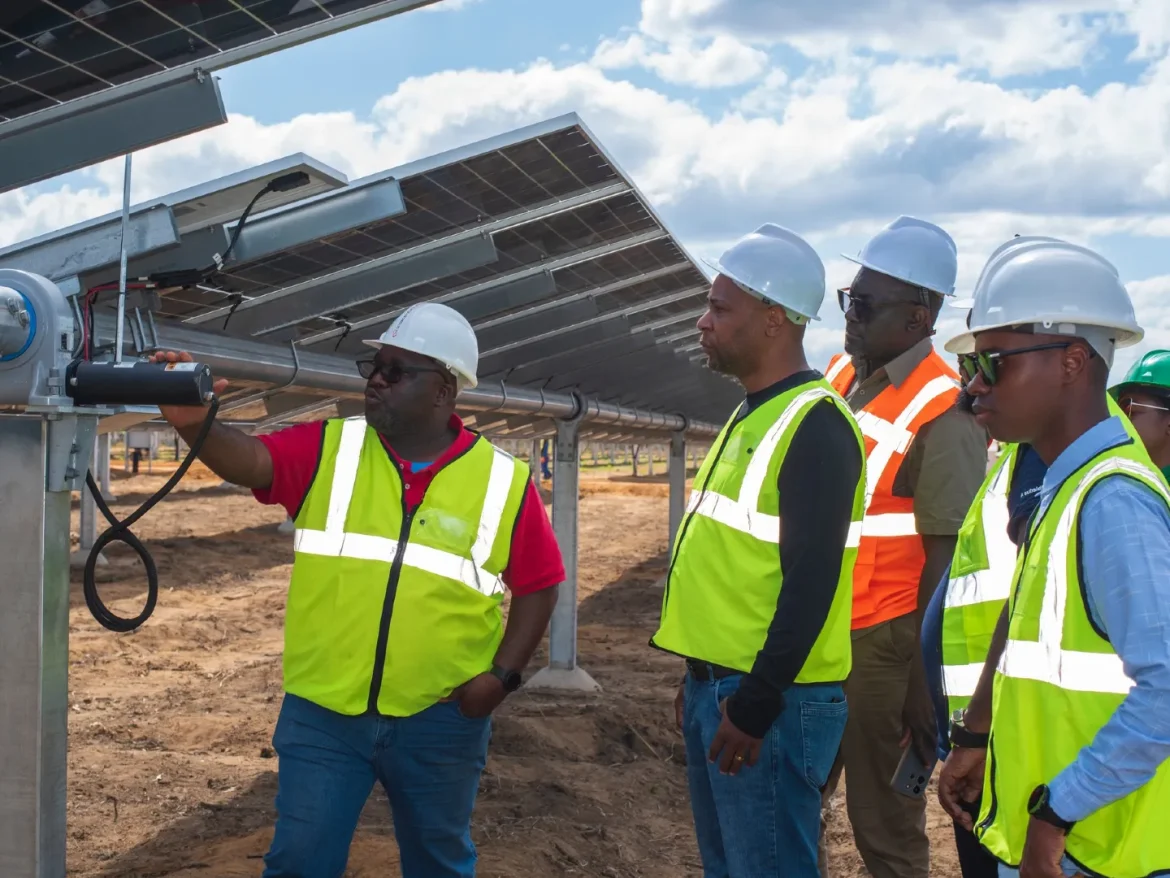
Solarcentury Africa and Zambia’s Industrial Development Corporation (IDC) have agreed to develop a 67 megawatt-peak solar power plant near Chisamba in Central Province, with the project designed primarily to supply large industrial users as Zambia seeks to address electricity shortages that have constrained businesses and economic activity. The plant will connect to the ZESCO transmission backbone and is intended to reduce the need to move electricity from the country’s southern generation centres, according to the developers.
The project comes as Zambia attempts to diversify an electricity system historically dominated by hydropower and exposed to increasingly severe weather-related supply risks. Government data show that Zambia had about 3,880MW of installed generation capacity in early 2026, but available domestic generation was only about 1,635MW against national demand of roughly 2,400MW, requiring substantial electricity imports.
The gap has been particularly damaging for industry. Zambia’s mining sector, which is central to export earnings and investment, competes with households, agriculture and manufacturing for constrained electricity supplies. The International Monetary Fund said electricity shortages had disproportionately affected households while the government prioritised large users such as mines, agriculture and manufacturing through alternative supply arrangements.
Against that backdrop, the 67MW project represents a shift towards using privately developed renewable generation to supply industrial demand more directly. IDC has already secured the site and undertaken initial technical studies, while Solarcentury Africa is expected to complete the project’s development, design, financing and delivery. The companies signed a Heads of Terms agreement rather than a final investment agreement, meaning the project remains subject to further development and financing steps.
The proposed plant will connect near Chisamba to the ZESCO backbone, an arrangement that could help reduce pressure on transmission routes carrying power from the south towards major demand centres. This matters because Zambia’s electricity challenge is no longer simply one of generation capacity. Transmission constraints, hydrological conditions and the financial position of the national utility all affect how much electricity can actually reach consumers.
ZESCO’s own reporting illustrates the scale of the infrastructure challenge. The utility has been expanding transmission and distribution networks while adding solar generation, including more than 100MW commissioned from two solar projects in 2025. It has also identified hundreds of megawatts of additional utility-scale solar capacity for commissioning as part of efforts to diversify the electricity mix.
The urgency has been heightened by Zambia’s dependence on hydropower. More than 80% of installed generation capacity was still based on hydro in 2025, according to the government’s budget documents. The severe drought that began affecting the country in 2024 reduced water availability at major hydropower facilities and forced Zambia to rely more heavily on imports and alternative generation.
The climate dimension therefore has a direct financial and industrial consequence. Drought can reduce electricity production precisely when businesses still have to meet production commitments, while emergency imports expose the system to regional power prices, foreign-exchange pressures and transmission constraints. Diversifying generation with solar does not eliminate these risks, but it can reduce the dependence of electricity supply on rainfall.
The economic significance of the Chisamba project will depend partly on how the electricity is contracted and delivered to industrial customers. Solarcentury Africa operates within Zambia’s evolving open-access electricity framework and is developing a merchant power portfolio in the Southern African Power Pool. Its Mailo solar project in Zambia has already begun trading electricity through the regional power market, providing an example of a private renewable project operating outside the traditional model of relying exclusively on a long-term utility power purchase agreement.
That development is relevant to Zambia’s broader electricity-market reforms. A more diversified group of generators and power traders could provide large consumers with additional procurement options while reducing the pressure on ZESCO to finance all new generation itself. But the model also requires reliable transmission infrastructure, transparent market rules and financially viable counterparties.
The government’s fiscal position makes that question particularly important. Zambia’s electricity sector has required substantial investment while the state faces constraints on its ability to provide conventional guarantees for private-sector projects. A World Bank assessment of Zambia’s energy transition has previously identified private-sector participation as an important avenue for addressing power shortages under those fiscal constraints.
For IDC, the project also sits within a wider industrialisation mandate. The state-owned investment corporation is responsible for supporting Zambia’s commercial investment agenda and has interests across sectors including energy, mining, agriculture, manufacturing and infrastructure. Its involvement therefore links the solar project to a broader question: whether reliable electricity can be developed alongside the industrial capacity that Zambia needs to create jobs and retain more value from its natural resources.
That connection is especially important for the mining industry. Zambia is seeking to expand copper production at a time when demand for the metal is being supported by electrification, renewable-energy infrastructure and other technologies associated with the global energy transition. Yet mines require large and reliable amounts of electricity, creating a potential tension between Zambia’s ambition to benefit from the clean-energy economy and the limitations of its own power system.
Solar power can help address part of that demand, but its variable output creates additional requirements for grid management, balancing and potentially energy storage. The economic case for new solar generation therefore extends beyond the cost of photovoltaic equipment to include the transmission capacity, system flexibility and market arrangements needed to integrate it effectively.
The project also reflects a broader change in Africa’s energy investment landscape. Across the continent, industrial consumers are increasingly exploring direct renewable-energy procurement as utilities struggle with constrained balance sheets, ageing infrastructure or insufficient generation. Private generation can provide an alternative source of supply, but its success depends on whether the resulting arrangements complement rather than fragment national electricity systems.
Zambia’s experience illustrates the distinction between adding renewable capacity and creating a resilient electricity market. The government has set a target of universal access to clean, sustainable and reliable energy by 2030 and has been working to increase the contribution of non-hydro generation.
The 67MW project is relatively small compared with Zambia’s national electricity deficit, but its intended industrial application gives it significance beyond its capacity. If developed successfully, it could demonstrate how renewable generation can be connected to specific industrial demand while reducing reliance on constrained public-sector generation and transmission resources.
There are, however, several stages between a Heads of Terms agreement and electricity reaching an industrial customer. Financing, grid connection, construction, permitting, commercial contracts and the financial strength of buyers will determine whether the proposed capacity becomes operational. The experience of Zambia’s wider solar pipeline suggests that the country’s challenge is increasingly one of converting project announcements and development pipelines into dependable generation.
 For Africa, that distinction is material. The continent’s energy transition is taking place alongside rapid growth in electricity demand from mining, manufacturing, data infrastructure, transport and urbanisation. In countries where public utilities cannot finance the required expansion alone, private renewable generation may become an increasingly important component of the investment mix.
Zambia’s 67MW project consequently offers a test of whether renewable energy can serve not only as a climate solution but as industrial infrastructure. Its ultimate value will be measured less by the headline capacity than by whether it provides predictable electricity to productive sectors, reduces exposure to hydrological shocks and supports an electricity market capable of attracting further investment without placing unsustainable costs on the public finances.


