


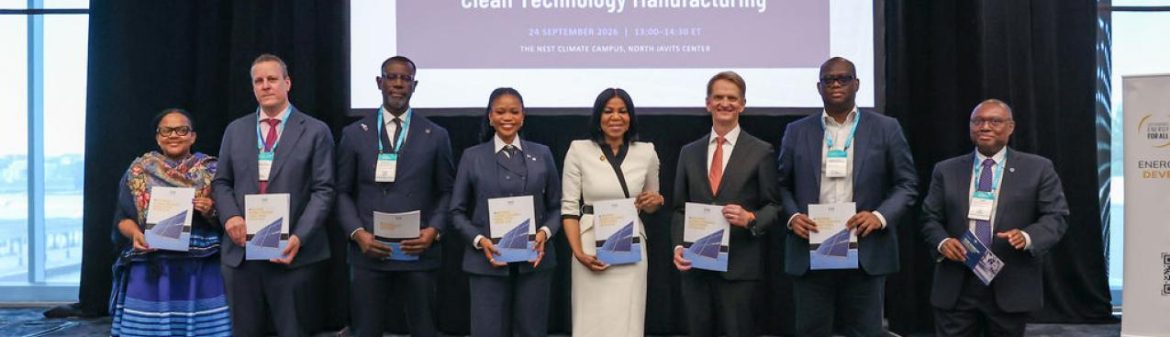
Botswana has launched two complementary national instruments designed to move its renewable energy ambitions closer to implementation while using the energy transition as a platform for industrial development, investment and economic diversification. The Botswana National Renewable Energy Power Sector Plan and the Botswana Clean Technology Manufacturing Policy and Investment Guide were launched in New York City on 24 September 2026 on the sidelines of New York City Climate Week and the United Nations General Assembly. Developed through the Ministry of Minerals and Energy with support from Sustainable Energy for All (SEforALL), the two instruments establish a framework that links renewable electricity development with the development of domestic clean technology value chains. SEforALL said the plan provides the analytical foundation for scaling renewable generation, while the manufacturing guide identifies opportunities to develop local value chains around solar photovoltaic manufacturing and related industries.
The launch signals an effort by Botswana to treat renewable energy not only as a source of cleaner electricity but also as an industrial and investment opportunity. The National Renewable Energy Power Sector Plan sets out scenarios, investment priorities and recommendations intended to guide the power sector towards Botswana’s 2030 renewable energy objectives and beyond. The Clean Technology Manufacturing Policy and Investment Guide complements that planning by examining how the expansion of renewable energy can create demand for equipment, technical services, manufacturing, installation and maintenance. Together, the instruments are intended to provide greater policy clarity to investors while establishing a pathway through which renewable energy deployment can contribute to domestic value creation, employment and economic diversification.
Speaking at the launch, Hon. Bogolo Joy Kenewendo, Minister of Minerals and Energy of the Republic of Botswana, said the country was entering a new phase in its energy development in which renewable energy would be central to strengthening the power system while creating opportunities for investment, industrial development and economic diversification. She described the two instruments as a roadmap for moving from ambition to implementation. Her remarks reflect the broader direction of Botswana’s energy policy, which has increasingly focused on reducing dependence on imported energy, improving domestic generation capacity and creating conditions for private-sector investment.

The approach is consistent with Botswana’s National Energy Policy, which identifies increased penetration of new and renewable energy sources as a pathway towards energy self-sufficiency and greater security of supply. The policy also links energy development with investment, export revenues, production in other economic sectors and employment. It envisages Botswana moving from a position of energy importer towards self-sufficiency, with potential surplus electricity available for regional export. The new renewable energy instruments therefore build on an established policy objective while providing more specific planning and investment tools for the next phase of the transition.
The scale of Botswana’s renewable energy ambition is becoming increasingly significant. The country’s Energy Compact targets a 50% renewable energy contribution by 2030, with solar and wind identified as major components of the planned expansion. Botswana’s National Development Plan discussions have also identified the need for increased generation capacity and stronger transmission infrastructure to meet domestic demand and potentially support electricity exports to the region. SEforALL has separately highlighted a target of 1.5 GW of solar photovoltaic capacity by 2030, alongside the broader objective of increasing renewable energy’s contribution to the electricity mix.
For Botswana, the implications extend beyond the amount of electricity generated. Reliable domestic power is a foundation for manufacturing, mining, digital infrastructure, commercial services and other productive activities. The country’s National Energy Policy has recognised that electricity transmission and distribution infrastructure must be strengthened to support economic growth and universal access. This means that renewable generation will need to be accompanied by investment in transmission, distribution, grid flexibility and other enabling infrastructure if the new capacity is to translate into wider economic activity.
The Clean Technology Manufacturing Policy and Investment Guide introduces a second layer to this energy strategy by focusing on the economic opportunities created by renewable energy deployment itself. Solar photovoltaic manufacturing and related activities can create demand for assembly, components, mounting structures, installation services, maintenance and technical expertise. SEforALL has identified opportunities in Botswana for local assembly of solar modules, manufacturing of mounting structures and components, and processing of energy-transition minerals. However, the organisation has also noted that the commercial viability of these opportunities will depend on supportive policies and incentives, infrastructure, skilled workers, access to finance and regional markets.
This regional dimension could be important because Botswana’s domestic market alone may not provide sufficient scale for every clean technology manufacturing activity. The Manufacturing Policy and Investment Guide places Botswana’s ambitions within the Southern African Development Community, the Southern African Customs Union and the African Continental Free Trade Area. These frameworks could allow companies operating in Botswana to access wider markets for clean technologies, components and related services. The potential benefit is not necessarily that Botswana would manufacture every component of a renewable energy system domestically, but that it could develop specialised capabilities that fit into regional and continental value chains.
Such an approach is particularly relevant as African countries seek to capture more economic value from the global energy transition. Much of the continent’s renewable energy development has historically involved imported equipment, foreign technology and external project expertise. Building domestic manufacturing and technical capabilities can create opportunities for African businesses to participate in more stages of the value chain, although competitiveness will depend on production costs, market size, skills, infrastructure, financing and access to technology.
For Botswana, the manufacturing guide therefore introduces an industrial-policy question alongside the energy-policy question: how much of the economic activity generated by the renewable energy transition can be retained within the country? Solar projects create demand for equipment and services, but without local capabilities a significant proportion of that expenditure can flow to external suppliers. Developing competitive local businesses could allow more value to remain within the domestic economy while creating opportunities for skills development and employment.
The policy package also comes as Botswana seeks to strengthen energy security. The National Energy Policy established the objective of achieving a more self-sufficient energy system and reducing dependence on external supplies. Increasing domestic renewable generation can diversify the power system, particularly given Botswana’s substantial solar resource. However, the transition also creates new requirements for planning and system management. Solar and wind generation are variable, meaning that transmission capacity, storage, grid management and complementary generation resources will influence how much renewable electricity can be integrated reliably.
This makes the Renewable Energy Power Sector Plan important as an investment-planning instrument rather than simply a statement of ambition. SEforALL describes the plan as a technical roadmap intended to translate Botswana’s renewable energy ambition into a credible and financeable pathway, covering renewable energy potential, grid investment needs and required policy and institutional reforms. The ability to identify these requirements clearly can help government and private investors assess where capital, infrastructure and institutional reforms are needed to move projects from planning to implementation.
The role of private capital will be particularly important. Renewable energy projects require substantial upfront investment, while clean technology manufacturing requires capital for facilities, equipment, workforce development and market development. Policy certainty can therefore influence whether investors are prepared to commit capital to projects with long development horizons. The Clean Technology Manufacturing Policy and Investment Guide seeks to address this by identifying investment opportunities, policy incentives, institutional support and other measures intended to attract and retain private capital.
Damilola Ogunbiyi, Chief Executive Officer and Special Representative of the United Nations Secretary-General for Sustainable Energy for All, said Botswana had an opportunity to turn its renewable energy ambitions into an engine for broader economic transformation, investment, innovation and sustainable growth. Her assessment reflects SEforALL’s broader mandate to support countries in advancing sustainable energy transitions and mobilising investment. SEforALL currently works with more than 200 partners and supports countries seeking to accelerate progress towards universal energy access and sustainable energy transitions.
The Botswana initiative also illustrates how energy security and climate action can intersect with economic policy. Increasing renewable generation can diversify the electricity system and, depending on the technologies displaced, reduce emissions from power generation. At the same time, using renewable electricity to support productive activities can improve the economic value generated from clean energy investment. The manufacturing guide takes this concept further by seeking to build industrial opportunities around the technologies required for the transition.
There are, however, important implementation considerations. Manufacturing does not automatically become competitive because a government identifies an investment opportunity. Companies need reliable electricity, transport and digital infrastructure, skilled labour, finance, predictable regulation and sufficient market demand. Botswana’s participation in SADC, SACU and AfCFTA could help address the market-size challenge, but regional integration alone will not guarantee commercially viable manufacturing. Businesses will still need to compete on cost, quality, reliability and technological capability.
The development of technical skills will also be important. A growing renewable energy market requires engineers, technicians, installers, project managers, financiers, environmental specialists and other professionals. If Botswana can align skills development with the investment opportunities identified in the two instruments, the energy transition could contribute not only to infrastructure development but also to the development of a workforce capable of supporting emerging clean technology industries.
The environmental dimension of clean technology manufacturing will also require attention. Renewable energy technologies can support lower-emission electricity systems during their operational life, but their production involves materials, energy, transportation and eventual end-of-life management. As Botswana develops clean technology manufacturing capabilities, environmental standards and resource-efficiency practices will therefore be relevant to ensuring that industrial growth remains aligned with wider sustainability objectives.
The two instruments ultimately reinforce one another. The Botswana National Renewable Energy Power Sector Plan addresses the supply side of the transition by identifying how renewable electricity generation can expand, while the Botswana Clean Technology Manufacturing Policy and Investment Guide focuses on the industrial opportunities that can emerge around that expansion. The combined approach moves the policy discussion beyond renewable generation capacity towards questions of investment, domestic value addition, manufacturing, employment, skills and regional trade.

The initiative also fits within the broader objectives of African Union Agenda 2063, particularly Goal 4 on transformed economies and job creation. Botswana’s own Agenda 2063 monitoring framework identifies manufacturing value added, research and development and economic growth among the indicators associated with Goal 4. Linking renewable energy investment with clean technology manufacturing, value-chain development and employment therefore places Botswana’s energy transition within a wider continental discussion about industrialisation and economic transformation.
For the wider African energy transition, Botswana’s approach highlights a question facing many countries: whether renewable energy expansion can generate economic value beyond the electricity produced. Across the continent, governments are seeking to improve energy access and security while attracting investment into renewable generation. The opportunity is to connect those investments with domestic businesses, technical capabilities, manufacturing and regional markets. Botswana’s two instruments provide a policy framework for pursuing that connection, although their eventual impact will depend on financing, implementation capacity, infrastructure development and investor response.
The launch of the Botswana National Renewable Energy Power Sector Plan and the Botswana Clean Technology Manufacturing Policy and Investment Guide therefore marks a shift towards integrating energy and industrial policy. The immediate task is to translate the plans into financeable renewable energy projects, commercially viable clean technology businesses and the infrastructure required to connect both. If implementation is supported by investment, skills development, regional market access and effective institutions, renewable energy could become not only a means of strengthening Botswana’s power system but also a platform for new industrial activity and economic diversification. The outcome will ultimately be determined by how effectively the country converts the policy clarity created by the two instruments into projects, investment and productive capacity.


