


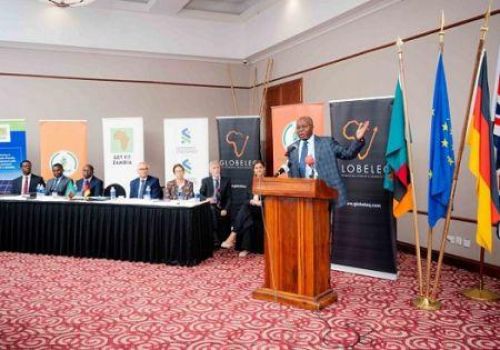
Globeleq has reached financial close on the 40-MWac Kafue Solar project in Zambia, clearing the way for construction of a renewable energy facility that has been in development for nearly eight years and adding new solar generation to a power system seeking to diversify beyond heavy dependence on hydropower. The 56-MWp photovoltaic project near Kafue Town in Lusaka Province will comprise two adjacent 20-MWac solar plants and is expected to generate approximately 123 GWh of electricity annually once operational. The project was awarded under the GET FiT Zambia programme and will sell its electricity to state-owned utility ZESCO under a 25-year power purchase agreement.
The financial close represents a significant step for Zambia’s efforts to accelerate private-sector investment in renewable energy. Globeleq said the project was awarded through the GET FiT Zambia programme, a competitive procurement initiative led by Zambia’s Ministry of Energy in partnership with German development bank KfW. The programme was established to attract private investment into renewable energy projects and support diversification of Zambia’s electricity generation base. According to Zambia’s Ministry of Energy, GET FiT has mobilised about $160 million in investment across its portfolio, supported by a €41 million German grant through KfW.
Long-term project finance for Kafue Solar has been provided by FMO and British International Investment (BII), which together committed $52.1 million. BII is providing $24.5 million while FMO is contributing $27.6 million, with Standard Bank South Africa acting as security trustee. The financing is intended to support the development, construction and operation of the two solar plants and associated grid infrastructure. FMO’s project disclosure identifies the facility as a 40-MWac project located close to Kafue and connected to the Kafue Town substation through a transmission line.
The project’s long development period illustrates some of the challenges involved in converting renewable energy projects from procurement awards into financed and operational assets. FMO records show that Globeleq was awarded the project in 2019 under Zambia’s Solar PV GET FiT programme, while Globeleq’s latest announcement confirms that financial close has now been achieved. The transition from award to financial close required project agreements, power purchase and grid connection arrangements and financing structures before construction could proceed.

Kafue Solar is expected to begin generating electricity in October 2027. Globeleq will retain ownership of the project and will manage construction, asset management and operations and maintenance. The company’s project structure gives ZESCO a long-term role as the electricity purchaser, providing a contracted market for the power generated by the facility. The arrangement reflects the importance of bankable offtake agreements in attracting development finance for utility-scale renewable energy projects in African markets.
The additional solar generation comes as Zambia seeks to strengthen electricity supply and reduce the risks associated with a generation system that remains heavily reliant on hydropower. FMO has highlighted the vulnerability of Zambia’s electricity system to climate and extreme-weather risks because more than 85% of the country’s power generation has historically depended on hydropower. Adding solar generation can therefore provide a complementary source of electricity, particularly during periods when hydrological conditions constrain hydroelectric output.
The need for diversification has become more significant as electricity demand rises across Zambia’s economy. Mining remains a major driver of electricity demand, while the government is pursuing wider industrial and economic expansion. Zambia has set a target of reaching 10,000 MW of electricity generation capacity by 2031, according to the Ministry of Energy. The government has also indicated that private-sector participation will be important in developing additional generation capacity as the country works to meet growing demand from households, businesses and industry.
The Kafue project is consequently part of a broader expansion of solar power in Zambia. The GET FiT programme has continued to advance additional solar procurement, including a 120-MW solar programme, while a separate 100-MW solar photovoltaic tender was launched in 2026. The government has been encouraging developers to move projects through the stages of negotiation, power purchase agreements, grid studies, construction and commissioning as quickly as possible.
For Globeleq, Kafue Solar is also a component of a much larger strategy in Zambia. The company has established a growing portfolio spanning solar, hydropower, battery storage and wind, alongside access to regional electricity markets. In March 2026, Globeleq completed the acquisition of a 51% stake in Lunsemfwa Hydro Power Company, which operates 56 MW of hydropower capacity and holds a power-trading licence within the Southern African Power Pool. The acquisition marked Globeleq’s entry into hydropower and gave the company direct access to regional electricity trading.
The Lunsemfwa acquisition provides a different dimension to the company’s solar investments because hydropower and solar can play complementary roles within a diversified electricity portfolio. Globeleq has also positioned Zambia as a regional development and commercial hub, opening a Lusaka office in 2025 to support project development, partnerships and commercial activities. The company has described Zambia as a priority market as it expands its renewable energy portfolio across the country.
Another major component of that portfolio is the Leopards Hill Solar and Battery Storage Project, which Globeleq launched in April 2026. The development combines 250 MWp of solar photovoltaic capacity with a 150-MW/600-MWh battery energy storage system. Located in Lusaka Province, the project is intended to support Zambia’s efforts to diversify its electricity mix while providing additional flexibility to the national grid. Globeleq has signed a grid connection agreement with ZESCO for the project and is targeting financial close by the end of 2026.
The scale of Leopards Hill is substantially larger than Kafue Solar and reflects the increasing role of battery storage in Zambia’s emerging renewable energy market. The battery system is designed to provide four hours of storage and can help shift electricity availability beyond periods of peak solar generation. Globeleq and project partners have positioned the development as an infrastructure investment that can contribute to grid stability as Zambia adds greater volumes of variable renewable generation.
Globeleq’s Zambian portfolio also includes the proposed 300-MW Mpika wind project. Together with Kafue Solar, Leopards Hill, Lunsemfwa Hydro Power Company and the company’s regional electricity-trading capability, the projects provide Globeleq with exposure to several technologies rather than a single generation source. This diversification is relevant to Zambia’s power system because solar, wind, hydropower and storage have different generation profiles and operational characteristics.
The broader significance of Kafue Solar is therefore not limited to the 40 MWac of contracted capacity. Its financial close demonstrates that a competitively procured renewable energy project can progress from development into construction with support from development finance institutions and a long-term utility offtake agreement. For Zambia, the project also adds a new source of electricity to a system that is seeking to expand generation while managing exposure to hydrological conditions.
The project is expected to generate about 123 GWh annually, with Zambia’s Ministry of Energy saying the additional electricity will contribute to supply for households, businesses and industry. The ministry has also reported that the project is expected to create more than 200 local construction jobs. Its reported tariff is below $0.06 per kilowatt-hour, which the ministry has presented as an indication of the potential for competitive procurement to support relatively low-cost renewable electricity.
The GET FiT structure is particularly important in this context because renewable energy projects in emerging markets can face difficulties securing long-term financing where offtake, grid connection and regulatory risks remain uncertain. Competitive procurement, government implementation agreements and development-finance participation can help establish the contractual framework required by lenders. In Kafue’s case, the combination of the GET FiT programme, ZESCO’s long-term power purchase agreement and financing from FMO and BII has provided the structure needed to reach financial close.
The project also reflects a wider shift in Zambia’s energy investment landscape. In recent years, the country has sought to attract independent power producers and development finance institutions into generation projects as electricity demand has increased. The government’s continued solar procurement programmes indicate that Kafue is unlikely to be an isolated addition to the national grid, but rather part of a broader pipeline of renewable generation intended to increase supply and reduce concentration in hydropower.
For investors and development institutions, the progress of projects such as Kafue Solar will also provide an indication of how Zambia’s renewable energy procurement framework performs beyond the initial project award. The period between procurement and financial close can determine whether a project ultimately reaches construction, particularly where developers must secure financing, complete technical studies, negotiate contractual arrangements and address grid requirements. Kafue’s financial close therefore marks the transition from development risk towards construction and operational execution.
Read more:Maamba solar project injects 100 mw as Zambia accelerates shift beyond hydropower
For Zambia, the immediate priority will now be delivering the project on schedule and integrating the additional generation capacity into the national electricity system. Construction will need to be accompanied by the completion of transmission infrastructure and other grid requirements associated with connecting the facility to the Kafue Town substation. Globeleq’s project information identifies a transmission connection as part of the development, underscoring the fact that generation capacity alone does not guarantee that new electricity can be delivered to consumers.
The development of Kafue Solar also comes at a time when Zambia is seeking to make its power sector more resilient to climate-related pressures. Hydropower provides a significant share of the country’s electricity, but drought and changing rainfall patterns can reduce reservoir levels and affect generation. Adding solar capacity can help diversify the system, while battery storage and regional electricity trading can provide additional flexibility as the renewable portfolio expands. FMO has specifically identified diversification away from Zambia’s heavy hydropower dependence as one of the development rationales for financing Kafue Solar.
Globeleq’s combination of generation assets and regional trading capabilities could also become increasingly relevant as Zambia participates in the Southern African Power Pool. The company’s acquisition of Lunsemfwa gives it access to a licensed regional electricity-trading platform, creating a potential link between domestic generation investments and a wider Southern African electricity market. The ability to combine generation diversification with regional trading could become increasingly important as countries across the region seek to manage electricity deficits and optimise available generation resources.

The next major milestone for Globeleq in Zambia will be the continued development of Leopards Hill, for which the company is targeting financial close by the end of 2026. If achieved, the project would add a much larger solar-and-storage development to the company’s Zambian portfolio. Kafue Solar, meanwhile, is expected to move into construction with first electricity targeted for October 2027.
The trajectory of these projects points to a broader transformation in Zambia’s power investment market, where solar generation, battery storage, hydropower, wind and regional power trading are increasingly being developed as complementary components of the electricity system. Kafue Solar’s financial close does not resolve Zambia’s wider power-supply challenges, but it adds a financed and contracted renewable energy project to a growing pipeline of generation investments.
For Africa’s wider energy transition, the project also demonstrates the importance of financial structures that can move renewable projects from procurement awards to construction. Development finance institutions such as FMO and BII continue to play a role in providing the long-term capital required for infrastructure projects that can face lengthy development periods. The Kafue transaction shows how government procurement, utility offtake arrangements and development finance can converge to unlock private-sector renewable energy investment.
The project’s eventual contribution will ultimately depend on construction, grid connection and reliable operations after commissioning. For now, financial close represents a critical development milestone after years of preparation. With construction expected to begin and first power targeted for October 2027, Kafue Solar is positioned to become another component of Zambia’s effort to expand electricity generation, diversify its energy mix and create greater resilience in a power system central to the country’s households, businesses and industrial economy.


