


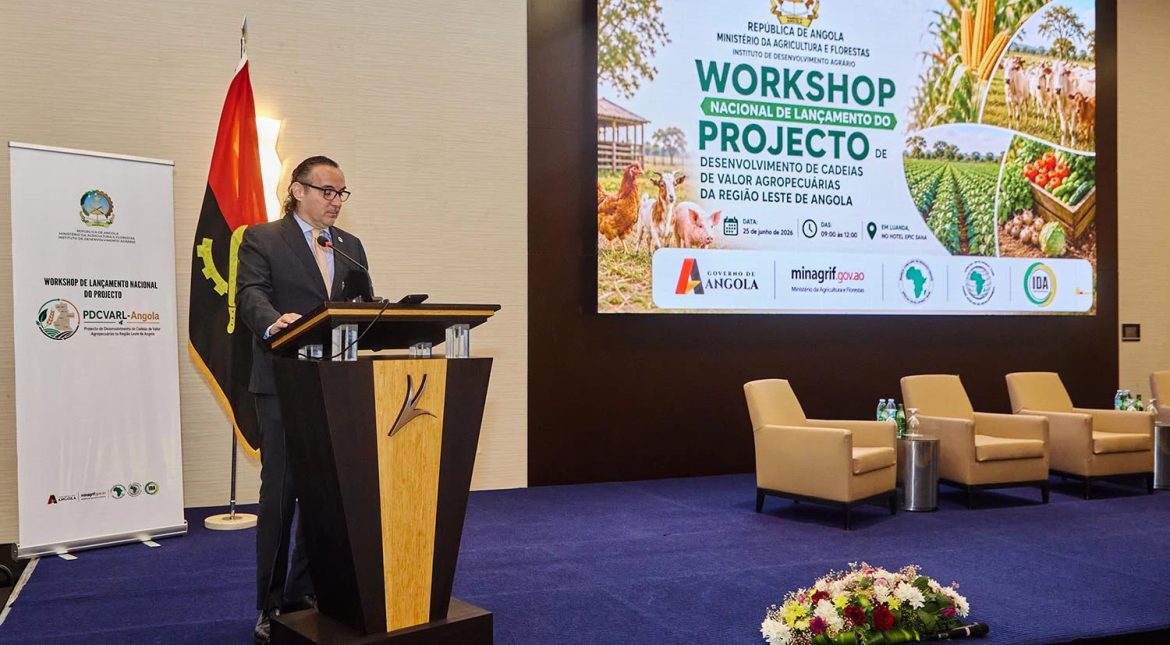
Angola and the African Development Bank Group have launched a major agricultural value-chain development programme targeting 240,000 households, or about 1.2 million people, across six eastern provinces, as the government seeks to reduce food imports, expand rural incomes and use the Lobito Corridor to connect farmers and agribusinesses to domestic and regional markets. The Eastern Region Agricultural Value Chain Development Project is designed to support production, processing, storage and marketing across crops including wheat, rice, soybeans, beans, groundnuts, cassava, coffee, cocoa and palm oil. The African Development Bank approved $211.4 million for the project in November 2025.
The initiative, formally launched in July, comes as Angola attempts to reduce its longstanding dependence on oil and minerals and build a broader productive base. Agriculture is central to that strategy because the country has significant land and water resources but continues to rely heavily on imported food. The African Development Bank estimates that roughly 85% to 90% of Angola’s population depends on agriculture and agricultural trade for their livelihoods, while national income has historically been driven largely by oil and mineral production.
The eastern region targeted by the project covers Lunda Norte, Lunda Sul, Moxico, Moxico Leste, Cuando and Cubango. The six provinces have substantial agricultural potential, with rainfall generally ranging between 1,200 and 1,800 millimetres a year and access to three major international river basins: the Congo, Zambezi and Cubango-Okavango. Yet production remains below what the region’s natural resource base could support. The development objective is therefore not simply to increase farm output, but to build the infrastructure, services and markets needed to turn production into commercial value.

That distinction is important for Angola. Raising yields without solving problems around storage, transport, processing, finance and market access can leave farmers exposed to post-harvest losses and weak farm-gate prices. The project is consequently structured around value chains rather than production alone. According to the African Development Bank, its design includes investments in production, conservation, storage, processing and marketing infrastructure. It is also intended to diversify exports, reduce imports, increase domestic revenue and reduce the economy’s dependence on oil.
Wheat and rice have particular importance because increasing domestic production could reduce the country’s exposure to international food prices and foreign-exchange pressures. Food imports can become more expensive when global commodity prices rise or when domestic currency conditions deteriorate. Increasing local production does not eliminate those risks, but it can provide a larger domestic supply base and create opportunities for local milling, storage, transport and food processing.
For smallholder farmers, however, the commercialisation challenge extends beyond access to land. Farmers need reliable seeds and fertiliser, extension services, irrigation where appropriate, mechanisation, finance and predictable buyers. Angola’s Ministry of Agriculture and Forestry has been emphasising these constraints as part of its broader agricultural transformation agenda. In February, Agriculture and Forestry Minister Isaac dos Anjos said the government was seeking to transform agricultural systems into modern agro-food systems while increasing production, employment and domestic food security. The ministry reported that agricultural production across major value chains increased by 8.6% during the 2024/25 agricultural season.
The eastern project therefore fits into a wider policy shift rather than operating as an isolated intervention. In June, Angola and the World Bank launched the AgriConnect Compact, which aims by 2030 to create up to 700,000 jobs, generate as much as $2.2 billion in annual added value and mobilise up to $1.45 billion in public and private agricultural finance. The programme places particular emphasis on resilient value chains, private investment and agribusiness development.
The scale of the African Development Bank project also gives it significance for employment. The bank expects the intervention to create about 7,500 direct jobs, with at least half targeted for women and one-third for young people. The wider project is expected to reach 1.2 million people, while its design includes specific youth interventions through the Technologies for African Agricultural Transformation Enable Youth Compact and the Lobito Corridor–Angola TVET Youth Employment Project.
For Africa, the emphasis on youth employment is particularly relevant. Agriculture remains one of the continent’s largest potential sources of employment, but much of that employment remains concentrated in low-productivity activities. Moving farmers and young workers into input supply, mechanisation, logistics, processing, digital agriculture, quality control and agricultural finance can create a broader rural economy than farming alone.
Women are another important part of the equation. The project’s appraisal documents indicate that about 55% of its direct smallholder beneficiaries are expected to be women. This matters because women play a substantial role in agricultural production and household food systems across Africa, while often facing greater constraints in accessing land, finance, technology and formal markets. Whether the project changes those constraints will depend on how its financing, training and market-access components are implemented at community level.
The Lobito Corridor adds another dimension. The corridor connects Angola’s Atlantic port of Lobito with southern Democratic Republic of Congo and northwestern Zambia, creating a potential route for agricultural and industrial products as well as minerals. The African Development Bank describes the corridor as a potential trading zone for agricultural and industrial products, while recent development plans seek to move it beyond a transport route into a broader economic platform.
That could change the economics of agricultural production in eastern Angola if transport links, aggregation centres and logistics services develop alongside farm output. A farmer producing more maize, soybeans or rice needs access to buyers beyond the immediate local market if the additional production is to generate commercial returns. Likewise, processors require sufficient volumes of consistent-quality raw material to justify investment in milling, storage and packaging facilities.
The emergence of the Caála Logistics Platform in Huambo illustrates the type of infrastructure being developed around this broader corridor strategy. The platform is intended to support agriculture, agribusiness, warehousing, distribution and light industry connected to the Benguela Railway and the Port of Lobito. Such infrastructure can become increasingly important if Angola succeeds in building larger agricultural production clusters.
There is also a regional trade opportunity. The African Development Bank’s project documents describe the long-term objective of turning eastern Angola into a food basket for the country and potentially the wider Southern African Development Community region. That would place Angola in a different position within regional food markets, shifting part of its role from importer towards producer and potentially exporter.
But the transition will require more than public investment. Private capital will be needed for farm inputs, machinery, warehouses, processing plants, cold chains, transport, insurance and working capital. Angola’s agricultural strategy is increasingly focused on bringing financial institutions and private-sector operators into the sector. The World Bank’s AgriConnect Compact, for example, explicitly seeks to mobilise public and private finance alongside farmers, agribusinesses and financial institutions.
Climate resilience will also influence the project’s long-term economics. More productive agriculture can increase incomes, but farmers remain exposed to droughts, floods and changing rainfall patterns. The African Development Bank has therefore framed the eastern project around climate-resilient food and nutrition security as well as income and employment. The region’s substantial water resources provide an advantage, but infrastructure and farm management practices will determine how effectively that resource base can be used.
The government’s broader agricultural agenda is already moving towards greater domestic production and value addition. In August, Angola and Brazil reaffirmed cooperation on agricultural investment, mechanisation, technology transfer, scientific research, training and value-chain development. The partnership reflects Luanda’s effort to attract technical expertise and private investment into a sector that it increasingly sees as central to economic diversification.
The African Development Bank’s role extends beyond financing. Its project documentation includes procurement and technical assistance for project management, baseline studies, financial management, monitoring and evaluation, environmental and social safeguards, civil engineering and agricultural infrastructure. Those components will be important in determining whether the project produces measurable improvements in productivity and incomes rather than simply increasing the amount of infrastructure constructed.
For Angola, the economic stakes are significant. Oil revenues have historically provided the fiscal and foreign-exchange base for the economy, but commodity dependence exposes public finances and the wider economy to external price cycles. A stronger agricultural sector could provide a more diversified source of domestic production, employment and business activity while reducing the foreign currency required to purchase food abroad.

The project’s success will ultimately be judged less by the number of farmers reached than by whether those farmers can consistently produce, sell and reinvest. If improved roads and storage are accompanied by reliable markets, finance and processing capacity, the eastern provinces could become an increasingly important agricultural production zone. If those links remain fragmented, higher production could still struggle to translate into sustained rural incomes.
For the wider region, the project represents an important test of whether Africa’s emerging economic corridors can support more than mineral exports. The Lobito Corridor has attracted international attention because of its strategic importance to critical minerals, but its longer-term development case increasingly includes agriculture, manufacturing, logistics and regional trade. Connecting agricultural producers to that infrastructure could broaden the corridor’s economic base and distribute more of its benefits into rural communities.
Angola’s eastern agricultural programme therefore sits at the intersection of three major development challenges: reducing dependence on commodities, strengthening food security and turning infrastructure corridors into productive economic systems. The $211.4 million AfDB investment provides a substantial starting point, but its wider impact will depend on whether public investment can crowd in private capital, improve market institutions and give smallholder farmers a commercially viable route from production to markets.
The measure of agricultural diversification will ultimately be found not in hectares cultivated or projects launched, but in whether Angola can produce more of the food it consumes, process a greater share of what it grows and connect rural producers to markets at competitive cost. The eastern region’s natural resources and location give it an opportunity to do so. The challenge now is converting that potential into a functioning agricultural economy.


