


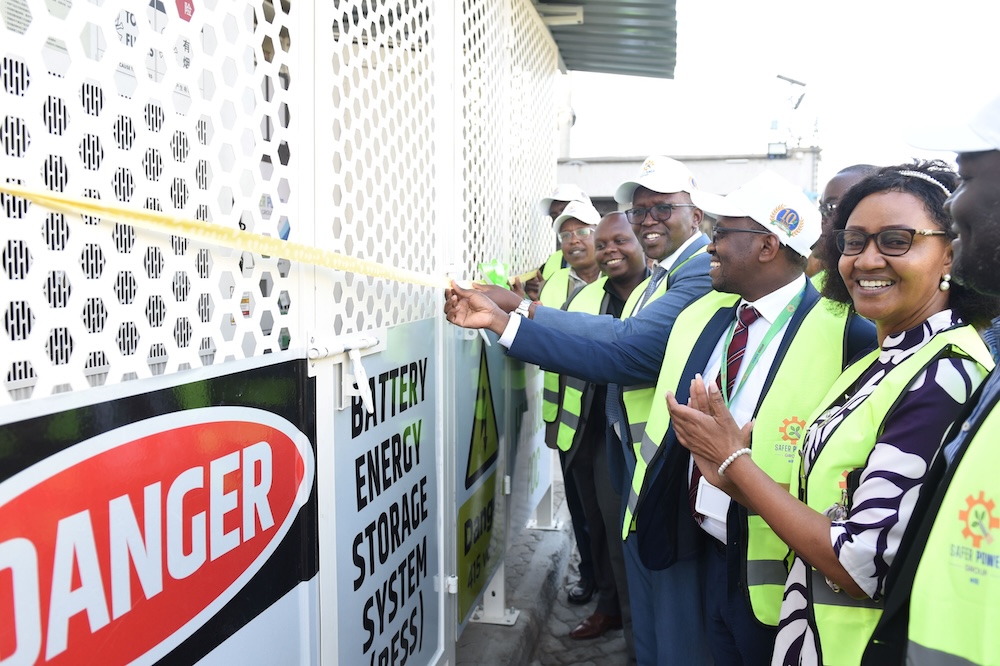
SBM Bank Kenya has committed $17 million to Safer Power Group to expand local manufacturing of power infrastructure and finance a new factory, placing commercial banking capital behind Kenya’s effort to build domestic clean-energy supply chains as demand for renewable power and electrification infrastructure grows across East Africa. The financing will support production of switchboards, control panels, distribution boards, meter boards, changeover systems and battery racks, strengthening the industrial base required to deploy renewable energy projects at scale.
The agreement comes as East Africa’s renewable energy market expands alongside rising electricity demand, industrialisation and investment in energy infrastructure. According to IMARC Group, the regional renewable energy market reached $4.3 billion in 2025 and is projected to reach $7.1 billion by 2034, supported by rising energy demand, renewable resource availability, infrastructure investment and declining technology costs.
For Kenya, the significance of the SBM-Safer Power financing extends beyond the construction of another manufacturing facility. It points to a broader shift in the economics of the energy transition: from importing equipment needed for clean-energy projects towards developing the industrial capacity to manufacture, assemble and maintain some of that equipment within the region.
Safer Power, a Kenyan engineering and energy company and licensed panel builder for Schneider Electric, plans to use the financing to increase production of electrical equipment used in power generation, distribution and industrial applications. The company’s product range includes specialised switchboards, control panels, synchronisation panels, distribution boards, meter boards, changeover systems and battery racks.
The investment comes at a time when African electricity systems are undergoing a structural change. Renewable energy projects increasingly require not only solar panels, wind turbines or geothermal facilities but also the electrical equipment that connects those assets to businesses, grids and consumers. Battery storage is adding another layer of demand for locally available equipment and technical services.
This creates an industrial opportunity for countries such as Kenya, where an established engineering sector and growing clean-energy market can provide a foundation for manufacturing. But the opportunity also exposes one of the transition’s persistent constraints: much of the equipment required to build clean-energy systems is still imported, leaving developers and industrial users vulnerable to foreign exchange movements, shipping costs, international supply disruptions and long procurement cycles.
The financing therefore has implications for both energy security and industrial policy. Local production does not eliminate dependence on international technology or components, but it can shorten supply chains for selected equipment, improve access to after-sales services and retain a greater share of project expenditure within the regional economy.
Safer Power Chief Executive Dalmus Mbai has argued that manufacturers face high upfront capital requirements for specialised equipment, limited access to credit and dependence on imported supply chains. The company’s expansion is intended to address some of those constraints by increasing domestic engineering and manufacturing capacity. The financing also illustrates the increasingly important role of commercial banks in the clean-energy transition. Renewable energy investment has often been associated with development finance institutions, climate funds and international investors. Increasing participation by commercial lenders suggests that some parts of the transition are becoming increasingly connected to conventional business and industrial finance.
SBM Bank’s own balance sheet provides context for that shift. Its net loan book reached Sh54.09 billion at the end of June 2026, an 18.3% increase from a year earlier, while the bank has been seeking to increase lending to businesses and small and medium-sized enterprises. That positioning matters because the energy transition requires capital at several points in the value chain. Large renewable-energy projects need project finance, while manufacturers require working capital and long-term funding for machinery and factories. Distributors need trade finance, installers require equipment financing, and businesses and households need credit to purchase clean-energy systems.
The manufacturing side of the transition is particularly important for Africa because the continent’s energy needs are expanding at the same time that governments are seeking greater economic value from renewable-resource development. A solar farm built with imported equipment can increase electricity supply, but the economic benefits can be broader when some engineering, fabrication, maintenance and associated services are developed locally. Research from the International Renewable Energy Agency and the African Development Bank has previously highlighted the potential economic benefits of a more ambitious African energy transition. Their analysis found that a transition aligned with a 1.5°C pathway could increase Africa’s GDP by an average of 6.4% by 2050 compared with a planned-energy scenario, while creating significantly more employment across the economy.
The figures do not mean that every clean-energy investment will automatically translate into industrial development. Local manufacturing must remain competitive on price, quality and reliability. It also requires access to skilled engineers and technicians, dependable electricity, suitable industrial infrastructure and financing structures capable of supporting businesses through the relatively high capital costs associated with manufacturing.
Kenya’s wider electricity sector provides a substantial potential market. KenGen, the country’s largest electricity generator, currently relies on renewable and clean sources for about 86% of its generation portfolio, while the government continues to pursue further renewable-energy development.
As renewable generation expands, demand for grid equipment, storage systems and electrical infrastructure is likely to remain closely linked to the pace of investment. The East African power market itself was valued at 21.7 GW in 2025 and is projected by IMARC to reach 29.2 GW by 2034. This creates an opportunity for manufacturers that can serve multiple markets rather than Kenya alone. East Africa’s interconnected economies and growing regional power trade could provide a larger market for locally manufactured equipment, although differences in standards, procurement rules, financing conditions and trade arrangements will influence how easily manufacturers can scale across borders.
The regional dimension is particularly relevant as African governments seek to reduce the economic vulnerability associated with imported energy technologies. Local manufacturing can support employment and skills development, but it can also contribute to a more diversified industrial base around energy, including engineering, fabrication, installation, maintenance and potentially emerging areas such as battery storage and green hydrogen.
Safer Power’s expansion into green hydrogen technology further reflects that potential shift. The company has been developing a green hydrogen roadmap and recently launched a green-powered manufacturing facility and hydrogen proof of concept, signalling an attempt to position manufacturing capacity alongside emerging clean-energy markets.
The challenge will be ensuring that financing for clean-energy manufacturing translates into productive capacity rather than simply expanding the number of imported components assembled locally. For Kenya and the wider region, the stronger economic outcome would come from developing capabilities in engineering, design, fabrication, testing and maintenance while building commercially sustainable companies able to compete beyond domestic markets.
The SBM Bank-Safer Power agreement therefore represents more than a green-finance transaction. It provides an example of how private capital can connect Kenya’s energy transition with industrial development. As East Africa’s electricity demand grows and renewable-energy deployment accelerates, the ability to manufacture and finance the infrastructure behind that transition will increasingly influence how much economic value remains within the region.
For Kenya, the longer-term test will be whether projects such as this can help create a competitive local manufacturing ecosystem capable of supplying the country’s expanding clean-energy market and, eventually, serving neighbouring African economies. That outcome will depend on access to affordable finance, technical skills, reliable infrastructure, predictable regulation and sufficient market demand. But the direction is increasingly clear: Africa’s energy transition is becoming not only a question of how much clean electricity the continent can generate, but also of how much of the equipment, expertise and industrial value required to generate it can be developed within Africa.


