


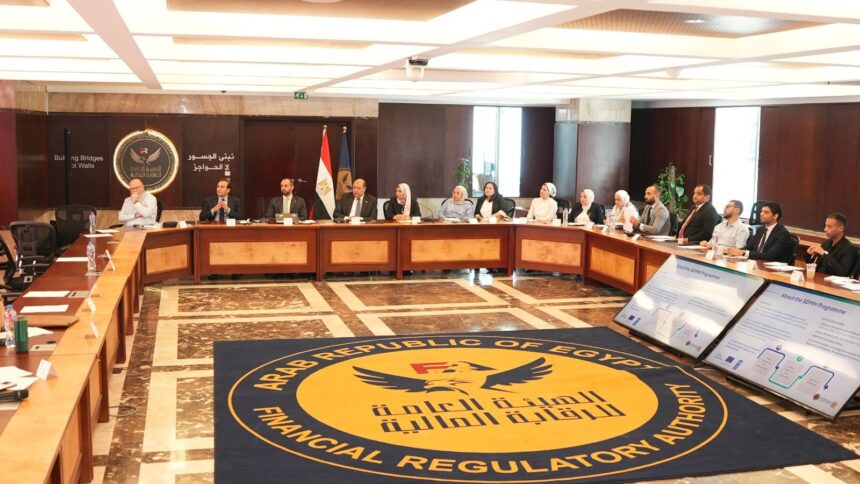
Egypt’s Financial Regulatory Authority (FRA) is developing a phased roadmap for implementing IFRS Sustainability Disclosure Standards, seeking to improve the quality and comparability of sustainability information while giving companies time to strengthen data systems, governance and internal controls. The proposed approach, discussed at a workshop with the European Union and United Nations Development Programme on August 30, would move regulated entities from simplified climate disclosures to initial implementation of the IFRS Sustainability Disclosure Standards and eventually to full implementation, with Global Reporting Initiative standards envisaged as a later component of the wider reporting framework.
The roadmap is being developed through the Sustainability Disclosure and Management Hub programme, implemented by UNDP under the EU-led Sustainable Finance Advisory Hub. The initiative brings together regulators, government institutions and market participants as Egypt works to establish a sustainability-disclosure system capable of supporting investment decisions and aligning financial markets with the country’s climate commitments and Sustainable Development Goals.
 The FRA’s proposed sequencing reflects a practical constraint facing regulators across emerging markets: companies cannot immediately produce high-quality sustainability information without the underlying systems, expertise and governance structures to collect and verify it. The assessment presented during the workshop identified gaps in the quality and depth of existing disclosures, institutional responsibility for sustainability, expertise and resources, as well as the connection between sustainability objectives, data, business performance and measurable outcomes.
Under the draft roadmap, the first phase would introduce simplified climate disclosures before entities move to an initial application of the IFRS Sustainability Disclosure Standards. A subsequent phase would bring entities towards full implementation. The proposed framework would then broaden to disclosures aligned with the Global Reporting Initiative Standards, creating a reporting architecture that incorporates impact-related information and double materiality alongside investor-focused sustainability information.
The distinction between these reporting approaches matters for financial markets. The IFRS Sustainability Disclosure Standards developed by the International Sustainability Standards Board are designed to establish a global baseline of sustainability-related information that is material to investors, with an emphasis on information that can affect a company’s cash flows, access to finance or cost of capital.
For Egyptian companies, that means sustainability reporting is increasingly being positioned as part of mainstream financial information rather than as a separate corporate-responsibility exercise. Climate exposure, resource constraints and other sustainability-related risks can affect operating costs, asset values, supply chains and financing conditions. Making those risks more consistently visible to investors could influence how capital is priced and allocated across the Egyptian market.
FRA Chairperson Islam Azzam said the proposed framework is intended to provide more reliable and comparable sustainability information so investors and other users can make more efficient decisions, while supporting capital allocation and the competitiveness of Egyptian markets. The regulator has already taken steps on ESG and climate-related disclosures, including measures aligned with the recommendations of the Task Force on Climate-related Financial Disclosures.
The transition is nevertheless expected to require substantial institutional preparation. The FRA’s proposed roadmap includes capacity building, technical guidance, digital transformation and data tools to address readiness gaps before mandatory implementation of each phase. Mahmoud Gibril, the authority’s Assistant Chairperson, said implementation would require stronger staff capabilities, improved data quality, governance systems and internal controls, as well as greater participation by companies, investors, auditors and assurance providers.
For financial institutions and listed companies, the implications extend beyond the sustainability department. Producing decision-useful disclosure under IFRS S1 and IFRS S2 requires companies to connect sustainability issues with strategy, risk management, governance and financial planning. This can require changes to internal data collection, board oversight, enterprise-risk systems and the controls used to substantiate reported information.
The cost and complexity of that transition is particularly relevant in emerging markets, where companies may have limited access to specialised sustainability professionals and where consistent environmental and climate data can be difficult to obtain. A phased regulatory approach could reduce the risk that reporting requirements move faster than the infrastructure needed to comply with them.
Egypt is not operating in isolation. Across Africa, regulators, accounting bodies and stock exchanges are developing different pathways towards the use of IFRS Sustainability Disclosure Standards. Nigeria released an amended adoption roadmap and Sustainability Reporting Guideline in February 2026, clarifying implementation expectations for IFRS S1 and S2, reporting timelines, assurance requirements and the categories of professionals able to undertake sustainability reporting.
Kenya has also developed a roadmap proposing a phased approach to adoption, with the objective of improving investor confidence, strengthening transparency and aligning sustainability reporting with international practices. The Kenyan roadmap identifies access to capital as one of the potential benefits of more consistent sustainability reporting.
Rwanda has similarly been developing an adoption roadmap, reflecting a wider regional effort to establish common sustainability-reporting infrastructure. These developments point to an emerging African regulatory landscape in which sustainability disclosure is increasingly being connected to capital-market development rather than treated solely as an environmental policy requirement.
The regional implications are significant because African companies increasingly compete for international capital against businesses operating in jurisdictions with more established sustainability-reporting requirements. Consistent disclosure could reduce some of the information gaps faced by international investors assessing African companies, particularly in sectors exposed to climate and environmental risks.
However, convergence with international standards does not automatically eliminate those information gaps. The quality of sustainability disclosure depends on the quality of the underlying data. Companies need reliable information on emissions, energy consumption, water use, climate exposure, supply chains and other material risks before they can produce consistent disclosures. In many African markets, building those datasets may prove more difficult than drafting the reporting requirements themselves.
Assurance is another issue. As sustainability information becomes more influential in investment decisions, investors are likely to place greater emphasis on whether reported information can be independently verified. The development of an assurance ecosystem capable of reviewing sustainability data will therefore become an important component of regulatory implementation.
For Egypt’s financial sector, this could have implications for how banks, insurers, asset managers and other non-bank financial institutions assess their own exposure to climate-related risks. Better corporate data can potentially improve credit analysis and investment decisions by providing more information about borrowers’ exposure to energy costs, water scarcity, extreme weather, carbon-intensive assets and changing market requirements.
The implications are particularly relevant as Egypt seeks to mobilise sustainable finance. The country has been developing green and sustainable-finance instruments, including sustainability bonds, green investment funds and a regulated voluntary carbon market. The FRA has previously said it is working on the implementation of IFRS S1 and S2 and emphasised the importance of proportionality in applying the standards.
Reliable disclosure is important to those markets because investors need to distinguish between projects and companies that generate measurable environmental outcomes and those that simply use sustainability terminology. Stronger reporting standards can provide a common information base, although they cannot by themselves guarantee the quality of a company’s underlying sustainability performance.
The proposed inclusion of GRI Standards at a later stage adds another dimension. IFRS Sustainability Disclosure Standards are primarily focused on information material to investors, while GRI’s framework places greater emphasis on an organisation’s impacts on the economy, environment and people. Combining the approaches could allow Egypt to develop a reporting system that serves both capital-market users and wider stakeholders, although companies will need clarity on how the different requirements interact.
That balance will be important for African regulators. Reporting frameworks that are too fragmented can increase compliance costs without necessarily improving the information available to investors. Conversely, standards that are introduced without sufficient attention to local data availability and institutional capacity can produce disclosures that are formally compliant but of limited practical value.
The FRA’s decision to phase implementation therefore reflects a broader regulatory question: how quickly should emerging markets converge with international sustainability standards, and how much transition support is needed to make that convergence meaningful? The proposed roadmap recognises differences in readiness across regulated entities and seeks to build reporting capacity before each stage becomes mandatory.
For businesses, the direction of travel is nevertheless becoming clearer. Sustainability information is increasingly being integrated into the same governance and risk-management structures that companies use for conventional financial information. Firms that have weak internal data systems or limited board oversight may face higher implementation costs as reporting requirements become more demanding.
For investors, greater consistency could eventually make it easier to compare Egyptian companies with peers in other markets. That could be particularly relevant for international capital seeking exposure to Africa, where differences in disclosure practices can make cross-border assessment more difficult.
For policymakers, the larger objective is to ensure that disclosure contributes to more efficient capital allocation. If investors can identify which companies are most exposed to climate and sustainability risks, and which have credible strategies for managing those risks, financial markets can incorporate that information into lending and investment decisions.
The proposed Egyptian roadmap remains under discussion and has not yet completed the approval process. Its eventual effectiveness will depend on the final requirements, implementation timetable and support available to regulated entities. The regulatory transition will also require coordination between the FRA, companies, accounting professionals, auditors, investors and other market participants.
Egypt’s move nevertheless illustrates a broader shift taking place across African capital markets. Sustainability disclosure is moving closer to the architecture of financial regulation as governments seek to attract investment, strengthen market transparency and prepare companies for a global economy in which climate and sustainability risks increasingly have financial consequences.
The significance of the FRA’s roadmap will ultimately be measured not by how quickly Egypt adopts an international standard, but by whether companies can produce reliable information that investors can use. For African markets, that distinction is critical. Better disclosure can support capital allocation and market confidence, but only when it is backed by credible data, effective governance and the institutional capacity to verify what companies report.


