


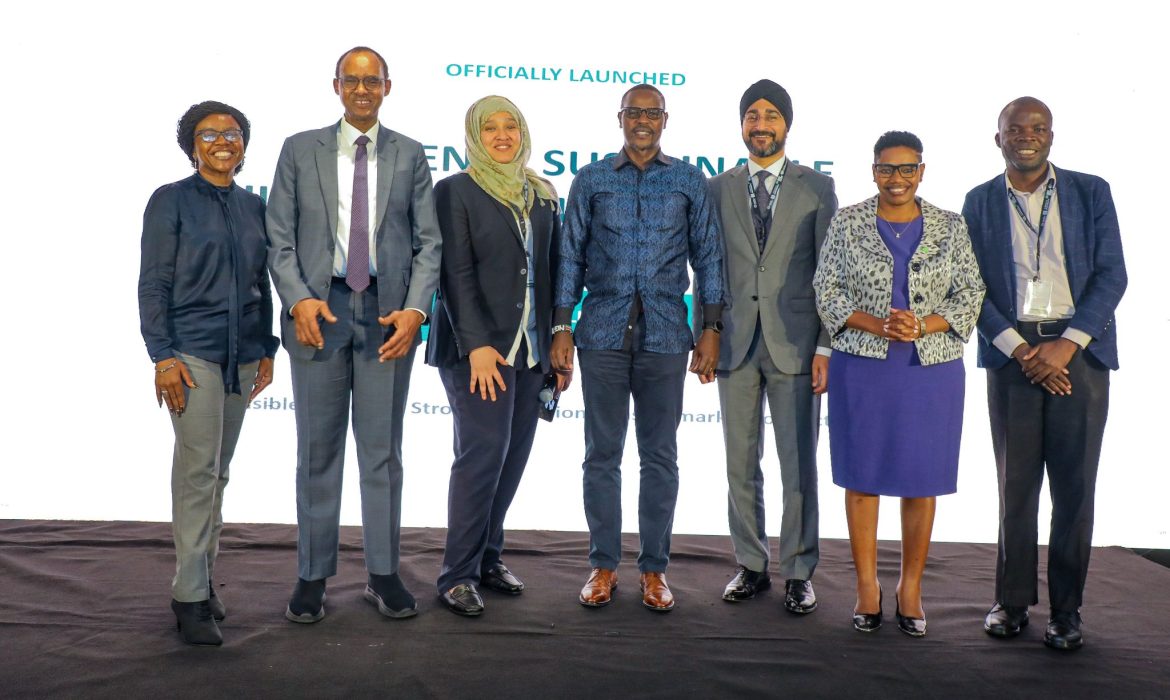
Kenya is seeking to strengthen the pipeline of investable sustainable construction projects as rapid urbanisation and rising climate risks increase pressure on buildings, infrastructure and public services. The Kenya Green Building Society (KGBS) has launched a national repository bringing together green projects, technologies, materials and solutions in an effort to make opportunities in the built environment more visible to developers, financiers, policymakers and other market participants.
The Kenya Sustainable and Resilient Built Environment Projects and Solutions Repository was launched during the KGBS Annual Conference 2026 in Nairobi. KGBS describes it as Kenya’s first national repository of its kind, designed to address a persistent market problem: sustainable projects and technologies exist across the country, but information about them is often dispersed among institutions, developers and individual initiatives.
The repository brings together three initial categories: certified green projects, projects progressing towards sustainability standards, and products, technologies and solutions supporting improved building performance and resilience. Where information is available, project profiles can include investment values, emissions reductions, energy and water performance, renewable-energy capacity, jobs, beneficiaries and climate mitigation or adaptation outcomes.
The initial engagement covers projects and opportunities in Nairobi, Mombasa, Kisumu, Lamu and Laikipia. The geographic spread reflects the different investment and infrastructure requirements emerging across Kenya’s urban and county economies, where construction activity is being shaped by housing demand, commercial development, infrastructure expansion and exposure to climate-related risks.
For the repository to become useful to investors, however, listing projects will only be the first step. Information will need to be credible, comparable and regularly updated, while individual projects will still require technical, legal and financial preparation before lenders and investors can commit capital. The distinction is important because a visible project pipeline is not necessarily the same as a bankable one.
KGBS has positioned the repository as market infrastructure rather than a financing facility. Its objective is to improve pipeline visibility and connect project owners and solution providers with certification, technical assistance, partnerships and appropriate sources of finance. That makes the initiative relevant to a market where the challenge is increasingly not simply finding capital, but matching available capital with projects that can demonstrate commercial viability and measurable environmental performance.
Kenya’s financial sector is already developing instruments capable of supporting that transition. KCB Group, for example, reported disbursing KSh48.8 billion in green financing in 2025 across renewable energy, sustainable agriculture, green buildings, clean transportation, water management and other climate-related investments. The bank also screened KSh587.9 billion of transactions under its environmental and social due-diligence framework across its markets.
KCB’s activity is part of a wider expansion of climate-related finance. In March, I&M Bank secured a $30 million green-finance risk-sharing arrangement with Sweden’s development agency Sida, including a $15 million guarantee covering 50% of the risk over eight years. The facility is intended to support lending for areas including renewable energy, energy efficiency, clean transport, green building renovations, circular economy projects and sustainable water management.
These financing structures illustrate why project preparation and information are becoming increasingly important. A bank can establish a green-lending facility, a development institution can provide a guarantee and investors can demonstrate demand for sustainable assets, but financing still requires projects with sufficient documentation, credible cash-flow assumptions, appropriate risk allocation and evidence that environmental claims can be measured.
The housing market provides another indication of growing investor interest. Kenya Mortgage Refinance Company listed a KSh3 billion sustainability bond on the Nairobi Securities Exchange in May after attracting applications worth KSh9.38 billion, more than three times the amount offered. The proceeds are being directed towards refinancing eligible green affordable home loans and social home loans, linking capital-market funding with climate-resilient and inclusive housing.
The transaction demonstrates that sustainable buildings can increasingly be structured as financial assets rather than treated solely as environmental interventions. For investors, the question is whether a building or housing development can generate predictable financial returns while meeting defined social or environmental criteria. For developers, the calculation increasingly involves whether better energy and water performance, climate resilience and resource efficiency can reduce operating costs, strengthen asset value or improve access to finance.
Affordable housing is particularly important in this equation because Kenya faces simultaneous pressure to expand housing supply and manage urban climate risks. Energy-efficient design, passive cooling, water efficiency, renewable energy and climate-resilient construction can reduce some operating and physical risks for households, while potentially improving the long-term performance of housing assets.
The investment case will nevertheless vary from one project to another. Sustainable construction can require higher upfront expenditure, while the financial benefits may emerge over several years through lower energy and water costs, reduced maintenance or improved asset performance. Reliable performance data can therefore help lenders and investors determine whether the additional capital expenditure is justified.
The repository’s emphasis on measurable indicators is relevant to that challenge. Energy consumption, water use, renewable-energy generation, emissions reductions and adaptation measures can give financiers more tangible information on the performance of a project. Such data can also support monitoring after financing, helping investors determine whether environmental commitments made during the funding process are being achieved.
The same principle applies to existing buildings. Kenya’s green-building transition cannot rely exclusively on new developments because much of the country’s future building stock will consist of structures that already exist. Retrofitting lighting, cooling, water systems, insulation and renewable-energy installations could provide opportunities to improve performance without replacing entire buildings.
Retrofit projects can present a different financing challenge because the investment is often distributed across individual properties and the expected savings accrue over time. A well-structured repository could make these opportunities more visible and allow building owners to demonstrate projected energy savings, investment requirements and potential returns.
The construction supply chain is also becoming part of the investment discussion. Materials, manufacturing, transportation and procurement decisions influence the environmental footprint and cost of infrastructure. Lower-carbon materials, recycled inputs, energy-efficient manufacturing and more efficient construction practices can therefore create investment opportunities beyond individual buildings.
Public procurement could play a role in developing those markets. Government departments and county administrations are major purchasers of construction materials and infrastructure services. Procurement requirements that recognise credible environmental standards could create stronger demand for sustainable products, giving manufacturers and suppliers greater incentives to invest in cleaner production and technology.
For Kenya, this broader market-development approach matters because the country’s climate and development objectives require investment across several interconnected areas. Buildings sit at the intersection of energy demand, water use, housing, employment, infrastructure and urban resilience. Improving their performance can therefore have consequences beyond the property sector.
The repository also comes at a time when the financial sector is placing greater emphasis on environmental and social due diligence. KCB’s reported KSh587.9 billion in screened transactions illustrates the scale at which environmental and social considerations can increasingly enter lending decisions.
The challenge now is to ensure that information collected through the repository is sufficiently robust for those decisions. Green credentials need evidence, methodologies need consistency and project information needs to remain current. Without these safeguards, a repository risks becoming primarily a showcase rather than an effective market mechanism.
KGBS’s own strategic focus recognises this distinction. The organisation describes its work as combining market and community growth, practical services and solutions, and policy, research and advocacy to advance a sustainable built environment. Its current repository initiative seeks to bring projects and solutions into a more visible national market while supporting the wider transition towards low-carbon, climate-resilient and resource-efficient buildings.

The ultimate measure of the platform will therefore be what happens after projects are listed. The number of projects seeking certification or investment will matter, but more important will be how many secure financing, how much capital is mobilised, what is constructed or retrofitted, and whether promised energy, water, emissions and resilience outcomes are achieved.
Kenya has been building the components of a green-finance market through bank lending, guarantees, sustainability bonds and other investment structures. The KGBS repository adds a project-pipeline dimension to that architecture. Its success will depend on whether it can help convert fragmented information into credible investment opportunities and move sustainable construction projects from concepts and proposals towards financing and implementation.
For a country experiencing rapid urbanisation while facing increasing exposure to flooding, heat, water stress and other climate risks, that transition is increasingly an economic and financial question as much as an environmental one. The availability of capital matters, but so does the availability of projects capable of absorbing it, delivering measurable returns and demonstrating that green construction can become a scalable part of Kenya’s development economy.


