


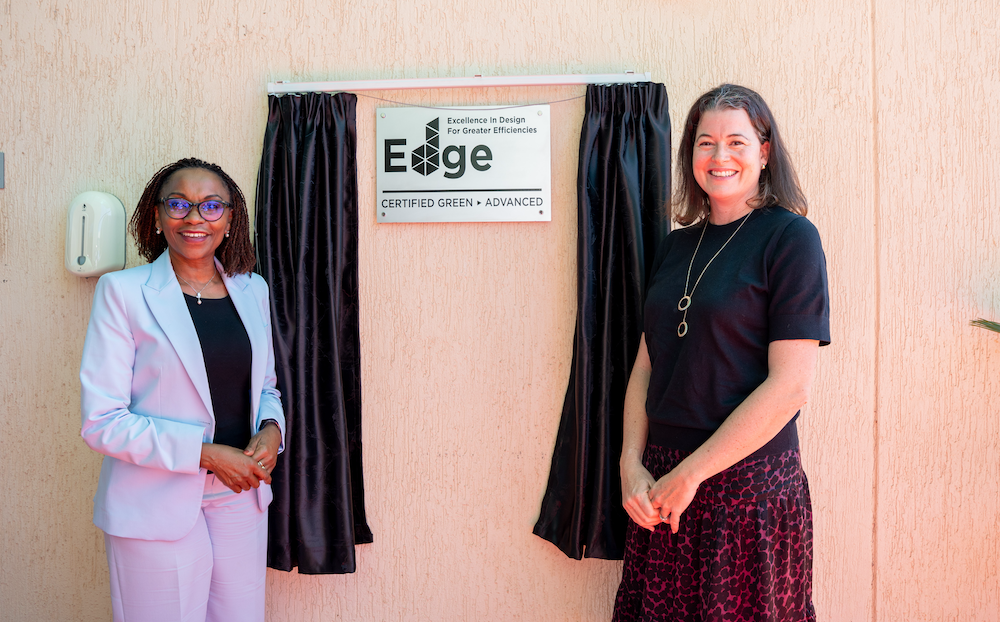
Kenya Wine Agencies Limited (KWAL) has become the first Kenyan manufacturer to receive Excellence in Design for Greater Efficiencies (EDGE) certification, with its Tatu City manufacturing facility achieving EDGE Advanced status after recording significant reductions in energy use, water consumption and the embodied energy of construction materials. The certification, backed by the International Finance Corporation (IFC), highlights how resource efficiency and renewable energy are increasingly becoming part of the commercial strategy for Kenyan manufacturers facing high operating costs and pressure to reduce environmental impacts.
The Tatu City facility achieved a 44% reduction in energy use, a 28% reduction in water consumption and a 53% reduction in embodied energy in materials, according to IFC. EDGE Advanced is awarded to projects that achieve at least 40% on-site energy savings in addition to meeting the broader EDGE efficiency requirements. The certification system was created by IFC to provide a measurable framework for green buildings and to demonstrate the financial case for resource-efficient construction.
For Kenya’s manufacturing sector, the development is significant because energy and water efficiency are increasingly linked to competitiveness rather than treated solely as environmental considerations. Manufacturers operate in an environment where electricity costs, supply reliability, water availability and production efficiency can directly influence margins. Investments that reduce resource consumption can therefore affect both environmental performance and the cost structure of industrial operations.
KWAL’s certification also illustrates the growing relevance of green-building standards beyond offices, residential developments and commercial property. IFC’s EDGE system covers several building categories, including warehouses and light industrial facilities, reflecting the increasing application of resource-efficiency standards to productive assets. In Kenya, EDGE has already become one of the country’s established green-building certification systems.
A major component of KWAL’s strategy has been the installation of a 700-kilowatt rooftop solar plant. The system was completed in eight months and currently supplies about 20% of the company’s annual electricity requirements, while reducing annual energy costs by an estimated 10%, according to the company. The investment provides a practical example of how renewable energy can be integrated into industrial operations without requiring a complete shift away from the national electricity system. Rooftop solar can reduce daytime electricity purchases and provide an additional source of power for facilities with substantial daytime loads. For manufacturers, the economic case depends not only on emissions reductions but also on the relationship between the cost of renewable generation, grid electricity prices, financing costs and the operating profile of the facility.
KWAL has indicated that it plans to increase its solar capacity to 1,500 kilowatts, more than doubling the current installation. If implemented, the expansion would further reduce the company’s exposure to grid electricity and increase the share of its operations powered by renewable energy. The move comes as Kenya’s manufacturing sector faces a broader challenge of maintaining competitiveness while responding to environmental pressures. Industrial companies are under increasing pressure from investors, customers and multinational supply chains to demonstrate progress on environmental, social and governance issues. At the same time, businesses must ensure that sustainability investments generate measurable operational value.
This is where certification frameworks such as EDGE can play a role. Unlike broad sustainability commitments, EDGE requires projects to demonstrate quantified improvements in energy, water and material efficiency. IFC describes the certification as a mechanism intended to establish the business case for green buildings and unlock investment in resource-efficient assets. The financial dimension is particularly relevant for emerging markets. Green-building investments can require higher upfront capital expenditure, creating a challenge for companies that operate under tight investment budgets. However, lower energy and water consumption can generate operating savings over the lifetime of an asset. The challenge for businesses and financiers is therefore to assess the upfront investment against measurable long-term reductions in operating costs and exposure to resource risks.
IFC has increasingly connected green-building standards with financial markets, including green construction finance and other sustainable-finance instruments. EDGE is also recognised within several international sustainable-investment frameworks, including the International Capital Market Association’s Green Bond Principles and the Climate Bonds Standard. Kenya has become an important market for this approach. IFC research has identified green-building finance as an area in which financial institutions, developers, policymakers and technical professionals can influence the growth of resource-efficient construction. The country’s expanding green-building market also provides an indication of how environmental standards are becoming integrated into investment decisions.
For manufacturing companies, however, buildings are only one part of the sustainability equation. Industrial facilities also have to address production processes, logistics, waste, water management, procurement and the emissions associated with electricity and fuels. KWAL’s combination of energy efficiency, rooftop solar, water recycling and more efficient lighting demonstrates how several interventions can be combined within a single manufacturing site.
Water efficiency is particularly relevant in Kenya, where climate variability and changing rainfall patterns create additional pressure on water resources. For industrial users, water recycling and reduced consumption can help lower operational exposure while contributing to wider resource-management objectives. The economic value of such measures can increase in areas where competition for water between households, agriculture and industry becomes more pronounced.
KWAL’s approach is also connected to the sustainability strategy of its parent group, Heineken Beverages International. The company’s sustainability agenda includes improving water efficiency and replenishment in water-stressed areas and reducing emissions through energy efficiency and increased use of renewable energy. For Kenya, the wider significance lies in whether such investments can move from individual corporate initiatives to broader industrial practice. The country has ambitions to expand manufacturing and strengthen domestic value addition, but industrial growth will require reliable energy, efficient resource use and infrastructure capable of operating under changing climate conditions.
The experience of KWAL suggests that green manufacturing does not necessarily require a choice between environmental performance and commercial efficiency. Energy savings, water efficiency and renewable power can potentially reduce operating costs while improving resilience to resource and energy risks. The commercial case, however, will depend on project economics, access to financing, technology costs and the ability of companies to maintain efficiency gains over time.
The development also places greater importance on credible measurement. As sustainability reporting becomes more prominent, companies and investors increasingly require evidence that environmental claims translate into measurable changes in resource consumption. Certification systems such as EDGE provide one mechanism for independently assessing performance against defined efficiency thresholds.
Kenya’s industrial transition will ultimately depend on whether more manufacturers can make similar investments at scale. For smaller companies, the capital required for solar systems, water-recycling infrastructure and efficiency upgrades can remain a barrier. Financial institutions, development-finance providers and policymakers therefore have a role in determining whether green manufacturing becomes accessible beyond large companies with stronger balance sheets.
KWAL’s EDGE Advanced certification is consequently more than a recognition of one manufacturing facility. It provides a case study of how renewable energy, resource efficiency and green-building standards can intersect with industrial competitiveness. As Kenya seeks to expand manufacturing while reducing its exposure to energy and climate risks, the ability to measure and finance these efficiency gains will become increasingly important to the country’s broader sustainability and economic development agenda.


