


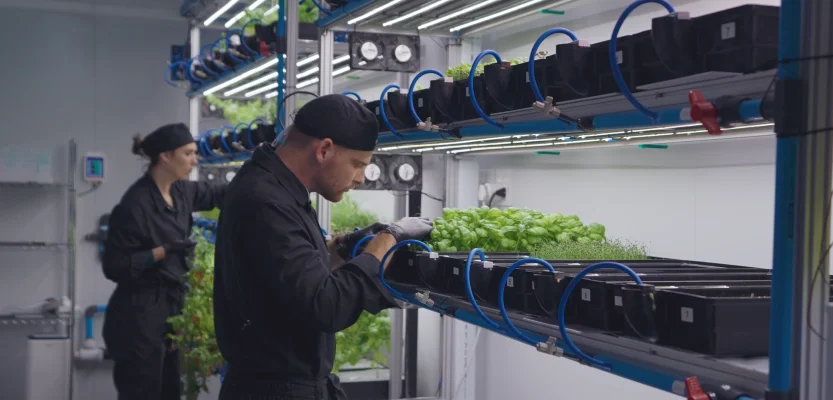
A Western Cape agri-tech company is supplying fresh produce to SPAR retailers through modular container farms, bringing hydroponic agriculture, controlled environments and renewable energy closer to consumers as South Africa faces growing pressure on water resources, food supply chains and agricultural production. Arable Grow’s move from a locally developed farming concept to a formal retail supplier illustrates how controlled-environment agriculture is beginning to enter mainstream food distribution, while also raising questions about the economics and scalability of resource-efficient farming in African cities.
Based in Somerset West, Arable Grow has developed modular farms inside shipping containers that can be positioned closer to urban markets and operate throughout the year under controlled conditions. The company says its hydroponic systems use about 95% less water than conventional farming and do not require pesticides, while renewable-energy and water-retention systems form part of the operating model. The company is currently supplying SPAR retailers in the Western Cape, creating a commercial route for a production system designed around shorter supply chains and more controlled growing conditions.
 The timing is significant for South Africa’s agricultural economy. Climate variability, water scarcity and rapid urbanisation are placing pressure on conventional food production, particularly in regions where agricultural activity competes with households and industry for limited water resources. The Western Cape has experienced severe drought conditions in the past, while Cape Town and surrounding municipalities continue to manage a complex relationship between water security, population growth and economic activity.
Controlled-environment agriculture does not remove those pressures, but it changes how some crops can be produced. Hydroponic systems deliver water and nutrients directly to plants rather than relying on soil-based cultivation, allowing growers to manage growing conditions more precisely. Arable Grow says its container farms can produce crops throughout the year and deliver them to retailers within hours of harvesting.
The potential economic value lies partly in proximity. Conventional agricultural supply chains can require fresh produce to travel from rural production areas to urban distribution centres before reaching consumers. That creates exposure to transport costs, fuel prices, road infrastructure and delays, while adding time between harvesting and retail. A decentralised model can place production closer to areas of demand, potentially reducing some of those logistical pressures.
For retailers, however, the challenge is not simply whether technology can grow crops. The produce must meet quality, food-safety and consistency requirements and be supplied at a price that works within a competitive grocery market. Arable Grow’s partnership with SPAR has therefore been as much about market access and supplier development as agricultural technology.
According to Bizcommunity, SPAR supported Arable Grow through its Supplier Development Programme, helping the company work towards Good Agricultural Practice certification and strengthen its operational capabilities. The arrangement allowed the startup to move from developing its technology to participating in the formal retail supply chain.
That distinction is important for African agriculture. Technology alone rarely determines whether an agricultural innovation becomes commercially viable. Farmers and agri-tech companies also need reliable routes to market, financing, certification, technical skills, distribution networks and customers willing to purchase their products. The connection between Arable Grow and SPAR illustrates how large retailers can influence which agricultural technologies move beyond pilot projects and into commercial supply chains.
The model also fits into a broader shift towards controlled-environment farming in South Africa. Other hydroponic producers are already supplying national retailers, while schools and community programmes are beginning to use solar-powered hydroponic systems as part of agricultural education and skills development. In July, the Western Cape government reported that Pelican Park High School was installing a solar-powered hydroponic agriculture hub designed to use substantially less water than conventional farming while providing practical training in modern agricultural technologies.
Such developments point to a wider question for African food systems: whether resource-efficient farming can become part of the infrastructure needed to supply rapidly growing urban populations. Africa’s urban population is expanding, increasing demand for reliable access to nutritious food while putting additional pressure on land, water and transport systems.
Urban agriculture cannot replace conventional farming. Staple crops such as maize, wheat, rice and other commodities require large-scale production systems that container farms are not designed to provide. Controlled-environment agriculture is more suited to high-value, fast-growing crops such as leafy greens and herbs, where freshness and proximity to consumers can have greater commercial value.
Its contribution therefore needs to be assessed within that narrower context. The case for container farming is strongest where water efficiency, year-round production, freshness and proximity to consumers can offset the higher capital and operating costs associated with controlled environments.
Energy is one of the most important variables. Climate-controlled agriculture requires electricity for lighting, pumps, ventilation, cooling and other systems. Renewable energy can reduce exposure to grid instability and potentially lower emissions, but the economics depend on the cost and availability of renewable generation, storage and other equipment.
This creates an important sustainability trade-off. A farming system can use substantially less water while still having significant energy requirements. Assessing its environmental performance therefore requires looking across the entire production system rather than focusing on a single resource metric.
For South Africa, where electricity reliability and energy costs have been major concerns for businesses, the ability to integrate renewable power into agricultural operations could become an important consideration. Distributed energy systems can provide agricultural businesses with greater control over electricity supply, although their initial capital requirements can create barriers for smaller producers.
The same issue applies to water infrastructure. Hydroponics can substantially reduce water use, but the technology still requires a reliable water supply and systems for managing nutrients, filtration and recycling. The economics and environmental benefits will therefore vary depending on local conditions, crop selection, energy sources and operating practices.
Arable Grow’s model also attempts to address food waste. The company says production can be adjusted according to demand, reducing the risk of surplus, while excess produce can be dehydrated and converted into a longer-lasting product.
Food waste is a significant economic issue across Africa because losses can occur at multiple points between production and consumption. Poor storage, inadequate cold-chain infrastructure, transport delays and market volatility can reduce the value of food before it reaches consumers. Producing closer to markets and extending the usable life of surplus produce could address some of these losses, although the scale of the impact will depend on the crops involved and the commercial viability of processing.
The retail connection is consequently central to the model. A farm located close to consumers still needs predictable demand. Supermarket procurement systems can provide that demand, but they also impose requirements around volumes, quality, packaging, certification and delivery schedules. For small agricultural businesses, meeting those standards can require investments that are difficult to finance without institutional or commercial support.
This is where supplier-development programmes can have wider economic significance. By helping smaller businesses meet formal procurement requirements, retailers can potentially broaden the number of local producers able to participate in organised food markets. That can create opportunities for technology-intensive agricultural enterprises while strengthening domestic supply chains.
The implications extend beyond South Africa. Across African cities, agriculture is increasingly being considered not only as a rural activity but as part of urban economic planning. Nairobi, Lagos, Accra, Kigali, Johannesburg and other rapidly expanding cities face questions about how food moves from farms to consumers, how much water production requires and how vulnerable supply chains are to climate and infrastructure disruptions.
Container farming offers one possible response, but its scalability remains an economic question. The technology requires capital-intensive equipment, specialised skills and reliable power. Producing at a competitive cost may therefore be easier in high-income urban markets or for premium products than in lower-income communities where consumers have limited purchasing power.
The commercial test will ultimately be whether the resource savings and supply-chain benefits compensate for the additional capital and operating costs. Lower water consumption can have economic value in water-stressed regions, while shorter delivery times may improve product quality and reduce losses. But those benefits need to translate into prices and margins that can support the operation without relying indefinitely on external support.
There is also a question of land use. Arable Grow’s container model is designed to require less land than conventional farming, potentially allowing food production in locations where agricultural land is scarce or expensive. The company says its systems are intended to form a network of modular farms across South African cities and towns rather than relying exclusively on large centralised farms.
If such systems expand, their role could be particularly relevant for peri-urban areas where access to agricultural land is constrained but consumer demand is concentrated. Locating production closer to markets could also create opportunities for local employment in farm operations, logistics, technology maintenance and food processing.
The skills requirement should not be underestimated. Controlled-environment agriculture combines agricultural knowledge with engineering, data management, energy systems and business operations. Expanding the sector would therefore require workers who can operate digital monitoring systems, manage hydroponic equipment and understand crop nutrition alongside conventional agricultural practices.
The education component of Arable Grow’s activities points towards this broader skills question. The company is working with Beaumont Primary School in Somerset West to introduce learners to urban farming, while other Western Cape initiatives are using hydroponics to give students practical exposure to modern agricultural technology.
For governments, the relevance is broader than supporting individual agri-tech businesses. Food security policy increasingly intersects with water management, energy planning, urban development and climate adaptation. Investments in agricultural technology are more likely to produce durable economic benefits when they are connected to those wider systems.
The financial dimension is equally important. Water-efficient farming can reduce exposure to water constraints, but container farms require upfront investment in equipment, energy systems, climate controls and distribution. Access to patient capital could therefore influence which agricultural technologies are able to move from demonstration projects to commercial scale.
For investors and lenders, the sustainability proposition will need to be assessed alongside conventional measures of agricultural viability. Water savings, reduced pesticide use and shorter supply chains may strengthen environmental performance, but financial returns still depend on crop yields, energy costs, labour requirements, retail prices and asset utilisation.
That makes the emergence of container farms relevant to the broader ESG discussion. Environmental performance cannot be measured solely through headline claims about water efficiency. Investors and corporate buyers will increasingly need to understand how energy is generated, how equipment is manufactured and disposed of, how workers are treated, how food safety is managed and whether the business remains financially viable.
For retailers, the model also raises questions about the resilience of local supply chains. A diversified supplier base can reduce dependence on distant production areas, but individual container farms may themselves introduce new operational risks if they depend heavily on specialised equipment or imported components. Resilience therefore requires diversification not only of production locations but also of technology, financing and supply networks.
South Africa’s experience is likely to be closely watched as other African markets confront similar pressures. The continent’s food systems will need to produce more nutritious food while managing increasingly constrained natural resources and adapting to climate variability. There is no single technology capable of resolving those challenges, but controlled-environment agriculture may have a role in selected crops and urban markets where its resource and logistical advantages are economically viable.
Arable Grow’s arrival on SPAR shelves is therefore less significant as a novelty than as a test of whether an alternative farming model can integrate into a mainstream commercial supply chain. The next stage will depend on whether the model can expand without losing its resource-efficiency advantages, whether production costs remain competitive and whether consumers and retailers sustain demand.
 For South Africa, the development highlights an emerging intersection between agriculture, technology, energy and retail. For the wider African market, it offers a more specific lesson: climate resilience in food systems may increasingly depend not only on changing what farmers grow, but also on changing where, how and with what resources food is produced.
The move from a shipping container in Somerset West to supermarket shelves does not establish that vertical farming is a replacement for conventional agriculture. It does, however, demonstrate that water-efficient, controlled-environment production is moving into the commercial food chain. As African cities grow and pressure on land and water intensifies, the economics of such systems could become an increasingly important part of the continent’s debate over food security and sustainable urban development.


