


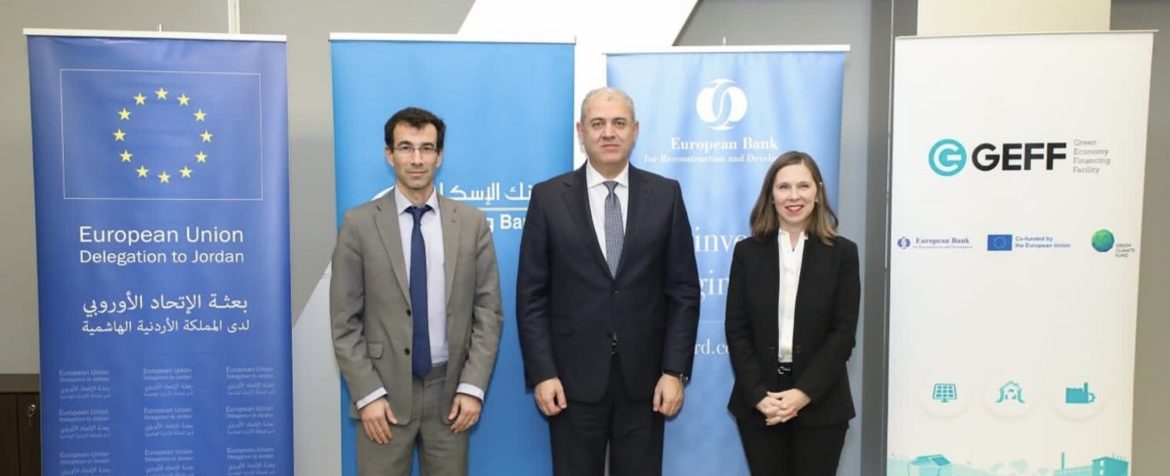
The European Bank for Reconstruction and Development (EBRD) and the European Union have agreed to extend a €70 million guarantee programme to Sub-Saharan Africa, targeting climate mitigation, green technologies and energy-intensive industries including critical raw materials. Announced as the first collaboration between the two institutions involving EU-backed guarantees in the region, the expansion is designed to reduce investment risks that can prevent commercially viable but higher-risk projects from securing private finance. The initiative forms part of the EU’s Global Gateway strategy and places risk-sharing, rather than capital availability alone, at the centre of efforts to finance Africa’s low-carbon industrial transition.
The agreement extends the European Fund for Sustainable Development Plus High-Barrier, or Hi-Bar, guarantee programme, which was originally established in 2024 with provision for up to €168 million in EU guarantees. The programme is designed to support projects that face unusually high barriers to finance, including first-of-a-kind investments and technologies that have not yet reached sufficient scale to attract conventional commercial funding.
 For African markets, the significance of the facility lies in the type of risk it is intended to address. Green infrastructure and industrial decarbonisation projects can require substantial upfront investment while carrying technology, market, regulatory, currency and execution risks. These risks can raise the cost of borrowing or prevent projects from reaching financial close even where the underlying resource or market opportunity is strong.
Guarantees can alter that equation by absorbing part of the risk that would otherwise be borne by lenders or investors. In practical terms, the objective is not to replace private capital but to make projects more investable by providing a form of credit enhancement or risk protection. The EBRD says the Hi-Bar programme is intended to mitigate key risks and enable greater private-sector participation in strategically significant industries.
This distinction is important for Africa, where the cost of capital remains one of the major constraints on infrastructure investment. A renewable energy project in an African market can face significantly different financing conditions from an otherwise comparable project in a developed economy because investors price in sovereign, currency, regulatory and market risks. Those additional costs can affect tariffs, project returns and the scale of investment that developers are able to undertake.
The guarantee programme focuses particularly on energy and energy-intensive industries. That brings the facility into an area of growing importance for African economies, where industrialisation and decarbonisation increasingly intersect. Modernising energy-intensive production while maintaining competitiveness will require investment in technologies and infrastructure that remain relatively expensive or commercially immature in many markets.
Critical raw materials add another dimension. Africa possesses significant deposits of minerals that are important to global energy and technology supply chains, including minerals used in batteries, renewable-energy technologies and other low-carbon applications. Yet extraction alone does not guarantee that African economies will capture substantial value from the transition. Investment in processing, refining, energy infrastructure and industrial capacity is required if mineral production is to support broader domestic value addition.
The EBRD and EU facility could therefore become relevant not only to renewable-energy projects but also to the infrastructure surrounding mineral-based industrial development. The programme specifically identifies critical raw materials and their value chains among the energy-intensive sectors eligible for support.
For governments, this creates an important policy consideration. Attracting investment into critical minerals and green industries requires more than offering access to natural resources. Investors also need reliable electricity, transport infrastructure, predictable regulation, skilled labour and credible mechanisms for managing environmental and social risks. Where these conditions are weak, even projects with strong long-term commercial potential can struggle to secure financing.
The same issue applies to new climate technologies. Technologies such as green hydrogen, industrial carbon reduction, battery storage and low-carbon manufacturing often have limited operating histories in African markets. Lenders may therefore have less evidence on which to assess their technical performance, revenue models and residual risks. The Hi-Bar model is explicitly intended to support technologies and business models facing these types of financing barriers.
This makes project preparation particularly important. A guarantee can reduce financial risk, but it does not automatically resolve weaknesses in project design, regulatory frameworks or revenue certainty. African governments and developers will still need to develop projects with credible demand, appropriate contractual structures, reliable technical assessments and clear environmental and social safeguards.
The programme also illustrates how Europe’s industrial strategy is becoming increasingly connected to investment in Africa. The EU’s Global Gateway strategy seeks to mobilise investment in infrastructure and sustainable development in partner economies. In the African context, the emerging relationship between climate finance and critical-mineral supply chains gives European institutions an economic interest in supporting projects that can strengthen low-carbon industrial capacity.
For African countries, the opportunity is potentially broader than exporting raw materials or renewable-energy resources. If financing structures can support local processing and manufacturing, they could contribute to industrial diversification, technology transfer and the development of domestic supply chains. The economic outcome, however, will depend on how projects are structured and how much value remains within African economies.
This is particularly relevant to countries seeking to use the energy transition to address longstanding infrastructure and industrial-development constraints. Reliable renewable electricity can support mining and processing operations, manufacturing and digital infrastructure, but only where transmission systems and industrial power supplies can match demand. Investment in generation without corresponding investment in grids and industrial infrastructure risks limiting the economic value of new capacity.
The facility also comes at a time when development-finance institutions are increasingly experimenting with guarantees and blended-finance structures to mobilise institutional capital. The European Commission already operates several guarantee programmes targeting renewable energy, green hydrogen and critical raw materials in Sub-Saharan Africa. Its Green Energy for Africa and Asia programme, for example, provides for up to €361 million in guarantees and technical assistance for renewable energy, green hydrogen and critical-raw-material value chains.
This wider financing architecture suggests that guarantees are becoming an increasingly important tool for addressing the gap between climate ambition and commercial investment. The challenge for Africa is to ensure that multiple facilities do not simply produce fragmented project pipelines, but contribute to coherent national and regional investment strategies.
The quality of institutions will remain central to that process. Investors assessing higher-risk projects will examine not only technology and resource availability but also regulatory stability, contract enforcement, environmental safeguards and the ability of public institutions to manage complex infrastructure transactions. Stronger governance can therefore reduce some of the risks that guarantee programmes are designed to mitigate.
There is also a question of scale. A €70 million guarantee facility is not equivalent to €70 million of direct investment. Its economic effect will depend on the volume of private capital it is able to mobilise and the projects ultimately supported. The EBRD describes the programme as a mechanism for enabling private-sector participation in investments that would otherwise remain underfinanced.
That distinction matters when assessing Africa’s climate-finance needs. The continent requires investment running into hundreds of billions of dollars annually across energy, transport, water, agriculture and industrial infrastructure. Guarantee instruments can help improve the economics of individual transactions, but they are one component of a much larger financing system involving development banks, commercial lenders, pension funds, sovereign institutions and capital markets.
For pension funds and other long-term investors, the emergence of risk-sharing mechanisms could eventually make some infrastructure and transition assets more accessible, particularly where guarantees help reduce downside risks. But institutional investors will still require predictable cash flows, appropriate risk-adjusted returns and strong governance.
The African policy challenge is consequently two-sided. Countries need mechanisms capable of reducing the risks attached to new green investments, while simultaneously strengthening the domestic institutions and infrastructure that make those investments commercially sustainable.
The EBRD–EU agreement provides another example of that approach. Its importance for Africa will ultimately be measured not by the headline value of the guarantee but by whether it helps projects move from development stages into financial close, construction and productive operation. The test will also be whether those investments strengthen African industrial capacity, improve energy systems and create opportunities for domestic firms to participate in emerging green value chains.
For the continent’s energy transition, the financing question is increasingly becoming a question of risk allocation. Africa has substantial renewable resources and critical-mineral reserves, but converting those assets into productive investment requires financial structures capable of absorbing early-stage risks while maintaining commercial discipline. The expansion of the Hi-Bar programme suggests that international development finance is moving further in that direction.
The broader implication is that Africa’s green-investment challenge cannot be reduced to a shortage of money. It is also a question of whether projects, institutions and markets are sufficiently prepared to attract and deploy capital at a cost compatible with economic development. For African governments pursuing industrialisation alongside decarbonisation, improving that investment environment may determine whether the continent captures greater economic value from the global transition or remains primarily a supplier of the resources on which it depends.


